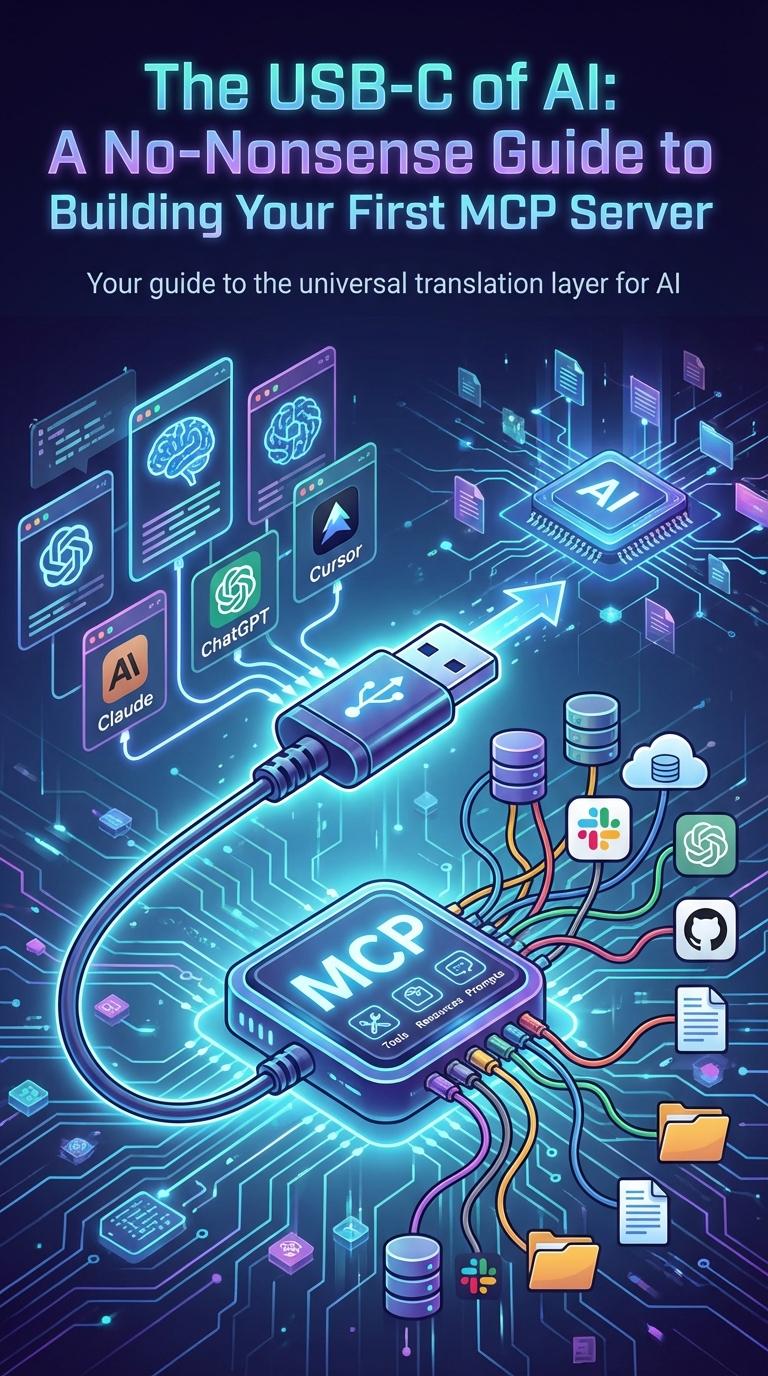
1. What the Heck is MCP Anyway? (The Basics)
There is a fundamental law in software engineering: fragmentation precedes standardization. For the past few years, we have been living in the chaotic, Cambrian explosion phase of artificial intelligence. Every time a new AI model or application emerged, developers were forced to architect bespoke, hand-coded connectors to link it to their specific data environments.
The "N×M" Nightmare
We called this the "N×M" headache—a combinatorial nightmare where N models multiplied by M data sources resulted in an exponential web of brittle API integrations.
Enter the Model Context Protocol (MCP). It is perhaps most aptly described through a hardware metaphor: the USB-C of AI. Just as the industry eventually realized the absurdity of maintaining separate chargers for phones, laptops, and headphones, MCP serves as a universal translation layer. It bridges the epistemological gap between AI entities—whether it be Claude, ChatGPT, or IDEs like Cursor—and the diverse landscape of human data.
Beneath the hood, MCP is elegantly mundane. It operates on a client-server architecture utilizing the battle-tested JSON-RPC 2.0 protocol. The "Host" (the AI application) interrogates your "Server" (the data source), establishing a seamless conduit of context.
Tools
The capacity for agency. Execute scripts or fire off API calls.
Resources
The capacity for perception. Real-time read access to context.
Prompts
Standardized recipes for behavioral logic and boundaries.
For the practitioner, building an MCP server has become remarkably frictionless. The TypeScript SDK remains the weapon of choice for web developers, while Python continues to dominate the data science sphere. If one is seeking the path of least resistance, the FastMCP library for Python is a revelation.
2. A Brief History of the AI "Plug-and-Play"
To understand the trajectory of our current ecosystem, one must look back to what we might call the Anthropic Big Bang of November 2024. When Anthropic released MCP, they drew heavy inspiration from Microsoft’s Language Server Protocol (LSP). The logic was sound: if decoupling language semantics from the editor revolutionized IDEs, why shouldn't a similar decoupling revolutionize AI's relationship with context?
However, the true paradigm shift—the "White Flag" moment—occurred in March 2025. When OpenAI officially adopted MCP for ChatGPT, the protocol shed its reputation as a mere "cool Anthropic feature" and crystallized into the definitive industry standard.
3. The Watercooler Talk: Hype vs. Reality
"The ultimate hallucination killer. AI now has sensory organs to see reality."
"Just a glorified wrapper for a REST API. Old wine in an over-engineered bottle."
This tension has sparked a particularly heated "Skills" war on Hacker News. A vocal faction questions the necessity of standing up full JSON-RPC servers, advocating instead for lightweight "Skills"—essentially declarative YAML or Markdown templates that define tool execution without the overhead of a dedicated server lifecycle.
4. The "Oh No" Factor: Security & Controversies
Granting an autonomous system the ability to perceive and manipulate your local environment is an inherently dangerous proposition. The abstraction of MCP makes it easy to forget the raw power being wielded, leading to a host of unintended consequences.
- ⚠️ NeighborJack Misconfigured server bind addresses exposing private files to local Wi-Fi.
- ⚠️ Indirect Injection Malicious GitHub issues hijacking instruction sets via Resources.
- ⚠️ Token Bloat Massive metadata overhead consuming context windows and budgets.
Furthermore, we must address the persistent RAG confusion. It bears repeating to every eager architect: MCP is not RAG (Retrieval-Augmented Generation). MCP is the delivery truck; it is not the warehouse. You still require vector databases and semantic search to find your data. MCP merely standardizes how the AI asks for it.
5. What’s Coming in 2026 and Beyond
Standing here in 2026, the roadmap for MCP reveals an ambition that extends far beyond simple chatbots. We are witnessing the maturation of a protocol preparing for enterprise scale and autonomous ecosystems.
Visualizing
The Agentic Future
The immediate technical hurdle is Stateless Scaling. The community is aggressively moving away from persistent, stateful sessions toward HTTP-based, stateless interactions. This is non-negotiable for Kubernetes clusters and enterprise load balancers.
More philosophically profound is the advent of "Agent Gossip." The protocol is evolving to support direct Agent-to-Agent communication. We are nearing a threshold where MCP servers will negotiate, share context, and delegate tasks among themselves, entirely bypassing the human in the loop.
We are no longer just connecting tools to models; we are laying the neural pathways for a distributed, autonomous web. The USB-C of AI was merely the beginning.