There is a peculiar nostalgia already attaching itself to the early days of generative AI. One cannot help but look back at the chaotic ritual of the “mega-prompt” with a mixture of fondness and absolute dread.
We remember the distinct anxiety of pasting a sprawling, 2,000-word treatise into a chat window, crossing our fingers, and hoping the underlying model wouldn't suffer a catastrophic attentional collapse and simply forget the first half of our instructions. Those days, mercifully, are behind us.
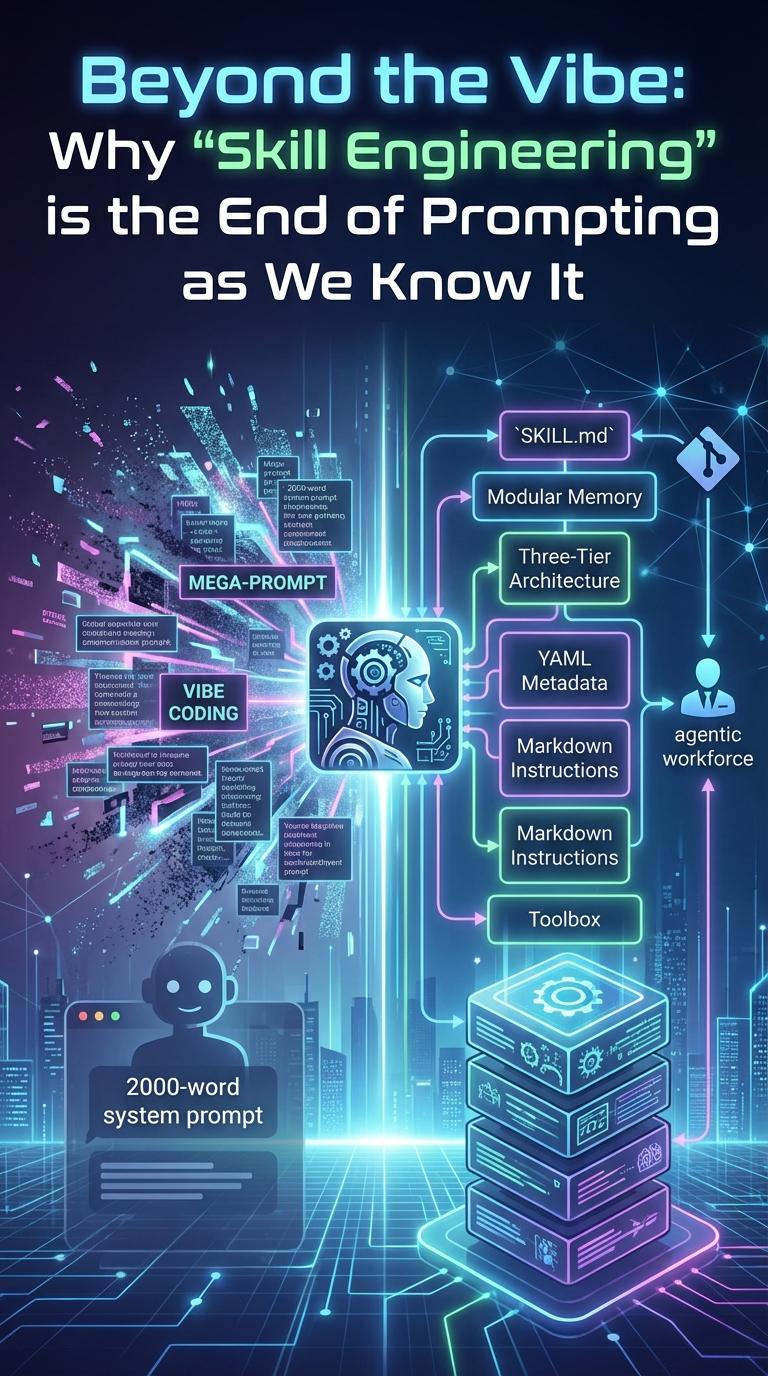
We are currently witnessing a profound architectural shift. The industry is moving away from “vibe coding” — a practice characterized by loose, conversational pleading with a black box — toward the rigor of actual software architecture for artificial intelligence. We have entered the era of Skill Engineering, and its primary vessel is the seemingly humble, yet conceptually vast, SKILL.md file format.
What Exactly is a SKILL.md?
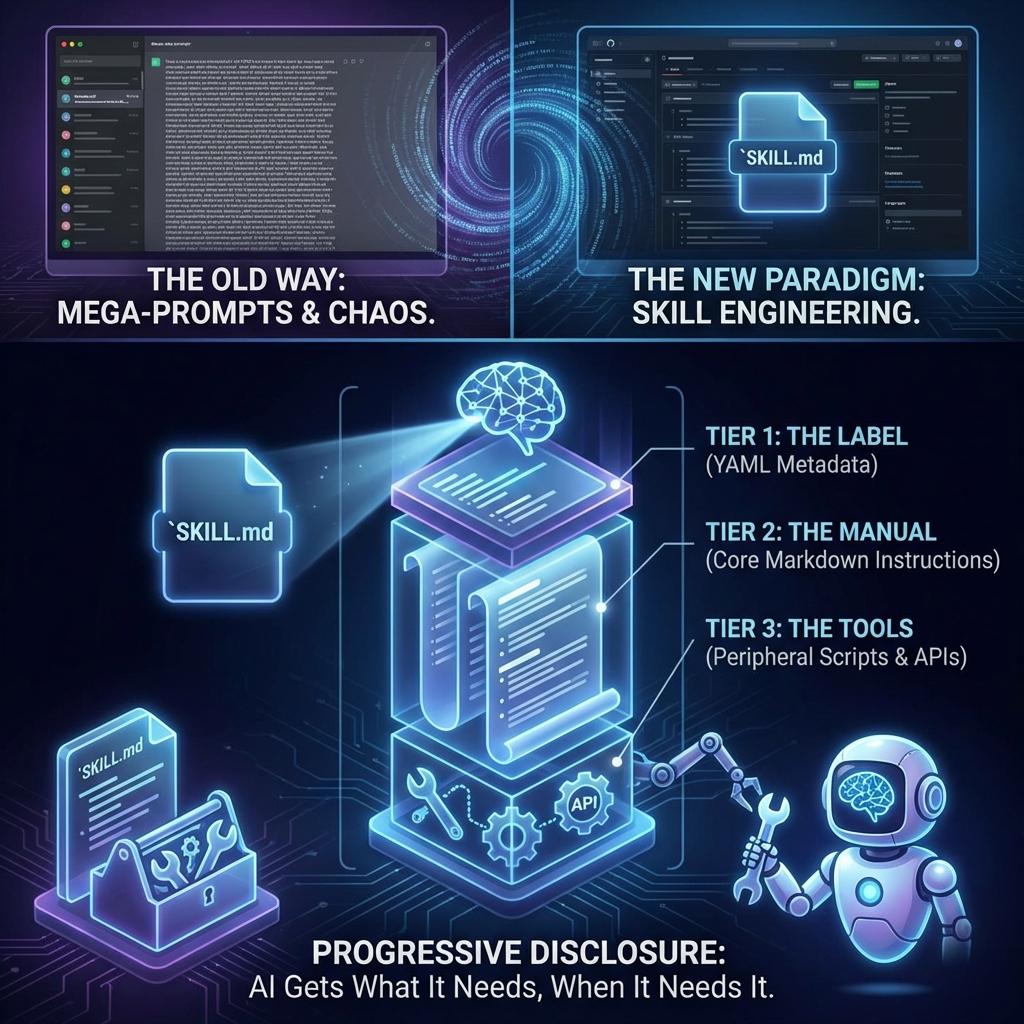
To understand the paradigm shift, we must stop thinking of instructions as “prompts” and start recognizing them as discrete cognitive modules.
Tier 1: The Label
The YAML metadata layer. It acts as an index, allowing the AI to scan a vast library of capabilities instantly.
---
name: skill_architect
version: 1.0.4
capabilities: [code_gen, refactor]
---
Tier 2: The Manual
The core Markdown instructions. This is the nuanced, explicit directive that the AI only ingests when the context necessitates it.
Tier 3: The Tools
Peripheral scripts, reference documentation, and API schemas dynamically retrieved during complex execution paths.
A Brief History of AI Instructions
How did we arrive at this formalized structure? It requires a brief historiography.
The Dark Ages of AI interaction (roughly 2023 to 2024) were defined by the “Context Dump.” Developers, desperate to force models to behave predictably, created bloated .cursorrules files that grew into unmanageable monoliths. It was an era of brute force.
2026“Prompts were no longer ephemeral utterances; they were standardized, immutable code.”
The Great Shift of 2025
Why the Hype is Real
The enthusiasm surrounding Skill Engineering is not merely the latest cycle of Silicon Valley vaporware; it is grounded in immediate, observable utility. Foremost is the concept of persistence.
A tiny, hyper-fast model equipped with an immaculately engineered SKILL.md will routinely outperform a massive, lumbering GPT-5 class model that is simply “winging it” on zero-shot inference.
Friction in the New Paradigm
Security Vulnerabilities
A sobering 2026 cybersecurity study revealed that 26.1% of community-shared skills contain obfuscated vulnerabilities. The open ecosystem comes with real risk.
The Folder War
Tooling ecosystems remain dangerously fragmented. Cursor, Roo, and Claude Code have yet to establish a true consensus on directory structures.
Agents That Rewrite Themselves
Looking ahead, the trajectory of Skill Engineering points toward a radically autonomous future. We are rapidly approaching the realization of an “NPM for Skills.” It is no longer science fiction to imagine executing a command to npm install a “Senior React Architect” skill.
The ultimate endpoint of this evolution is Meta-Context Engineering. We are beginning to see the rise of recursive agents: systems capable of analyzing their own execution failures and autonomously rewriting their own SKILL.md files.
The Verdict
The era of unstructured interaction with machine intelligence has concluded. The dichotomy is now clear: if you aren't engineering skills, you are merely chatting.