
On October 16, Google started testing Google Personal Intelligence ads in AI Mode. The test takes users who connected their apps through Personal Intelligence and shows them ads personalized with insights from those connected apps. Personal Intelligence itself launched ad-free.
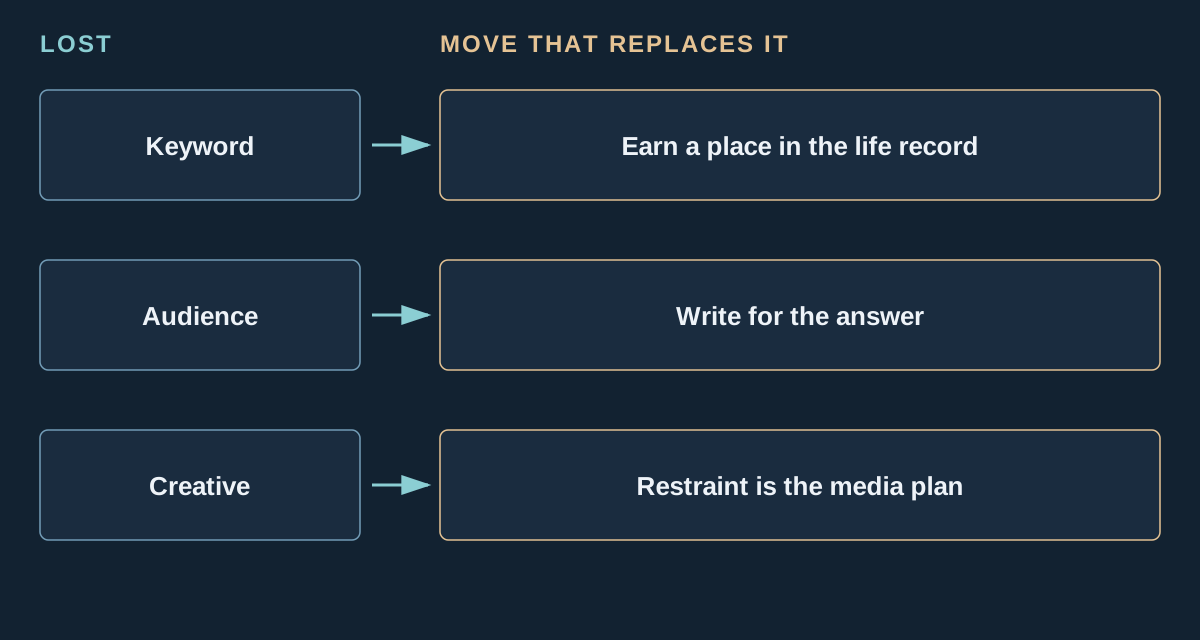
The privacy debate started within hours, and it misses the point for marketers. The real story is not what Google knows. It is what advertisers just lost: the keyword, the audience, and the creative. Three controls that defined paid search for twenty years now sit on Google's side of the table, and the test offers nothing to replace them.
The Test That Moved Targeting
Here is what actually changed. Search Engine Land reported on October 16 that Google began testing ads in AI Mode for users who opted into connecting their apps. Personal Intelligence lets AI Mode use limited information from connected Google apps, such as insights and summaries, to generate more relevant answers. Under the test, that same information may also personalize the ads those users see.
Google's protections matter, and they are specific. The feature is opt-in only, and users can disconnect anytime. Ads will not be based directly on the contents of a Gmail inbox or a Google Photos library. Advertisers get no access to connected apps. Sensitive information will not be used to personalize ads. Google also updated its privacy policy to clarify how connected-app information may be used for advertising personalization.
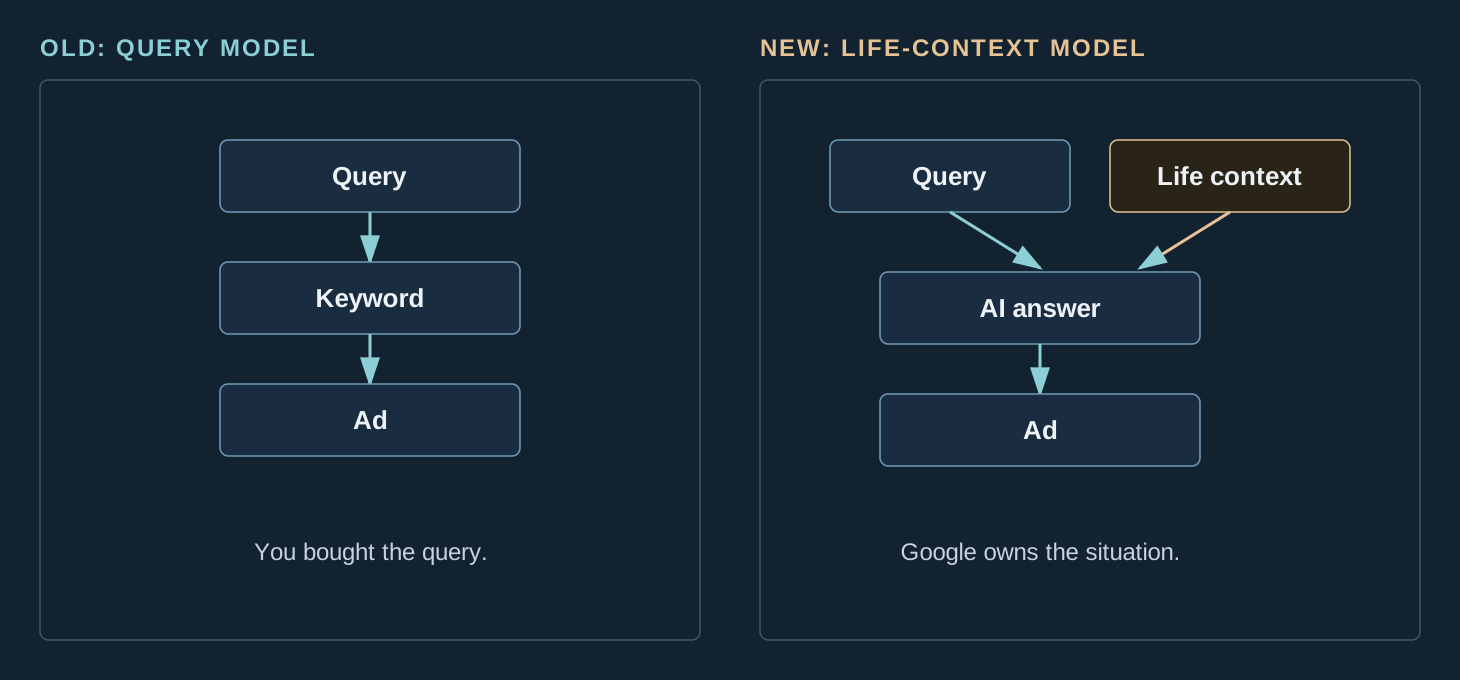
Read that list twice. It rules out the version of this story that writes itself. Google is not scanning your inbox and selling the contents to advertisers. The mechanism is narrower: insights and summaries from connected apps join the query, the context of the AI-generated response, and the user's interests in deciding which ad appears. The ad still reflects the query. The query just stopped being the whole story.
Its monetization lead, Asad Awan, has described memory-based ChatGPT ads, chosen partly by what ChatGPT remembers about a user. OpenAI draws on history inside ChatGPT. Google draws on Gmail, Calendar, and Photos. Both are moving targeting from what you typed to what you have lived.
The life record is the targeting now. Receipts, confirmations, and photos are the signals a query used to be.

Three Controls, Gone
Paid search had a clean deal. You picked the keyword, you defined the audience, you wrote the creative. Personal Intelligence ads break all three at once.
The keyword goes first. In classic search, the query was the buy. In AI Mode, the query is a hint inside a larger picture. The assistant already knows the user has a marathon on the calendar and bought a pair in April. The ad that wins is not the one that matched the keyword best. It is the one that fits the life the query sits inside. Keyword research does not disappear, but it stops being the unit of purchase. The unit becomes the situation.
The audience goes second. You never get to see the life context that made the ad relevant. Google holds it, and Google says advertisers will not get access to connected apps. There is no segment to build, no list to upload, no lookalike to model. Your targeting options in this test are what they were before: nothing new.
The creative goes third. In May 2026, Google began testing Conversational Discovery ads and Highlighted Answers in AI Mode, formats in which Gemini writes the ad creative in response to each query. Your landing page and your feed become raw material for a model that writes the pitch in the moment. The headline you approved in a brand review never runs. A paraphrase of it does, shaped by a conversation you cannot see. This goes past the format problem ChatGPT ads already showed, where AI-written ads behave like banners. Here the model does not just place the ad. It writes it.
That is the Life-Context Gap. You keep the budget and the accountability. Google keeps the signal, the segment, and the sentence.
The Life Record Is the Targeting
So what do you do? Stop optimizing for the query and start earning a place in the life record.
A life record is the trail of real transactions a person already has with you: the order confirmation in their inbox, the booking receipt, the warranty registration, the support ticket you resolved, the loyalty account they use. When an assistant summarizes a user's history to answer a question, brands with a genuine record in that history have something to be recalled for. Brands without one are strangers, and strangers do not get recommended.
This is why the receipt is now a media asset. The confirmation email you treat as a transactional afterthought is the document an assistant reads when it summarizes what a person bought, from whom, and whether it worked. A clear, complete, honest confirmation is machine-readable evidence of a real relationship. A vague or misleading one is worse than none, because it teaches the assistant that your brand is the kind that hides the details.
The same logic applies to the product feed. Google already pulls promotions off advertiser sites into campaigns. The feed is how a machine learns what you sell. In a life-context world, the feed also has to match the receipt, the landing page, and the review record, because the assistant cross-checks them. Inconsistency is not a minor data-quality issue anymore. It is the reason the assistant picks your competitor, whose price, availability, and terms all agree.
Write for the Answer
The second move is about the page, not the ad. In a life-context world, your most important reader is the assistant that answers the question, and it does not read like a shopper. It reads for checkable facts it can quote.
That changes what a good product page looks like. A page built for a human skims well: a bold claim, a lifestyle photo, a testimonial, a button. A page built for an answer needs the facts the claim rests on, in plain text. The price, the sizes, the compatibility list, the delivery window, the return terms, the warranty, the date the page was last updated. Every one of those is a sentence the assistant can lift without guessing. Every one you hide behind a hover, a PDF, or a chatbot is a sentence the assistant replaces with your competitor's.
Being cited in the AI answer was already the new visibility game. Personal Intelligence ads add a second layer. The same facts that earn a citation also earn the ad placement beside it, because the ad is chosen with the same context. A fact-dense page does double work. A vague page does none.
There is a discipline inside this that most teams skip: date your facts. An assistant that summarizes a user's life cares about recency, and a price from March is a lie in October. Put the updated date on the page, keep the old price out of the index, and treat a stale spec sheet as a live error.
The assistant is your new first reader. It quotes facts, not adjectives.

Restraint Is the Media Plan
The third move is the one nobody wants to hear, because it is about not doing something. Personal Intelligence is opt-in. Users can disconnect anytime. The test lives or dies on whether people feel helped or watched.
An ad that lands exactly right feels like the assistant knew what you needed. An ad that lands one inch past that feels like the assistant read your mail. The difference is not the targeting technology. It is the creative judgment around it: the claim you make, the frequency you accept, the sensitivity you respect. Google says sensitive information will not be used to personalize ads, and that some conversations should never carry an ad at all. The brands that survive this channel will act as if that line is closer than Google draws it, not further away.
That restraint is not a moral pose. It is the media plan. Every user who disconnects their apps over a creepy ad takes their life context out of the channel for every advertiser. The channel is a commons, and the fastest way to drain it is to treat the opt-in as permission to be aggressive. The teams that win will be the ones whose ads a user would describe as useful, not as accurate.
What to Do This Week
Do not wait for a rollout announcement. The test tells you where the channel is going, and the groundwork takes longer than the announcement will give you.
Audit your receipts first. Pull your own order confirmation, booking confirmation, and shipping emails. Read them like an assistant would. Do the product names, prices, and terms match the site exactly? Fix the mismatches before you spend another dollar on AI placements.
Then audit your top ten product pages for quotable facts. Price, specs, availability, delivery, returns, warranty, updated date. If a fact lives only in an image, a PDF, or a chatbot, move it into plain text. If a fact is stale, fix it or remove it.
Then write the rule for your team: no ad creative that leans on life context the user did not bring into the conversation. If the user asked about marathon shoes, the ad can talk about marathon shoes. If the assistant happens to know about the knee pain, your ad does not mention it.
The query was a clean deal. You said what you wanted, the advertiser answered, and both sides could see the exchange. Life-context targeting is murkier, and it will only stay available to advertisers who keep it honest. Earn the record. Write the facts. Hold the line.