On October 5, OpenAI announced the next expansion of ChatGPT ads: visual ads that appear while users generate images, plus a measurement ecosystem with more than 20 partners. The coverage read it as a channel growing up. The numbers read it as something less flattering.
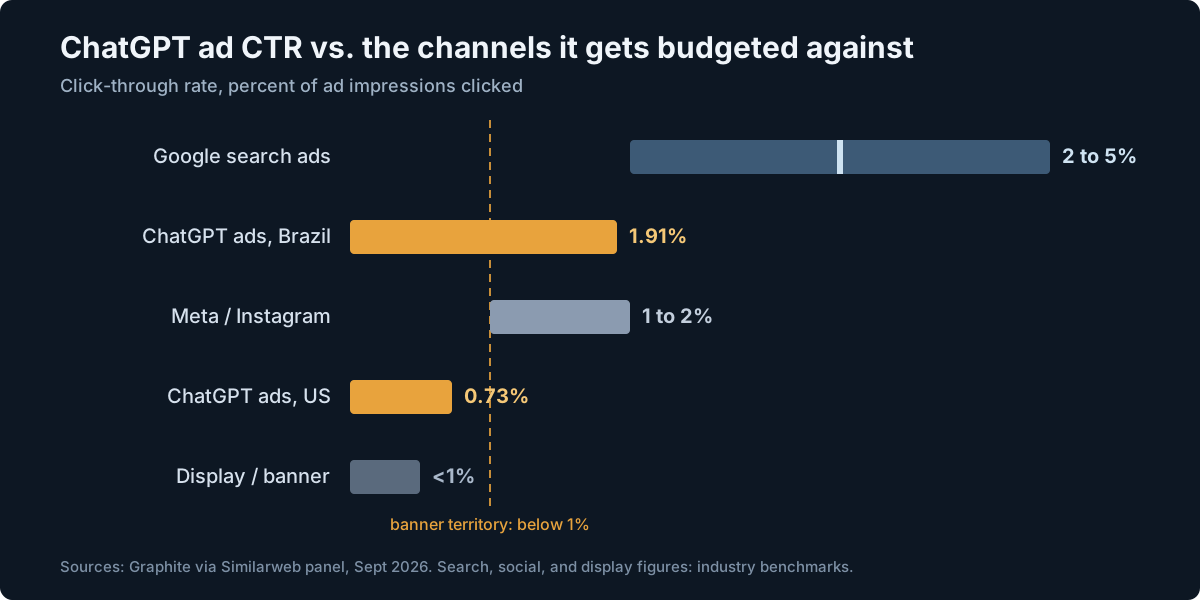
ChatGPT ad click-through in the US sits at 0.73%. Banner ads live below 1%. Google search ads average 2 to 5%. ChatGPT ads are being priced and budgeted like search while performing like display. That mismatch is the story of the week, and no measurement partner fixes it.
ChatGPT ads launched in February 2026 on free and low-cost tiers, expanded to India in August, and now reach 1.2 billion weekly users, according to TechCrunch. Graphite's State of ChatGPT Ads report, built on Similarweb panel data and published September 29, puts the channel at a billion-dollar annualized run rate with tens of thousands of advertisers. Growth is real. The question is what the growth is made of.
The ChatGPT ads announcement everyone applauded
The visual format is the headline. OpenAI will start testing it later this month, US only, with a small group of advertisers. The ads appear alongside the image being generated, clearly labeled, kept separate from the output. OpenAI repeated its standing promise that advertising doesn't influence answers, including image generation.
The measurement list is longer than the format list. Conversion data flows through Hightouch, Tealium, and LiveRamp. Attribution runs through AppsFlyer, Triple Whale, Adjust, DV Rockerbox, Northbeam, Branch, Singular, Kochava, Airbridge, and Tenjin. Full-funnel measurement comes from Fospha, Measured, and INCRMNTAL. Geo-based incrementality experiments run with Haus, Measured, and WorkMagic. DoubleVerify and Integral Ad Science are piloting brand-suitability evaluation in controlled environments, without access to real conversations, according to Search Engine Roundtable.
Then the partner claims, and the word claims matters. DV Rockerbox measured WeightWatchers at 15.3% lower cost per acquisition than its blended paid-search benchmark. WorkMagic reported statistically significant lift for wellness brand Dose, with 67% of incremental purchases coming from net-new customers. Triple Whale said 93% of Portland Leather's visitors from ChatGPT ads were new. Three hand-picked cases, unverified. Treat them as directional at best.
OpenAI also made a quieter argument worth hearing. The company says clicks undersell its ads because people often buy later without clicking, and that 52.7% of eligible one-day view-through conversions happened within an hour of someone seeing an ad. Hold that number. It becomes important in a minute.
The numbers under the confetti
Graphite's report is the best outside look at the channel so far. The headline rates, for Free and Go users through mid-September:
US 0.73%. The UK 0.74%. Canada 0.75%. Australia 0.67%. New Zealand 0.6%. Then the spread opens up: South Korea 1.21%, Japan 1.53%, Mexico 1.55%, Brazil 1.91%.
Put those next to the channels ChatGPT ads get compared to. Google search ads average 2 to 5% depending on industry. Display and banner ads sit well under 1%. Facebook and Instagram land around 1 to 2%. In English-speaking markets, ChatGPT ads are banner inventory wearing a search costume.
The advertiser postmortems sharpen the picture. CarsXE ran ChatGPT ads for its vehicle-data APIs from late August to late September: 39,453 impressions, 449 clicks, a 1.14% CTR, $2.62 average CPC, $29.79 CPM, 11 platform-reported conversions, roughly $107 per acquisition. They paused. Not because nobody clicked. Because the audience that clicked wasn't the audience that buys B2B APIs, and their measurement couldn't prove the outcomes they cared about. CarsXE published the whole thing.
Two caveats keep this honest. Panel data isn't OpenAI's books, and each market covers a different time window. OpenAI's help center notes the channel still lacks performance benchmarks across advertisers and industries. The direction is consistent across every source anyway.
Attention inventory in an intent costume
Here is the category error. ChatGPT ads show one ad per response, placed below a complete answer. The user arrived with a question, got the answer, and is leaving. The ad is what they pass on the way out.
That is a banner. It has the shape of intent because it sits inside a conversation, but the click behavior belongs to display. Budgeting it like search means judging it against 2 to 5% click-through it will never touch in English markets. Nobody wins that comparison except the auctioneer.
OpenAI's own defense accidentally agrees. The 52.7% view-through stat is the oldest move in the display playbook. Banner networks have leaned on seen-but-not-clicked conversions for two decades because the clicks were never there. If the strongest evidence for the channel is that people buy without clicking, the channel isn't search. It's display with better targeting data.
That reframes Monday's announcement. The measurement expansion isn't maturing ChatGPT ads into search. It's maturing them into display, which is the category they already belong to. The partners OpenAI named are the exact plumbing display runs on: multi-touch attribution, incrementality testing, brand-suitability scoring. The attribution fight is about to replay inside chat.
The ad appears after the answer. The user already got what they came for. Everything after that is borrowed attention.
The churn nobody puts on the slide
The quieter signal is the advertiser roster. One analysis found high turnover among the top advertisers, the pattern of brands testing briefly and pulling back rather than settling in. That's normal for new inventory, and it's also the number that decides whether a channel survives.
The reasons are visible in the postmortems. CarsXE paused over audience mismatch and unprovable outcomes. Multiple agencies have documented the gap between dashboard-reported clicks and the clicks their own analytics can find. OpenAI's help center still lists no cross-advertiser benchmarks. A channel where you can't prove what happened will churn advertisers faster than any measurement partnership can onboard them.
There's also a hidden tax. Graphite found that top advertisers use 98% fresh copy written around the conversation's use cases. Half of the top ten run more ads per user inside ChatGPT than they run on Meta. The creative doesn't transfer. Every new advertiser starts from a blank page, and blank pages are expensive.
The first ad that interrupts making
Buried in the announcement is the one genuinely new thing. Visual ads during image generation are the first mainstream ad format that appears while the user is making something, not searching or scrolling.
Search is the find moment. Social is the browse moment. Generation is the make moment, and the mindset is different. Nobody generating a logo or a room mockup is in buyer mode. They're in producer mode, mid-task, attention wide open, wallet closed. Creative built for intent will misfire here. Creative built for inspiration might not.
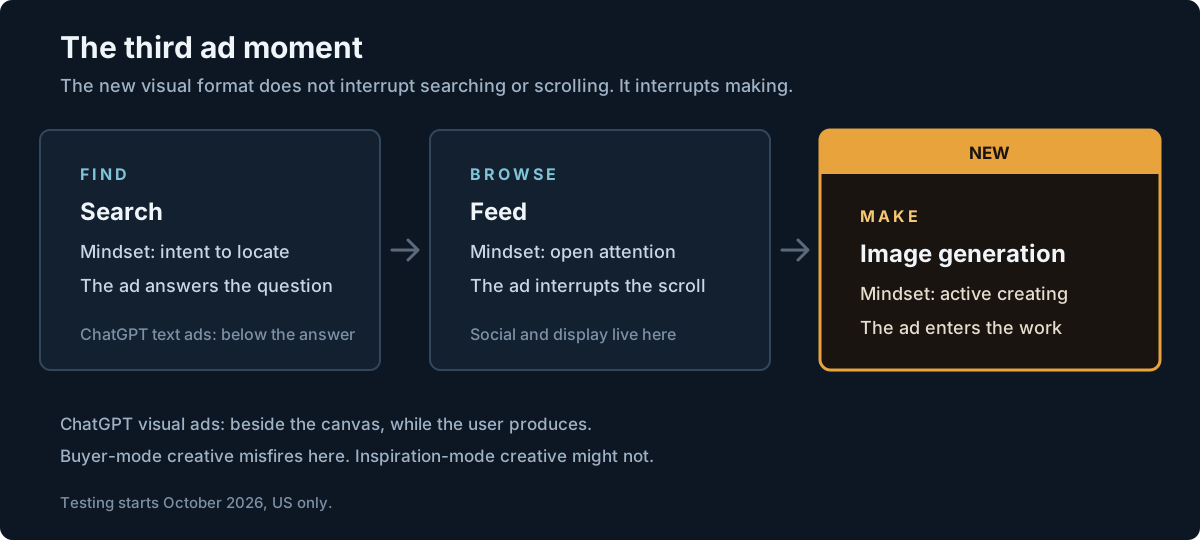
The user isn't searching or scrolling. They're making something. The ad walks into a different mental room than the one search ads knock on.