
AI Mode ads are the story marketers keep filing under new inventory. That filing is wrong, and October 28 proved it in a single day. Google told investors its search ad growth slowed in part because AI Mode monetizes worse than classic search. Then Google expanded AI Mode ads to ten more countries. On the same day, an agent bought audio advertising from another agent, with no human touching the deal between the brief and the booking.
Put those three facts together and the picture changes. The marketplace did not add a channel. It moved inside the answer, and the buyer moved inside a machine. A marketer who keeps buying the way they bought in the keyword era will keep paying for a market that no longer holds its auctions where they can see them.
The Miss and the Expansion
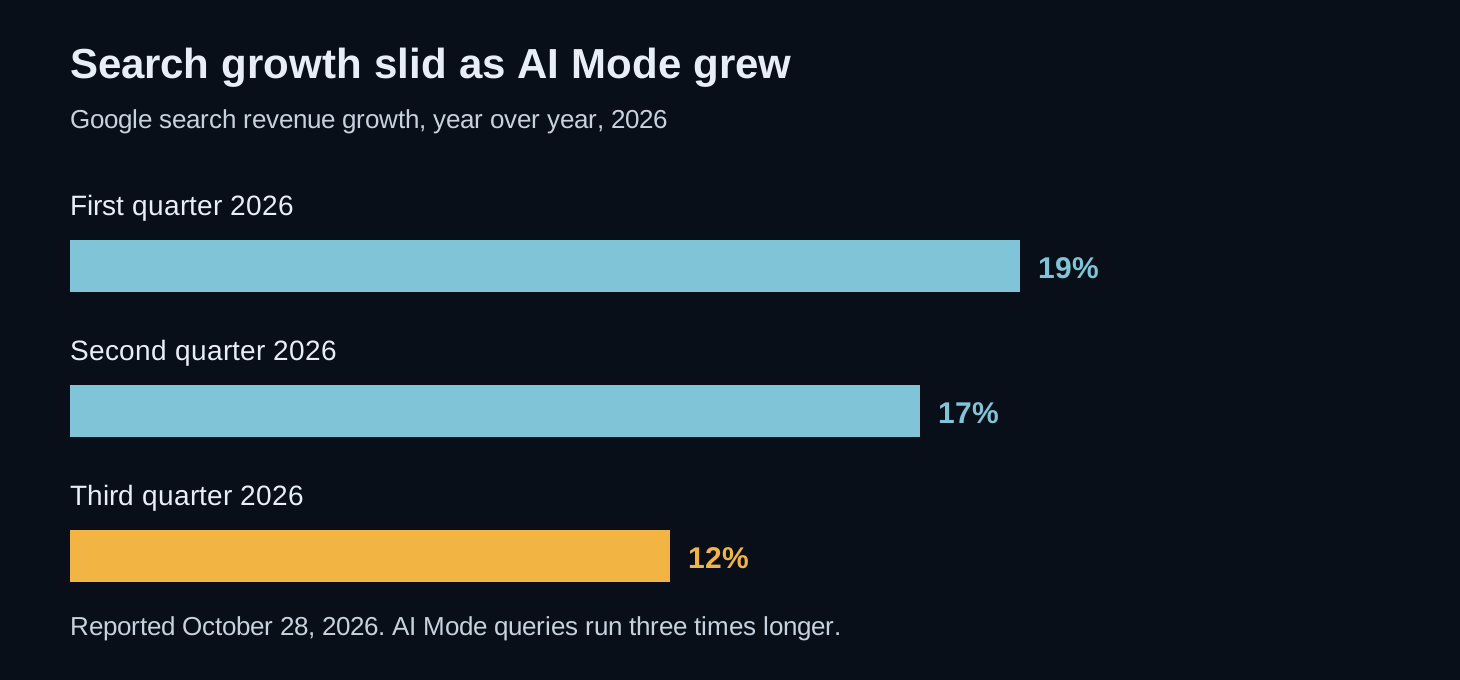
Alphabet reported third quarter revenue of $127.6 billion on October 28, up 25 percent from a year earlier, but below the roughly $128.2 billion Wall Street expected. Google advertising came in near $82 billion, short by about $1.4 billion. Search revenue grew 12 percent to about $63.3 billion, down from 17 percent in the second quarter and 19 percent in the first, per TechCrunch's report of the earnings call. YouTube advertising grew 9 percent to about $11.2 billion. Cloud more than doubled to $30.7 billion and beat expectations. Shares fell about 10 percent after hours.
Chief business officer Philipp Schindler gave the line every search marketer should have underlined. He pointed to greater use of AI Mode and to lower monetization in AI Mode as a reason search advertising growth slowed more than expected. He did not blame AI Mode alone. Currency moves and weaker retail and media spending also weighed on the quarter, according to Search Engine Journal's account of the call. Still, the admission stands on its own. Google is changing how people search faster than it has worked out how to charge for the new version.
Google's answer to that gap, announced the same week, was to sell more of the new version. AI Mode ads expanded to Australia, Canada, India, Kenya, Malaysia, New Zealand, Nigeria, Pakistan, the Philippines, and Singapore, with Brazil, Mexico, and the UK planned for the fourth quarter of 2026, according to Google's expansion announcement as covered by Analytics Insight. In the US, Google added multi-turn ads that can appear in answers to follow-up questions, not just the first question. Google said click rates for sponsored product listings in AI Mode were comparable to organic listings, based on its own US data from August and September.
Read the two moves as one decision and the strategy is plain. Google cannot wait for AI Mode monetization to catch up on its own, so it is putting paid placements inside the experience that is pulling queries away from classic search. That is a reasonable move for Google. It is a warning for everyone buying ads on Google. Your budget is following the user into a surface where the old auction rules, the old query reports, and the old click benchmarks do not describe what you just bought.
The Answer Is the Shelf
AI Mode is a chatbot-style tab inside Google Search that answers in long written form instead of handing over a list of links. CEO Sundar Pichai said on the earnings call that search query growth was the fastest in five years, that AI Mode queries run three times longer than traditional searches, and that one in five AI Mode searches globally involves voice, images, or documents. A query that long is not a keyword. It is a paragraph of intent, sometimes with a photo attached, and it keeps going across follow-ups.
That length is why an ad inside the answer behaves differently from an ad beside a results list. In classic search, the user scans options, compares headlines, and clicks a link. The advertiser sees the keyword, the position, and the click. In AI Mode, the user reads an answer, and a sponsored suggestion sits inside that answer as part of the reading. The user may never visit a results page at all. The click, when it happens, comes after the answer has already shaped the choice.
Google has been testing how far that shaping can go. On October 16, Google confirmed it was testing AI Mode ads for people who linked Gmail or Photos through its Personal Intelligence feature, according to Search Engine Land's reporting as summarized by Marketing Newsroom. The ads can draw on summaries and insights from those connected apps, not on the raw inbox or photo library itself. Sensitive categories stay out, users can disconnect at any time, and advertisers get no new controls and no view of the connected apps. The reversal matters because Google said in March that people who connected their apps would not see ads in AI Mode. Seven months later, they do, in a test.
Treat that test as a preview of where targeting is headed, not as a targeting tool you can use today. You cannot buy a Personal Intelligence audience. You cannot see which app insights shaped an impression. You can only write pages and product facts clear enough that an answer engine picks them up, and run campaigns eligible to appear when it does. Eligibility runs through existing Search, Shopping, and Performance Max campaigns, including AI Max, according to campaign readiness coverage of the test. There is no separate AI Mode campaign type to optimize. The lever you actually control is the content the answer reads.
The shopper in this picture is not browsing a store. She is asking a question and reading an answer, and the sponsored suggestion she meets will arrive as part of that answer. Win the answer and you win the shelf. Lose it and no bid adjustment brings you back.

The Buyer Vanished Too
While Google was moving ads into the answer, the buying side moved into an agent. On October 28, Triton Digital announced what it calls the audio industry's first agentic selling media buy. An agent working for the brand Otrium, with Draft Digital as the agency, matched audio products to the campaign brief and settled terms with the seller side. The campaign is live with the publisher Talpa Media, running through Talpa's Sync infrastructure. The whole path from request and negotiation to booking in the ad server happened through communication between AI agents, with no manual intervention required to move the deal from brief to booking, according to Advanced Television's report on the announcement. Triton says the exchange took minutes instead of days.
Humans did not disappear from the deal. They moved upstream. Triton's announcement and the trade coverage agree that teams set the terms, price guardrails, and data standards before the agents acted, and that every booking gets checked against those standards before it goes live. Philip Sonneveldt of Otrium put the condition plainly in trade coverage: speed only counts if the guardrails hold. Triton disclosed no budget, price, or results for the campaign, so this is one test deal, not proof that audio buying flipped overnight. The test still shows the shape of what comes next. Negotiation, the part of media buying that used to take days of calls and emails, just ran as a machine exchange.
That shape collides with what marketers say they want. DoubleVerify's 2026 Global Insights Report, released October 29 from a survey of 2,020 marketers, found 97 percent plan to use AI across some aspect of media planning, buying, and optimization in 2026, according to the GlobeNewswire release. Adoption inside individual workflows runs far behind the plan. Brief summarization reached 37 percent in 2025, up from 28 percent in 2024. Campaign activation reached 35 percent, up from 31 percent. Bidding optimization reached 29 percent, up from 24 percent. Marketers are planning for AI everywhere and using it in slices.
A separate survey sharpens the tension. Smartly and Alter Agents surveyed 500 US and UK marketers in October 2026 and found 77 percent comfortable with AI in advertising when a human has final approval, as reported by Puglisi Consulting. An agent-to-agent deal tests that condition hard. No person touched the Triton deal between brief and booking. The human approval, if it means anything now, has to live inside the brief and the guardrails written before the agents start. A team that writes sloppy briefs and expects a human to catch the bad buy at the end has already given up the only approval point left.
What You Actually Lose
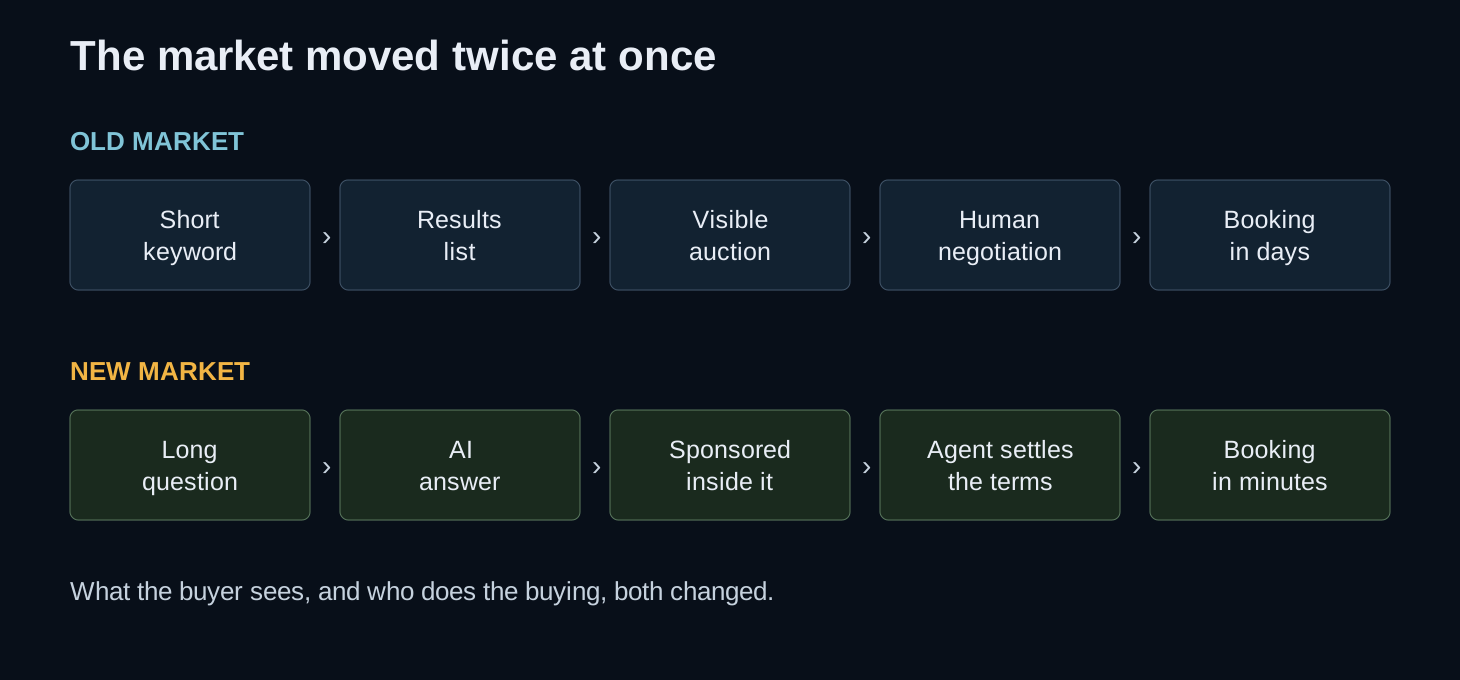
Three controls used to define a media buyer's job. First, the visible auction: you saw the keyword, the bid, the competitor set, and the position you paid for. Second, the negotiation: you haggled over price, placement, and terms, and you knew what you traded away. Third, the placement report: you could say where the ad ran and what it sat next to. AI surfaces weaken all three at once, and that is the part most coverage skips while it counts new ad formats.
The visible auction fades because a multi-turn answer has no single keyword to bid on and no results page to rank in. The query is three times longer than a classic search, it changes as the user follows up, and the sponsored suggestion appears inside prose. Your report may show a click, but it will not show the conversation that produced it. The negotiation fades because an agent settles terms in minutes against guardrails you wrote last week, and the log of that exchange, if you get one, is a machine record, not a call you sat on. The placement report fades because the ad sits inside an answer that changes with each follow-up, so the context your brand appeared in is a moving paragraph, not a fixed page.
None of this means human buyers are finished. It means the human job moved. Writing the brief, setting the guardrails, and reading the booking log are now the buying. A buyer who treats the brief as admin work and waits to judge the results will judge a deal that already ran. A buyer who treats the brief as the deal itself, with prices, exclusions, and kill switches written in plain language an agent cannot reinterpret, keeps the part of the job that still decides outcomes.
The Brief Is the Contract
Start with the brief, because it is now the approval. Every agent buy should carry five lines before any agent acts. A price floor or ceiling, stated as a number, not as a goal like good value. A list of excluded placements, publishers, and content types, written as names, not as vibes. A spend cap per deal and per day, so one confident agent cannot spend a quarter in an afternoon. A kill switch: the exact condition that stops the agent, and the person who can pull it. And a booking log requirement: for each deal, the agent must record what it bought, from whom, at what terms, and against which brief line.
That log is the receipt that makes agent buying auditable. Without it, you cannot answer the first question finance will ask after a bad buy, which is who approved this. With it, you can trace a bad placement to the brief line that allowed it, fix that line, and run again. The Triton deal shows the pattern to copy and the gap to close. Humans set the guardrails in advance and checked bookings against them. Your version should add one demand Triton's announcement does not describe: a log you can read without asking the vendor to translate it for you.
Write product facts for the answer at the same time. Price, availability, returns, shipping, and the exact product name belong in plain text on your own pages, in headings and opening paragraphs that match the specific questions customers actually ask. AI engines rewrite prompts into their own follow-up searches and cite pages their retrieval returns, so a page that buries its price in an image or a script gives the answer nothing to quote. This is the same discipline I have pushed in my earlier writing on agent shoppers, where orders arrive without a customer record attached. If the agent cannot read your facts, it will quote someone else's.
A signature used to close a negotiation. Now the brief closes it before the negotiation starts. Write it like a contract, because that is what it became.

Split the Scoreboard
The second move is measurement, and it has to happen before the next budget review. Split every Google report you can into classic search and AI surfaces, even if the platform lumps them together in its default view. If your agency or your dashboard cannot split them, that gap is now a budget risk, not a reporting nicety. Search growth fell from 19 percent to 12 percent across three quarters while AI Mode queries climbed. A blended number hides that shift inside an average, and an average is where a shrinking channel borrows credit from a growing one.
Judge AI Mode on profit per answer, not on click rate. Google's claim that sponsored product listings in AI Mode click about as often as organic listings sounds reassuring until you remember what those clicks are. A click inside a long, multi-turn answer, after the answer already framed the choice, is a different sale from a click on a results list. It may be worth more, because the user arrived pre-sold, or less, because the answer did the selling and your page only closed it. You cannot know which until you tie the click to a number your agent and your platform did not produce. I wrote about that check in my Oct 27 post on agents grading their own work, and it applies here with the same force. Pick one human-owned number per campaign, revenue from the finance system or signups from the product database, and let that number decide whether AI Mode spend scales.
Run one small agent buy with a human watching the log end to end before agents touch a real budget line. Pick a low-risk placement, write the five-line brief, read the booking log the same day, and fix the brief line that surprised you. Triton ran one test deal with one publisher and one brand. Copy that modesty. A team that scales agent buying on the strength of a vendor demo is repeating the exact mistake the DoubleVerify numbers warn about: planning for AI everywhere while using it in slices, and calling the plan progress.
Keep the Receipt
Google will keep selling ads inside the thing that is eating its own search business, because that is where the queries went. Agents will keep buying media from agents, because minutes beat days when the guardrails hold. The marketers who come out ahead will not be the ones who bought AI Mode first or the ones who banned agents from their media plan. They will be the ones who can show, for any given deal, the brief that approved it, the log that recorded it, and the split report that priced it.
The auction moved into the answer. The buyer moved into an agent. Your receipt is the only part of the market that still has your name on it.