
Purchases made through AI shopping agents have roughly quadrupled since April 2026, growing about 43 percent a month, according to BrightEdge data reported by The Wall Street Journal. That is the fastest growing checkout line in retail, and most of the industry is still talking about it like a future trend.
Here is the strange part. Only about 3 percent of the ecommerce companies BrightEdge works with let an AI agent complete a transaction. The agents are buying anyway, through marketplaces and workarounds, and the orders land without the one thing every marketing dashboard assumes: a person.
This is AI agent shopping, and it breaks the basic unit of marketing measurement. Not the campaign. Not the channel. The customer. When the buyer is software acting for someone else, the order tells you what sold and nothing about who bought it, what else was considered, or why your product won. That gap is the story. Plenty of coverage treats agent commerce as a plumbing problem, checkout APIs and credentials. The plumbing matters less than the blindness.
The Order With Three Blanks
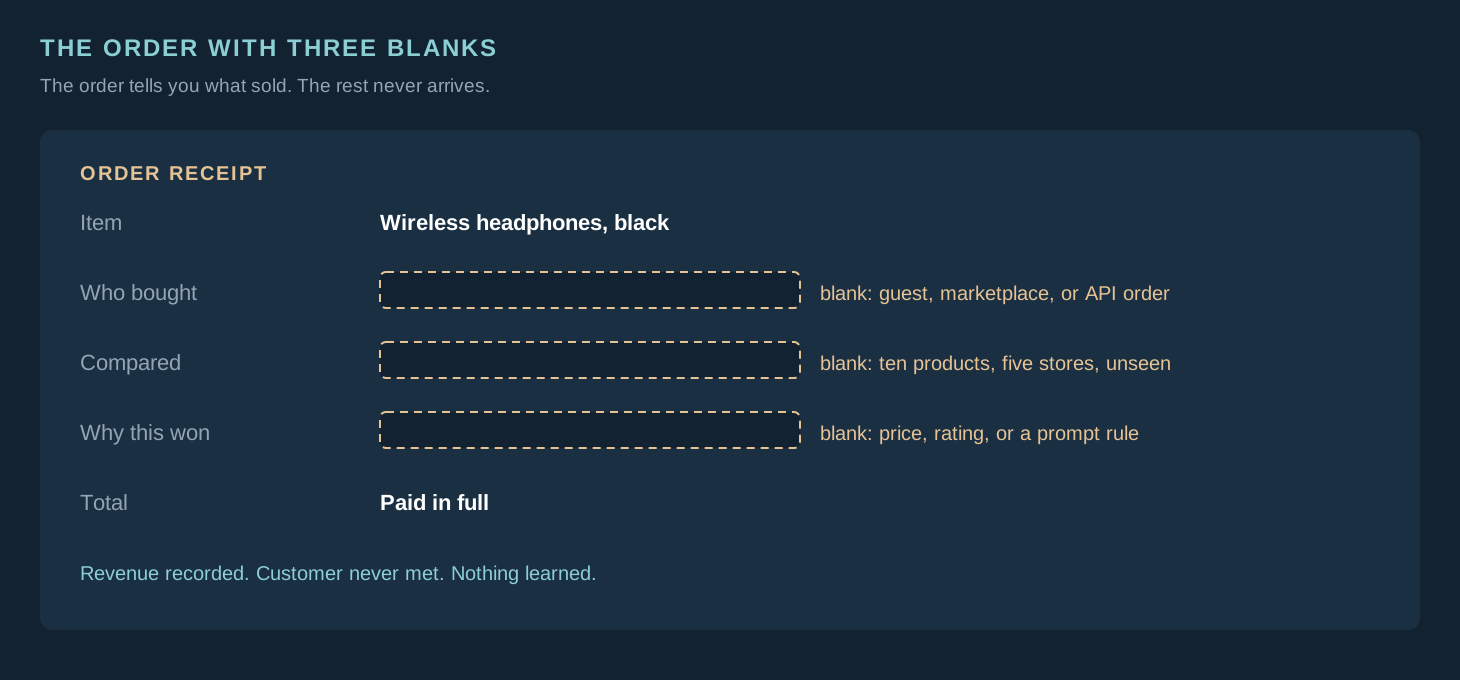
A normal order carries a story. Someone saw something, wanted it, compared it, bought it, and maybe came back. Your analytics, your email list, your retention math all assume that story exists. An agent order breaks it in three places.
First blank: who bought. Agent orders often arrive as guest checkouts, marketplace orders, or API orders with no profile attached. There is no account history, no segment, no lifetime value to update. The customer record stays empty while the revenue line grows.
Second blank: what was compared. The agent may have weighed ten products across five stores before picking yours. You see only the winner. You never learn which rival you beat, or how close it was, or what would have flipped the choice.
Third blank: why this one won. Price, rating, shipping speed, return terms, or a rule buried in a prompt you will never read. The reason for the sale is the most valuable part of the sale, and it is the part that never arrives.
Where the Buyer Went
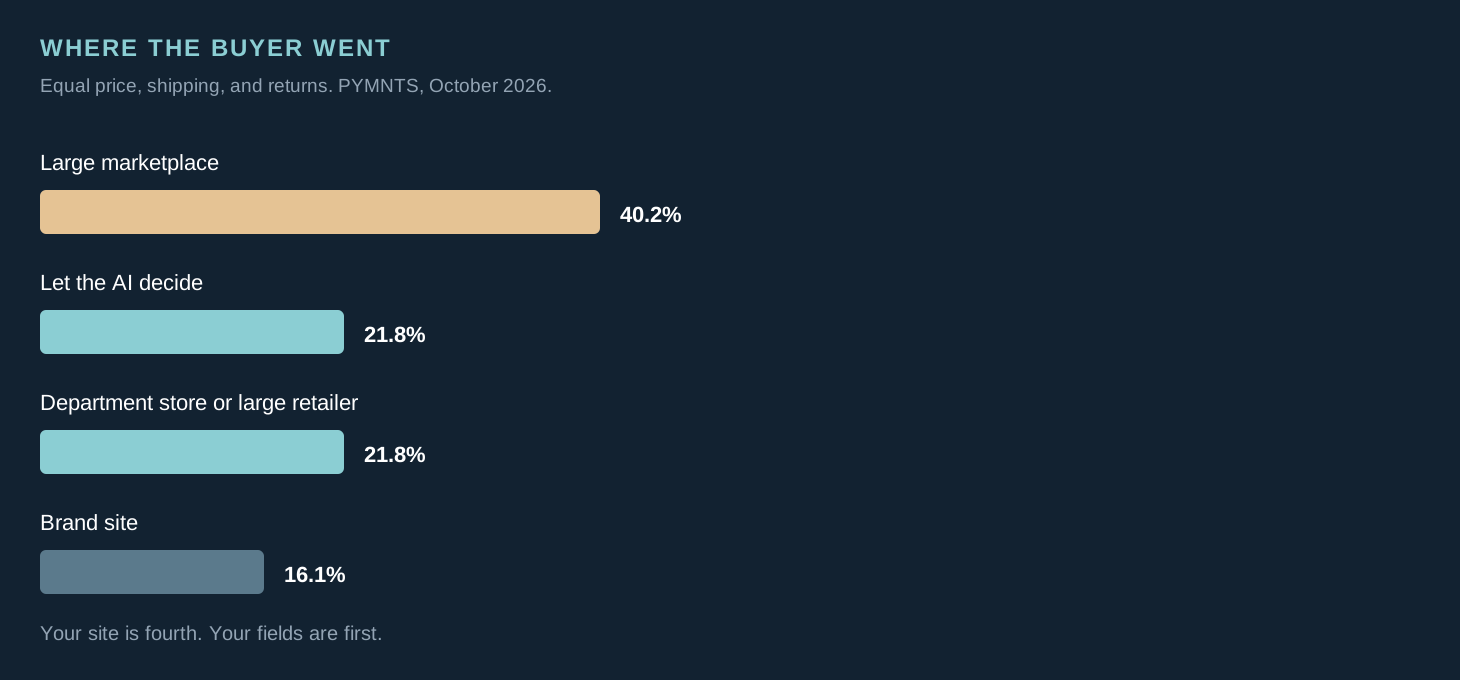
PYMNTS asked shoppers where they would send an AI agent when price, shipping, and returns were equal across sellers. The October 2026 report, titled From Prompt to Purchase: Who Wins the AI Shopper, found 40.2 percent would pick a large marketplace, 21.8 percent a department store or large retailer, 16.1 percent a brand site, and 21.8 percent would let the AI decide.
Amazon closed 59.7 percent of the most recent AI-assisted purchases in the survey, and 57.9 percent of AI shoppers said they usually buy there. That looks like marketplace loyalty until you read the next line. Among marketplace shoppers, 53.9 percent would switch to a brand site for a lower price. Only 12.1 percent would switch for AI-handled checkout.
Read that carefully. Shoppers are not loyal to the marketplace. They are loyal to the deal. Agents follow the deal too, only faster and with no brand affection to slow them down. A buyer who never visits your site will never be won over by your site. They will be won over by your fields: price, availability, shipping time, return terms, the structured facts the agent actually reads.
Why the Funnel Goes Blind
The marketing funnel assumes a person. Someone sees an ad, visits, compares, buys, returns, buys again. Each step leaves a trace, and the traces add up to a story you can act on. An agent compresses research and purchase into a step you cannot observe. Your analytics log a sale with no journey. Attribution tools assign it to direct traffic, to the marketplace, or to nothing at all.
That mislabeling has a cost. You keep optimizing for humans while a growing share of buyers never see your homepage, your bundle, your review page, or your story. The brand work that wins human shoppers is invisible to the agent, which reads fields instead of films.
The Journal also reported the other side of the blindness. Retailers are losing visibility into who initiated a purchase, what the agent compared before choosing, and why. Purchase errors by agents risk raising returns and chargebacks. An order you cannot explain is also an order you cannot defend when it comes back. I have written about the invisible costs of agent failures before. An agent order that gets returned for a reason nobody recorded is that same failure with a shipping label on it.
The Checkout Post Got It Half Right
Earlier this year I wrote about why stores cannot sell to AI agents yet. That was a plumbing problem: no agent checkout, no sale. The new problem sits on top of it. Even where agents can buy, the sale teaches you nothing.
The industry keeps framing agentic commerce as infrastructure. Protocols, checkout APIs, credentials, delegated payment. All of it is needed, and none of it answers the question a marketing leader actually asks after the sale: what did we learn? Infrastructure tells you the order went through. It does not tell you why, or what to change next time.
Brands that treat agent orders as a rounding error will keep optimizing a funnel that covers a shrinking share of buyers. The funnel is not wrong. It is just blind to its newest customer.
Four Moves for the Agent Order
First, tag agent orders as their own channel. Detect agent checkouts, marketplace agent orders, and API orders, and give them a channel name in your reporting. If you cannot count them, you cannot manage them, and right now most teams are counting them as direct traffic or not at all.
Second, publish product truth that machines can read. Price, stock, specs, shipping time, return terms, in structured data and feeds, kept current. The agent does not read your brand film. It reads your fields. Wrong fields lose the sale before a human ever hears about it.
The receipt tells you what sold. It never tells you who decided.

Third, measure agent orders separately. Share of orders, return rate, margin, price sensitivity. Compare them against human orders. If agent orders return twice as often, that is a product data problem, not a customer problem, and you can fix product data.
Fourth, set an agent policy on purpose. Allow agents, shape what they see, or block them, but choose. A policy you never wrote is still a policy. It is just one your competitors and the marketplaces wrote for you while you were busy.
The box arrives either way. The question is what you learned from it.

The Metric That Matters Now
Watch agent order share. Not as a curiosity metric, as a channel metric, sitting next to paid search and email in the same report. When agent orders pass a threshold of your business, pick your own, say one in ten, the product feed becomes your storefront and the listing page becomes a detail nobody reads.
I have written about the measurement collapse in agentic AI. This is where it lands in revenue. A sale with no shopper attached is not a data gap you can fill later. It is a customer you never met, and every month the share grows while the meeting never happens.
Your best customer might never visit your site. That is fine. Selling blind is the part to fix.