Digital out of home advertising just had its best quarter on record, and most of the coverage is drawing the wrong lesson from it. The story going around says screens are back because they finally got digital targeting. Programmatic buying, geofencing, audience segments, retargeting from foot traffic. The full digital toolkit, now on a billboard.
That pitch mistakes the wrapper for the reason. A screen on a freeway did not get valuable because a platform can slice its audience into segments. It got valuable because the rest of the internet got harder to trust, harder to reach, and harder to prove. The screen is the one place left where the ad cannot be skipped, blocked, or answered away by a chatbot. Its power is physical and boring. Same place, same message, same people, day after day. Sell that, and the targeting becomes a footnote. Sell the targeting, and you pay digital prices for a poster.
The Numbers Are Real
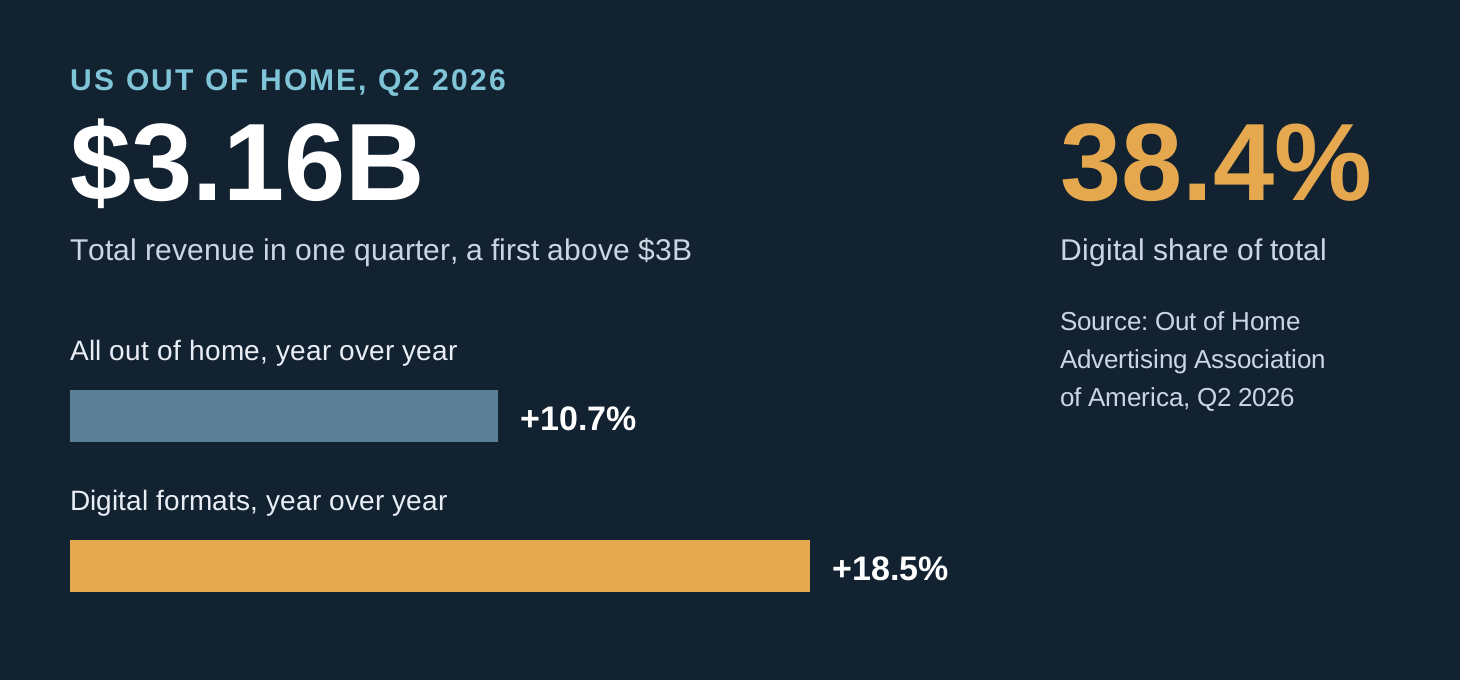
Start with the numbers, because this is not a nostalgia piece. US out of home revenue reached $3.16 billion in the second quarter of 2026, up 10.7 percent from a year earlier, according to the Out of Home Advertising Association of America, as reported by Advision. It was the first quarter above $3 billion. Digital formats grew faster, up 18.5 percent, and took 38.4 percent of the total. That is a real shift in money, not a trade press mood.
The timing is not a coincidence. Two forces hit digital at once. First, the web filled with machine-written pages. Pew Research Center analyzed a random sample of 10,000 webpages collected in July 2026 and found about one in ten showed significant signs of AI authorship, Advision reports, with the share above one in three among pages published after ChatGPT launched. Second, answer engines started resolving questions without sending anyone to a website at all. One review of 12 studies cited by Billboard Insider found AI Overviews cut click rates by 15 percent to 89 percent, and MarTech Cube cites data showing a 58 percent lower average click rate for the top ranking page when an AI overview appears.
Put those together and a brand faces a simple problem. Its digital ads sit in a feed nobody trusts, beside content nobody wrote, on pages fewer people visit. A billboard sits on a road people actually drive. It cannot be faked by a bot farm, because the audience is a traffic count on a real street. It cannot be skipped, because there is no skip button on a freeway. That is the whole pitch, and it was true before anyone added a targeting dashboard to it.
The Wrong Lesson
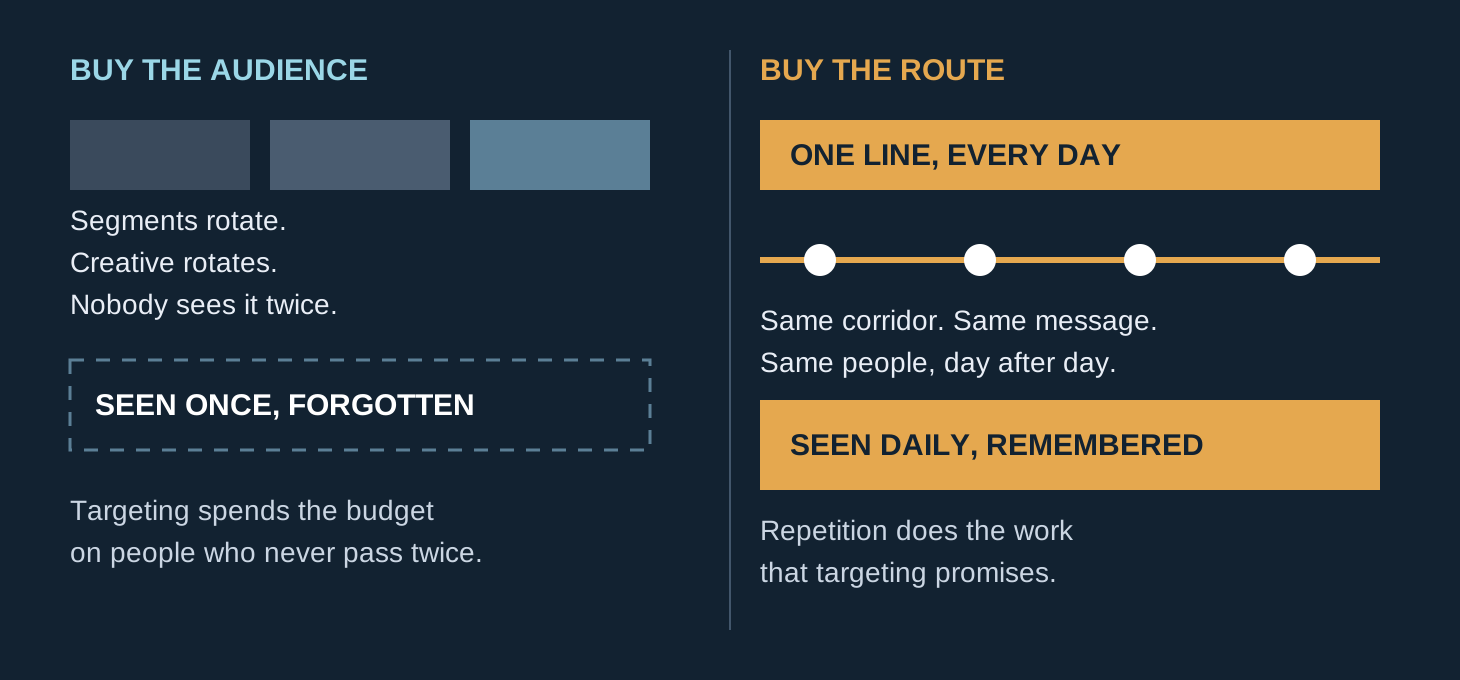
The sellers saw the same numbers and reached for the familiar playbook. Buy screens the way you buy display. Slice the audience, rotate the creative, chase the segment, retarget the device that passed the board. MarTech Cube's October piece on the category praises exactly this: geofencing that targets by location and behavior, mobile IDs captured from people who enter a targeted zone, follow-up display and social ads served to those same people later the same day. Read it closely and it describes a surveillance funnel with a poster at the top.
That funnel misunderstands what a screen is for. A display ad can wait for the right person, because the person is sitting still, looking at a screen they chose, with time to click. A driver is not sitting still. A commuter on a platform is not shopping. The screen gets a glance, not a session. Targeting cannot fix a glance. It can only change which glance-worthy message shows up, and if the message changes every time, the glance never adds up to anything.
Worse, rotating creative destroys the one advantage a screen has over a feed. A feed rewards novelty, because the user scrolls past anything familiar. A commute rewards sameness, because the same person passes the same board twenty times a month. The tenth viewing is where a billboard starts working. A campaign that rotates six messages across six segments makes sure nobody reaches a tenth viewing of any of them. It buys reach and throws away repetition, then reports the reach as a win.
There is also a quieter cost. Building retargeting audiences from physical exposure, by capturing device IDs from people who walked past a zone, turns a public moment into a tracked one. Some of that is done with consent frameworks and anonymized IDs, and the vendors will tell you so at length. A brand still has to decide whether it wants its name on the practice. The screen worked before anyone tracked the passerby. Tying the buy to tracking invites the privacy fight that digital already lost, into the one channel that had stayed out of it.
A Screen at Speed
Think about the actual moment a screen gets seen. You are driving, or riding, or waiting for a train. Your eyes leave the road or the platform for a second or two. In that second, the screen has to do exactly one job: plant a line you can still repeat at the next light.
That constraint kills most digital habits. A clever headline with a setup and a payoff needs three seconds and a second reading. A screen gets one. A list of three benefits needs a pause nobody takes. A QR code needs a phone out, a camera open, and a reason, all while moving. The formats that survive are embarrassingly simple. A name. A promise. A place. Seven words or fewer, big enough to read from the far lane, unchanged for weeks.
This is why the old billboard rules still beat the new dashboards. Pick a corridor your buyers actually travel, not a demographic your platform assembled. Put one line on it. Leave it alone. The driver who sees it on Monday, Wednesday, and Friday does not need to be in a segment. She needs to recognize it on Friday. Recognition is the targeting. It just runs on geography and time instead of on data.
The driver in this picture is not an audience segment. She is a person on a route she drives every week. The board works if it is still there, still saying the same thing, the tenth time she passes it.
Buy the Route, Not the Audience
Here is the test I would run before spending real money on screens. Pick one corridor, one message, and one measurable action, and hold all three steady for four weeks.
First, the corridor. Choose a stretch of road or a transit line that your actual buyers use, and prove it with something you already know. Store locations, delivery zones, event attendance, the neighborhoods your best customers come from. If you cannot name the corridor from your own customer data, you do not have a screen buy yet. You have a media plan looking for a map.
Second, the message. One line, seven words or fewer, with the brand name in it. No rotating variants, no dayparted versions, no clever second line for the evening commute. The test is whether repetition builds recall, so changing the message mid-test destroys the test. Write the line so a person can repeat it to a friend without looking at it again. If they cannot, rewrite it before you buy anything.
Third, the measurement. Do not judge the screen by clicks, because a screen has no click. Judge it by lift in the place it ran, against a place it did not. Track branded search in the exposed metro against a control metro over the same four weeks. Track store visits or site visits from the exposed area against the control. Track direct traffic and brand-name searches, the messy signals that actually move when recall moves. A vendor impression count is not a result. It is a receipt for showing up.
Run that test against the targeted version if you want proof. Same budget, one corridor with one line, against the same budget spread across segments and rotating creative. I have not seen a vendor publish that head-to-head, and the absence tells you something. The industry reports reach and impressions for the targeted buy, because those numbers look good even when nobody remembers anything. Recall is harder to fake, so it gets measured less.
What Digital Still Does Best
None of this means digital is dead or that screens replace it. That would be the same mistake in reverse, swapping one overclaim for another. Digital is still where a sale closes. The screen plants the name, and search, social, and your site finish the job. The order matters.
Use the screen to make your brand the familiar name in a place, then make sure the familiar name is easy to find when the person finally searches. That means a search presence that answers the exact brand query, a site that loads fast and states the offer plainly, and a product page an answer engine can quote. I wrote recently about how the auction moved inside the AI answer, and the same logic applies here. The screen gets you into the consideration set. The answer engine decides what the person hears about you next. A brand that buys screens but neglects the page the answer reads from is paying to be remembered, then forgotten on the second click.
Digital retargeting has a place after the screen, but keep it honest. Retargeting a metro where your boards ran is geography, and it is defensible. Building a personal profile from a passerby's device and following that person around the web is a different choice, and it trades the screen's one clean advantage, public presence without tracking, for a tactic people already resent online. Use the first. Think twice about the second.
And keep the screen out of the performance report it does not belong in. A board that lifts branded search 12 percent in its metro did its job, even if its click rate is zero, because it has no click to measure. A dashboard that forces every channel into the same click column will always make the screen look like a failure and the feed look like a success, right up until the feed stops sending traffic at all. I covered that trap from the publisher side in my post on traffic that was never a contract. The contract was always attention, not clicks, and attention is what a screen still sells.
The commuter on the platform has time, but not attention to spare. One clear screen beats a wall of rotating ones, because the wall trains him to look away.

One Line, Kept
Screens are back for a reason the dashboards did not create. The open web got crowded with machine content and drained by answer engines, and a physical surface stayed real. Brands that buy the surface for what it is, one place, one line, repeated until it sticks, will get their money's worth. Brands that buy it for what digital promised, perfect segments and rotating creative, will get a beautiful report and a forgotten campaign.
Next time you pass a board you cannot read at speed, do not blame the driver. Blame the buyer who paid to say six things to a person with one second to look.