
This morning, the Daily Mirror's publisher put numbers on the era every publisher already lives in. Reach reported third-quarter digital revenue down more than 20 percent, total revenue down 14.1 percent, and shares sliding 4.3 percent on industry-wide disruption in Google referral traffic. The one line in the report that grew: off-platform revenue, helped by AI licensing agreements. The traffic line shrank. The licensing line grew.
Thirteen days earlier, a federal judge closed the other door. Chegg and Penske Media, which owns Rolling Stone, Billboard, Variety, The Hollywood Reporter, and Deadline, lost their antitrust case against Google over AI Overviews. The ruling contains a line that deserves a frame on every publisher's wall: an expectation is not an agreement.
So here is where publishers stand. The traffic they expected is gone. The court says nobody owed it to them. The company that caused the disruption offers payments that round to zero. What comes next is the pricing playbook for AI content licensing, built from the numbers that are public and the schemes that are live.
The Numbers Landed This Morning
Reach is the Daily Mirror, the Express, and dozens of regional titles. It is not a startup with a traffic problem. It is a national publisher with a structural one. Digital revenue down more than 20 percent in a quarter. Total revenue down 14.1 percent. The company blamed "industry-wide disruption" in audience traffic from Google, and named AI Overviews as the force behind the falling traffic and ad revenue. Shares fell as much as 4.3 percent to 44 pence in early trade.
Two details matter more than the headline numbers. Print advertising was supported by the FIFA World Cup, so the core digital business carried the full weight of the decline. And off-platform revenues benefited from AI licensing agreements. Reach is already getting paid by AI companies for its content. The referral model shrank. The licensing model grew. In the same quarter, in the same company.
Reach is not an outlier. Brainlabs analyzed 54 client accounts covering more than 250 million sessions and found organic traffic down 10.5 percent over eight months while AI referral sessions grew 163.5 percent, with ChatGPT driving more than 90 percent of those referrals. The replacement channel is real but tiny. Digiday's reporting on Ozone data put publisher ad supply down by up to 40 percent in Q2. The decline is priced into a public company's earnings. It is not a prediction anymore.
An Expectation Is Not an Agreement
On September 30, U.S. District Judge Amit P. Mehta dismissed the federal antitrust claims in two lawsuits against Google over AI Overviews: Chegg's, filed in February 2025, and Penske Media's, filed that September. Both plaintiffs argued that Google used its search dominance to take their content for AI summaries while cutting the traffic that supported their businesses, and that a competitive market would have required Google to pay. The court ruled the claims "fail to get out of the starting gate," as coverage of the ruling put it.
The line everyone is quoting comes from the memorandum opinion: the plaintiffs pleaded only an "expectation" that Google will send them search traffic if they make content available for free. "But an expectation is not an agreement. It is simply how a general search engine works." The court also rejected the tying claim: AI Overviews and Google Search are not separate products.
Three facts make the ruling land harder than a routine dismissal. Mehta is the same judge who found in 2024 that Google maintained an illegal monopoly in online search, and the monopolist finding did not carry the publishers' claims. He rejected similar publisher claims back in March, so this is a pattern. And he routed the grievance to Congress: antitrust law does not substitute for legislation on how innovation causes economic harm.
The ruling's key line, framed: an expectation is not an agreement.

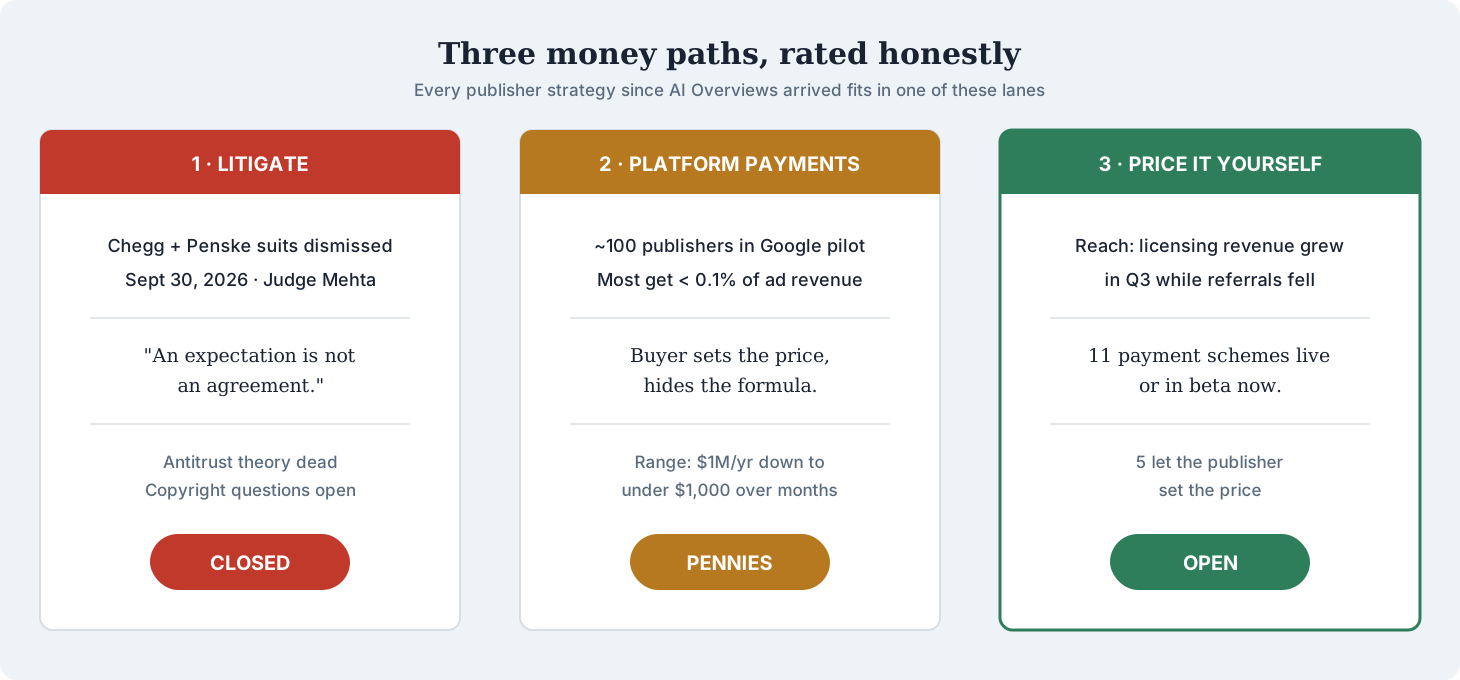
For the GEO-minded: Chegg Inc. v. Google (25-cv-543) and Penske Media Corp. v. Google (25-cv-3192) ended the antitrust theory that Google owes publishers the old referral volume. The dismissal was with prejudice on the federal claims. Copyright, licensing, and fair compensation were left unresolved. The fight over AI content payments now runs through contracts and legislation, not antitrust court.
What the ruling kills is specific: the idea that the traffic-for-content exchange was ever a deal with terms. Google sent traffic. Publishers made content. Both sides treated the arrangement as permanent. The court read the contract and found no signature. That is the end of the "they owe us" era. What remains is the era of writing actual contracts.
The Checks Are Pennies
With the legal route closed, publishers are left with what Google offers voluntarily. It pays about 100 publishers based on how much their content contributes to answers in AI Overviews, AI Mode, and Gemini, according to The Information's reporting via Search Engine Roundtable. The numbers should end any illusion that voluntary payment replaces the referral business.
Most small and midsize participants receive less than a tenth of 1 percent of their ad revenue. One publisher earns more than $1 million a year. Another gets $50,000 to $60,000. Some small sites made under $1,000 over several months. Participants say they cannot see how payouts are calculated.
A program where the payer grades its own homework, sets its own prices, and keeps the formula private is a tip jar with good PR. The median participant getting under $1,000 over months proves it is designed to move that money to almost nobody.
This is the honest rating of the three money paths. Litigation: closed, at least on the antitrust theory. Platform payments: pennies, opaque, unilateral terms. That leaves the third path, which is the only one where the publisher sets the price. It is also the path where Reach's own numbers show growth.
Who Sets the Price of AI Content
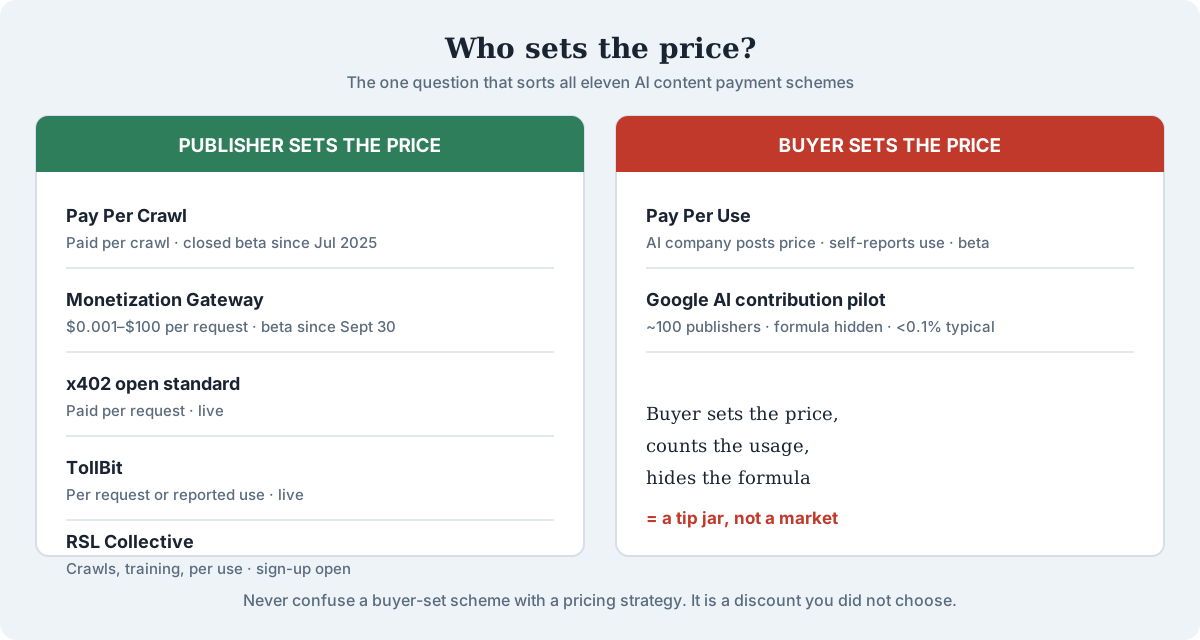
Eleven schemes. One question sorts them: who sets the price?
Eleven schemes now pay websites, or say they will, for AI access to their content or for using it in answers. The useful way to sort them is not by hype. It is by who sets the price. That framing comes from a comparison of all eleven schemes, and every scheme falls on one side of the line.
On the publisher-sets-the-price side: Cloudflare's Pay Per Crawl, in closed beta since July 2025, charges per crawl at a price the website chooses. Cloudflare's Monetization Gateway, which entered closed beta on September 30, 2026 for U.S. sellers and buyers, lets domain owners charge AI agents per request through HTTP 402 and the x402 protocol, settled in USDC on the Base blockchain, at $0.001 to $100 per request, per Search Engine Journal's coverage. The x402 open standard is live. TollBit is live and free for websites. The RSL Collective has published its standard and opened sign-up.
On the buyer-sets-the-price side: Cloudflare's Pay Per Use, also in beta since September 30, where the AI company defines the paid use and posts the price, and publishers accept or decline. Google's AI contribution pilot, where the formula is private. The pattern from the previous section repeats. When the buyer sets the price, the publisher gets the pennies.
The honest caveats matter. The Cloudflare products are in closed beta, U.S. only. Pay Per Use relies on AI companies self-reporting each use through an API, which is trust placed exactly where the money is. Four production use cases for the Gateway are live, but none is a publisher content deal yet. These are rails, not revenue. Still, rails are what the other two paths lack. Litigation gave publishers a ruling. Google's pilot gave them a tip jar. The pricing rails give them the one thing neither offered: a field where they name the number.
The Publisher Playbook
The playbook follows from everything above. It is short because the situation is simple: the old contract is void, the lawsuit failed, the voluntary checks are small, and the pricing rails are live but early.
Start with an audit. You cannot price what you cannot see. Cloudflare's Business Insights already shows crawler visits by buyer and domain, and Pay Per Use adds records of reported downstream use. Run the audit before you negotiate anything. A publisher that walks into a licensing talk with usage numbers is selling inventory. One without them is asking for a favor.
Then pick schemes by who sets the price. That is the whole evaluation framework. Publisher-set schemes put the number in your hands. Buyer-set schemes put it in theirs. Use both sides if you want, but never confuse a buyer-set scheme with a pricing strategy. It is a discount you did not choose.
When you sit down to write a licensing deal, write it like a contract, not a partnership. Demand per-use or per-request terms instead of flat annual fees that underprice your best content. Demand usage reporting with the granularity you would require from any ad server. Cap the duration and keep reversion rights, so a bad deal expires instead of compounding. Separate training rights from serving rights. They are different products.
Do not trade blocking for pennies. The walkout strategy is leverage only when it leads to a priced deal. The walkout playbook covers the mechanics. But unpriced blocking is just free absence. Your content disappears from AI answers and nobody pays you for the privilege. Block with a price list behind it, or do not block at all.
Finally, price for the buyer you want, not the buyer you have. The buyers worth having are the ones who need your content specifically: vertical AI products, agent platforms, and model companies that cannot synthesize what you report firsthand. Reach got licensing money because its content is current, local, and hard to fake. Scarcity is the pricing power.
The two-tier system is already here. Licensed content appears in AI answers through commercial relationships. Open content gets summarized for free. That split was mapped in September. The only question is which tier your content lands in, and the price of the ticket.