
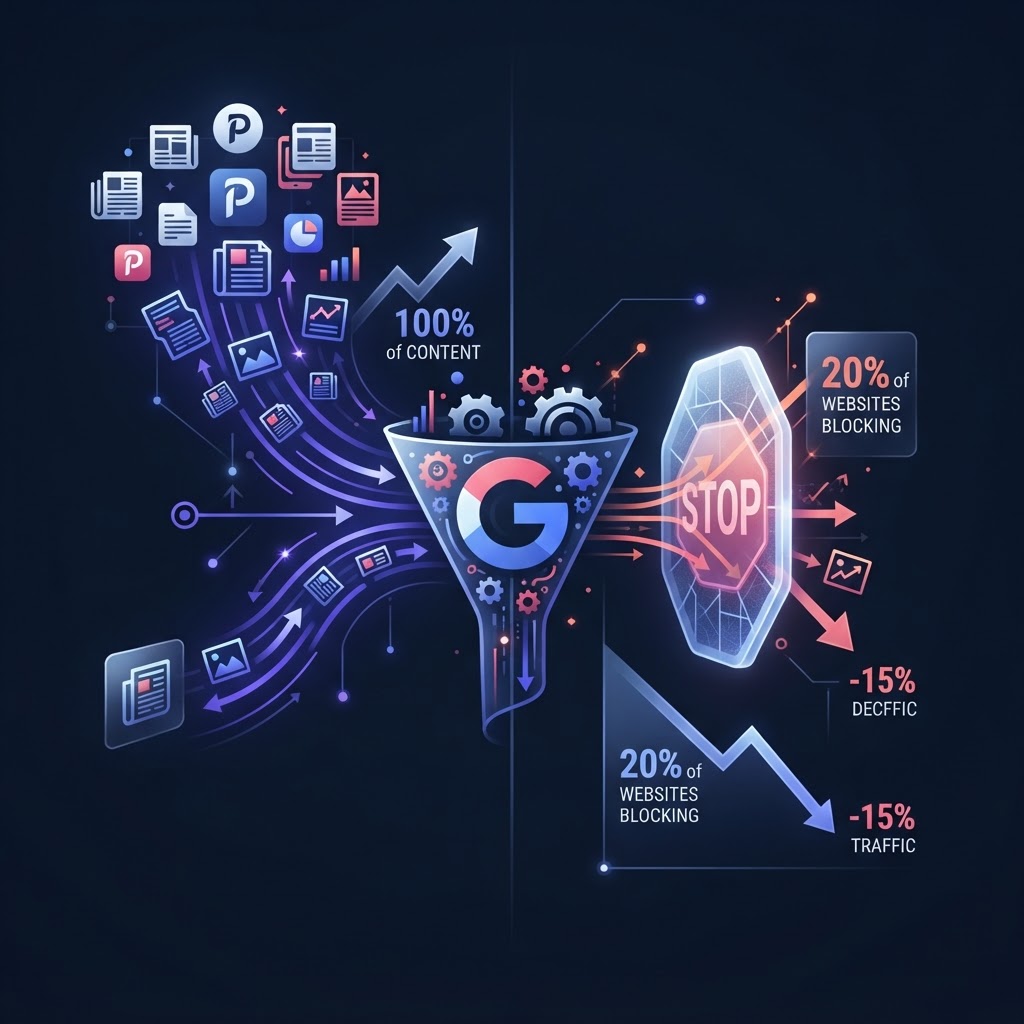
On September 15, Cloudflare will start blocking Google's crawler by default on every new website that runs ads. Cloudflare hosts roughly one-fifth of all websites on the internet. This is not a niche policy change.
The move targets Google's practice of using one crawler for both search indexing and AI training. Publishers have to choose: let Google scrape their content to train the AI products eating their traffic, or disappear from Google Search entirely. Cloudflare is calling that a false choice and forcing a third option: block both.
"We've been clear about what we want," said Cloudflare chief strategy officer Stephanie Cohen. "We want a technical solution that allows you to be discoverable without having to give your content away for free."
What happens to your SEO strategy when the content Google relies on starts disappearing?
The Block Starts September Fifteen
Cloudflare's new default policy is simple. Any crawler that scrapes for both search indexing and AI training gets turned away at the door on ad-supported pages, unless the site owner explicitly opts in. The company announced the change in a blog post framing it as "content independence day" for publishers.
Google is the unnamed target. The search giant famously uses one crawler to both index sites and train its AI models. This forces publishers into an impossible corner. They can allow both functions and watch Google scrape their content to train the AI products regurgitating their data without compensation. Or they can shut off both and vanish from the world's largest search engine.
Google introduced Google Extended, a tool that nominally lets publishers opt out of AI training without leaving search. But publishers don't trust it. Executives at two media companies told Adweek they worry the program will penalize their search visibility. The UK's Competition and Markets Authority is now requiring Google to offer a separate opt-out from AI search features, but publishers are equally hesitant to trust a solution controlled by Google rather than an outright block.
USA Today Is Already Preparing
This isn't theoretical. USA Today Inc., which includes USA Today and a nationwide network of news sites, is preparing to delist from Google within the next six to twelve months, according to CEO Mike Reed.
"For those with licensing agreements, they get our content," Reed said. "For those without, we block them."
USA Today has already struck licensing deals with Meta, Microsoft, and Amazon. The content has value when it's not free. Reed's calculus is straightforward: if Google won't pay, Google won't get the content. And the traffic Google sends is no longer worth enough to justify giving it away.
Beehiiv, the newsletter platform, announced a partnership with Cloudflare that gives its entire network of creators the ability to block the Google crawler. The infrastructure for a publisher walkout is being built right now.

The Math That Changed
For decades, abandoning Google Search was commercial suicide. The search engine was the single largest source of audience discovery for most websites. Blocking Google meant choosing obscurity over principle.
That calculus has flipped.
Search traffic has been declining for years as Google keeps users on its own properties. Adweek reported that Newsweek's readership fell from 100 million in May 2025 to 23 million in June 2026. That's a 75% drop in thirteen months. USA Today has maintained roughly 1 billion monthly pageviews for three years, but only by diversifying into newsletters, social media, and events.
Here's the math publishers are running. Once search traffic drops below a certain threshold, the value of appearing in Google becomes less than the value of withholding content as a bargaining chip. The traffic isn't worth what it used to be. The content is still worth something to Google's AI products. Blocking becomes rational when the trade flips.
Every major media company has a model for what blocking Google would look like, according to one executive who spoke anonymously. The decision is mostly a matter of timing. When does the traffic value fall below the licensing value?
We've already covered how Google is drawing synthetic brand images in search results, cutting out the original sources entirely. Publishers see that and do their own math. If Google is generating images from their content without linking back, what exactly are they getting from being indexed?
What This Means for SEO
If you're a brand investing in SEO, the content ecosystem Google relies on is shrinking. When publishers block Google's crawler, three things happen.
First, search results quality degrades. Google loses access to premium content from publishers who produce original reporting, research, and expertise. The gap gets filled with whatever remains, which increasingly means AI-generated content and lower-quality sources. Your brand's SEO is competing in a thinner, noisier index.
Second, AI Overviews lose training data. The generative answers Google surfaces in search depend on scraping the web. If 20% of websites start blocking by default (Cloudflare's share), the training pipeline narrows. Answers get worse. Citations get fewer. The Google ad ecosystem that depends on search quality takes a hit.
Third, the licensing economy emerges. Publishers who block Google are doing it because they have or want licensing deals. Content goes behind paywalls, both literal and technical. Brands that relied on organic search to reach audiences through publisher sites lose that channel.

What to Actually Do
Stop treating SEO as a stable channel. The rules aren't just changing. The playing field is shrinking. Here's what matters now.
Build direct audience. Email lists, SMS, owned communities, social presence you control. If your only path to customers runs through Google, you're renting infrastructure from a landlord whose tenants are leaving. Authentic, human-made content is already becoming the trust signal that cuts through AI noise. Own the channel.
Diversify your visibility. Google isn't the only search surface anymore, and it may not be the most reliable one for long. AI assistants like ChatGPT, Perplexity, and Claude are answering queries directly. Make sure your brand is represented in those answers, not just in Google's index. CMOs who can't run the AI they bought are already falling behind on this shift.
Watch September 15. Cloudflare's deadline is real. If major publishers follow through, the web fragments. Some sites will be in Google's index. Some won't. The SEO playbook that worked for twenty years assumes a unified, indexable web. That assumption is breaking.
The Fragment
Google has no backup plan. Every publisher would prefer Google to come to the negotiating table and pay for content. But the threats are no longer empty. USA Today has a timeline. Cloudflare has a deadline. Beehiiv has the infrastructure.
If Google refuses to license content, search results get worse. AI Overviews get thinner. The product that generates most of Alphabet's revenue starts degrading from the inside. The brands that see this coming and build audience outside Google's walls will be the ones who don't need to panic when the walkout reaches their traffic numbers.
September 15 is the date. Everything after that is negotiation.