
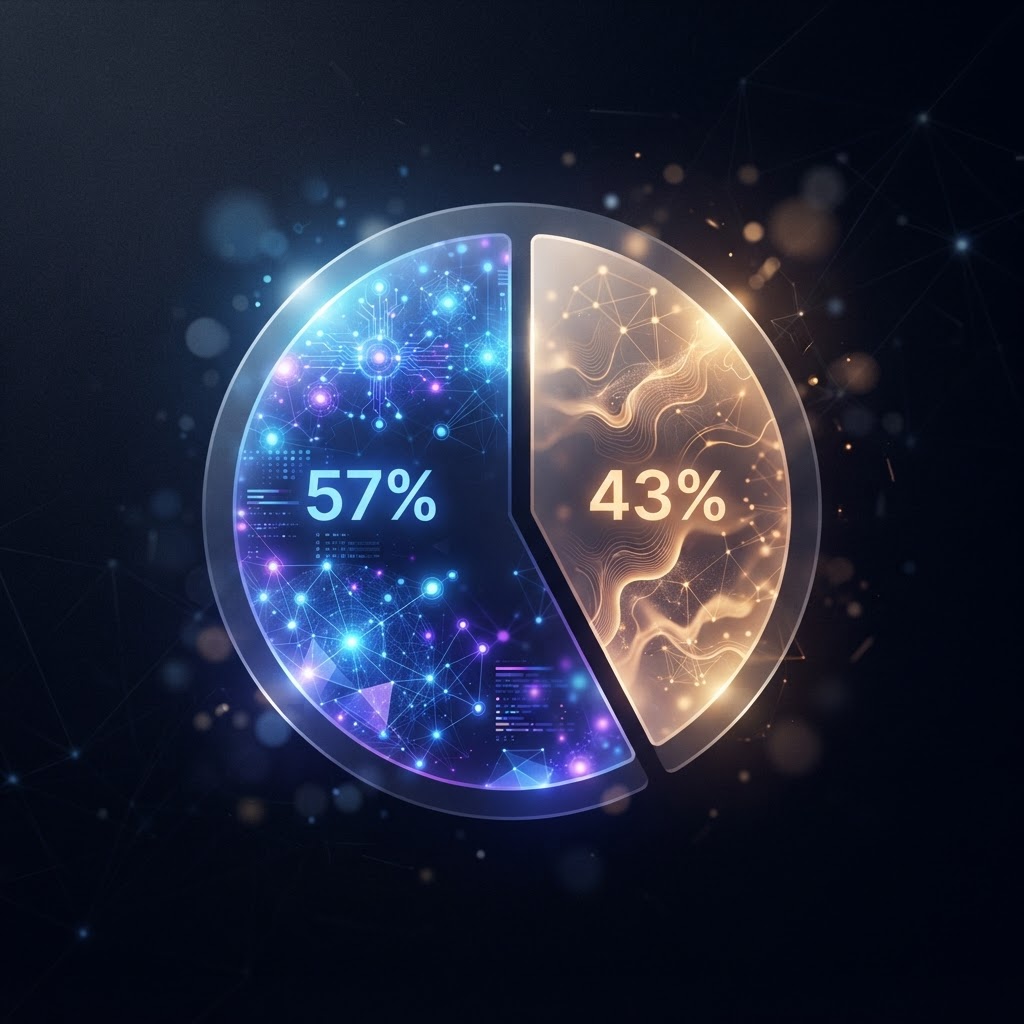
The internet crossed a line in 2026 that nobody in marketing is ready for. According to Cloudflare's Radar data, bots now account for 57.5% of all internet traffic. Not next year. Not eventually. Right now.
This isn't an ad fraud story. This is about the foundational assumption underneath every marketing dashboard, attribution model, and media plan: that there's a human on the other side of the screen. That assumption just became a lie more than half the time.
The Numbers Behind the Flip
The data comes from three independent sources, all pointing the same direction. Cloudflare puts automated traffic at 57.5% of all HTTP requests. Imperva's Bad Bot Report tracked it at 53% in 2025, up from 51% the year before. Human Security's 2026 State of AI Traffic report found automated traffic growing 8x faster than human traffic, with AI agent traffic specifically surging roughly 8,000% in a single year.
Let that sink in. For every 1% growth in human traffic, automated traffic grew 8%. AI agent traffic didn't just grow. It exploded from nearly nothing to a meaningful share of the web in twelve months.
At Cannes Lions 2026, Stu Solomon, CEO of Human Security, put it bluntly: "We're at a unique inflection point in history where more than 50% of the traffic on the internet is machine-based. The controls, the optimization, the marketing, everything is predicated on this notion that there's a human on the other side of the screen, and that's just not the case anymore."
He's right. And the implications go far beyond fraud detection.

Your Attribution Model Just Broke
Here's what nobody is talking about. Every multi-touch attribution platform, every MMM model, every pixel-based tracking system was designed to measure human behavior. Clicks, scrolls, form fills, purchases. When a bot generates those same signals, your attribution model can't tell the difference.
This is the same attribution poisoning problem we've been tracking, but at a scale that changes the conversation. It's one thing when a small percentage of your traffic is fake. It's another when fake traffic is the majority. Your top-performing campaign might be optimizing for bot engagement. Your best-performing channel might be the one bots love most.
The bot traffic measurement blind spot we identified earlier this year was a warning shot. Now the gap between what your dashboards say and what actually happened has grown so wide that the dashboards themselves have become fiction.
Ad fraud losses are projected to exceed $165 billion globally in 2026, according to fraud detection firm Anura. But the real cost isn't the fraud itself. It's the decisions you make based on data that's been quietly contaminated by bot traffic for months.
The Two-Audience Problem
Lauren Benedict, VP of global ad sales at Roku, raised a point at Cannes that every CMO needs to hear: brands now need to think in terms of two distinct audiences. Human and agentic. Different engagement patterns. Different decision criteria. Different content needs.
"Brands need to start thinking in terms of two distinct audiences, human and agentic, and build strategies that serve both," she said.
This isn't theoretical. Two-thirds of US media buyers are already focused on agentic AI for ad buying and campaign execution, according to IAB's 2026 Outlook Study. When agents are both buying and consuming media, you're not just advertising to humans anymore. You're advertising to machines that represent humans, and sometimes machines that represent nothing at all.
Solomon illustrated the gap between agent capability and judgment with a story from his own team. They programmed an agent to buy three birthday cakes from a bakery website. The agent navigated the site, selected the cakes, completed the purchase, and returned a $750 bill. "It got the job done, but it didn't have the human understanding of what good looks like," he said.
Your marketing strategy now needs to account for agents that will transact on behalf of humans, make decisions based on content structured for machine extraction, and operate at a speed that breaks any human-paced feedback loop.

Authentication Is the New Moat
The platforms best positioned for the bot-majority internet share one trait: authenticated, logged-in users. Reddit has built its defense on verified community identity. Roku has 100 million authenticated households. Tripadvisor holds more than a billion human-generated reviews.
Roelof van Zwol, EVP at Reddit, explained their approach: rather than blocking agentic traffic, the platform focuses on identification and containment. "We do want to make sure that when there are agents, we limit what they can do, or at least that they make themselves known," he said.
This is the strategic shift that matters. The open web, where anyone (or anything) can show up anonymously, is becoming a liability. Logged-in, authenticated environments where identity is verifiable are becoming the premium inventory. If your marketing strategy is still built on anonymous display inventory and open-web programmatic, you're increasingly buying bot traffic at human prices.
The Cloudflare AI crawler block trend was the first signal. Publishers are fighting back against automated scraping. But the deeper shift is that authentication, not content volume, is becoming the trust layer that separates real engagement from bot noise.
Content Has Two Masters Now
Tripadvisor's Allison Lambroza shared a data point that reframes content strategy: Tripadvisor is now the most cited travel source in over 70% of AI queries. Their flywheel is the same one that built the company. Trusted reviews from real people feed LLMs that reward specificity and recency.
This is the content paradox of the bot-majority internet. The content that performs best for AI extraction is structured, specific, and sourced. The content that performs best for humans is narrative, emotional, and contextual. Most brands are still producing one type and hoping it serves both.
If you haven't already, read our analysis of the AI visibility trap and how agent-to-agent marketing is creating invisible influence networks. The bot-majority internet accelerates both trends. Your content needs to be extractable by agents and resonant with humans, and those are increasingly different formats.
Who Owns the Damage
The accountability question is where this gets uncomfortable. When an AI agent acts on behalf of a human and something goes wrong, who's responsible?
Solomon pointed to a framework that's gaining traction: agents must be authentic, authorized, and accountable. "The accountability starts with the person, the human being, who set it on its journey in the first place," he said.
This connects directly to the agentic commerce authorization liability gap we've covered. But the bot-majority internet adds a new dimension. When bots are the majority of your traffic, the question isn't just who authorized the agent. It's whether the engagement, the click, the purchase, the review you're seeing in your dashboard came from a human at all.
The silent shopping revolution driven by AI agents is already reshaping how brands think about transactions. But most brands haven't connected that trend to the traffic data. When agents browse, compare, and buy, your analytics register those actions as human engagement. Your attribution model credits them to campaigns. Your optimization algorithms learn from them.
You're training your marketing systems on bot behavior and calling it customer insight.
What Changes Monday Morning
Three things need to happen immediately.
Segment your traffic by human vs. bot. Not "filter out bots." Segment them. Understand what percentage of your engagement, your clicks, your conversions come from automated sources. You can't fix what you can't see, and right now most marketing teams are flying blind.
Build for two audiences. Your content, your ad creative, your landing pages, and your measurement all need to account for the fact that a growing share of your traffic is agentic. Content that's extractable and structured for AI agents isn't optional anymore. It's a separate channel with different requirements.
Rethink KPIs from page views to intent signals. Van Zwol from Reddit made the point that feedback loops will compress dramatically. Waiting three weeks for campaign results is already obsolete. The teams that win will be the ones measuring intent, qualification, and authenticated engagement rather than raw volume metrics that are now majority-bot.
The bot-majority internet isn't a future problem. It happened. The question is whether your marketing strategy has caught up to the reality that more than half of what you measure isn't human anymore.
The brands that figure this out first will have a structural advantage. Not because they have better creative or bigger budgets. Because they'll be the only ones making decisions based on data that's actually real.