
On October 28, SEO consultant Cyrus Shepard posted a small case study on LinkedIn. He had used Google's new Search generative AI control to take one site out of AI Overviews and AI Mode. Three things happened. AI impressions went to zero right away. The AI impressions the site used to get had carried an estimated click rate of about 0.9 percent. And regular organic clicks fell too.
That last one is the finding that matters. Google says the opt-out control is not a ranking signal and does not touch ordinary search. One site's test says the story is messier than that.
The study is small. Shepard did not name the site, its traffic, the test dates, or how far regular clicks fell. He called the pattern a possible "Search SERP Halo Effect" and closed with a warning: results not guaranteed, always test your own data. Take the warning seriously. Then ask the question the coverage skipped.
Everyone is arguing about whether the halo is real. The better question is which switch you would even pull, because there are three of them, they do different things, and most sites are already pulling the wrong one.
The Test That Flipped the Question
Google gave site owners a clean opt-out on August 31, 2026, when the Search generative AI control rolled out to all websites worldwide. It lives in Search Console under Settings, and it covers AI Overviews, AI Mode, and generative AI features in Discover. On October 21, Google added it to its official list of ways to control what you share with Search. For the first time, leaving AI answers did not mean damaging your regular search presence.
Shepard's test used that control. He flipped one site from include to exclude, then compared the before and after in Search Console. AI impressions dropped to zero, which is exactly what the switch promises. The surprise was the second number. Regular clicks fell in the same window, even though the control is supposed to leave regular search alone.
Here is the detail that changes how to read the test. AI Overviews still appeared on the results pages throughout. The site just was not in them. So this was never a test of pages with and without an AI answer on top. It was a test of being cited versus not being cited while the answer still sits above you.
That distinction is the whole story. The answer stays. Your name leaves it. And the clicks that used to land on your blue link got thinner.
Shepard's own numbers keep the claim honest. AI impressions were about 8 percent of the site's total, so the AI slice was real but not huge. The 0.9 percent click rate is an estimate, worked out from overall clicks before and after, not a number Google reports. Google's generative AI performance report counts impressions only. There is no click count for AI features to check it against.
Three Switches, Three Costs
The opt-out conversation sounds like one decision. It is three, and they do not cost the same.
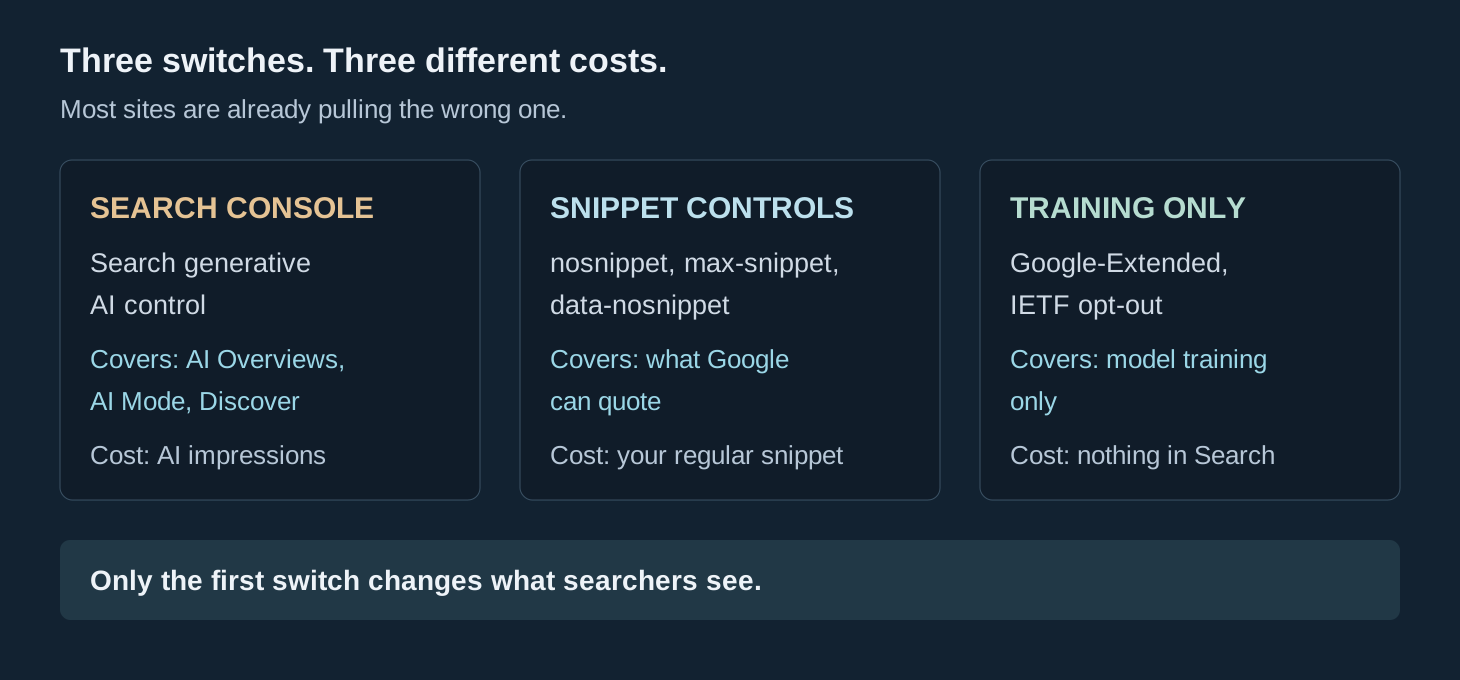
The first switch is the Search Console control Shepard tested. Include is the default for every property. Exclude keeps your links and content out of AI Overviews, AI Mode, and generative AI in Discover. It works per property, and it is all or nothing. You cannot leave AI Overviews while staying in AI Mode. Google says the setting is not used as a ranking or inclusion signal for other parts of search, and exclusion generally takes one to two days to go live. What it costs you is the AI impressions themselves, whatever clicks they carried, and whatever halo there is. It does not stop AI training.
The second switch is the snippet controls, and these are the oldest tools in the box. A nosnippet tag keeps your text out of AI Overviews as a direct input, because Google's own documentation says so. It also kills your ordinary search snippet, which is the price. A max-snippet limit caps how much Google can quote, in the answer and everywhere else. A data-nosnippet attribute hides one element only, which makes it the cheapest of the three when a single paragraph is the thing you want to protect. The cost here is visible in your regular result. Your listing gets shorter or plainer, and every searcher sees that, not just the AI answer.
The third switch is Google-Extended in robots.txt, plus the shared AI training opt-out Google and Bing plan to honor from 2027. This one controls training, not search. Google's help page says so in plain words. Yet a September 7 audit of 110 publishers found 37 of 96 readable robots.txt files block Google-Extended, while zero of 63 readable article pages set nosnippet. More than a third of publishers pulled a lever that does nothing in search, while none pulled the one that does. The cost of this switch is nothing in search, and that is the problem. You feel protected and you are not.
Most sites that think they opted out of AI search did the training version. Their content still shows up in AI answers, still gets cited, still gets summarized. The switch they flipped governs a future model, not the results page in front of them today.
A wrong switch is worse than no switch, because it ends the conversation. Someone checked the box and told the boss it was handled. Nothing changed where the clicks happen.

Why the Halo Might Be Real
There is a decent case for Shepard's guess. A searcher sees your name twice on one page, once inside the answer and once below it. Familiarity is cheap and it works. Google moved links higher inside AI answers on October 15, and Preferred Sources highlighting only works for sites that stay included.
There is also a decent case against it. One site, no disclosed size, no control group, no magnitude for the drop. Regular clicks fall for plenty of reasons, and a short test window catches all of them. Ahrefs compared 300,000 keywords and found the top result loses 58 percent of its clicks when an AI Overview sits above it, up from a 34.5 percent loss in its earlier study. AI answers clearly take clicks as well as give them. A Search Atlas study of 18,377 queries found ChatGPT and Gemini citations overlap Google's top 10 by only about 6 to 12 percent, so the answer and the blue links are different shelves. Being on one does not promise the other. Both of those are vendor studies, so read them as directional, not settled.
One more number leans toward staying in. First Page Sage looked at 218 of its client sites and found visitors arriving from a page with an AI Overview converted to leads at 2.6 percent, against 1.7 percent without one. That is the agency's own client data, not an independent study. Still, it points the same way Shepard's test does: the people who click through after seeing an AI answer are not the worst visitors.
My read is simple. Treat the halo as a working guess, not a fact. The cost of staying in is small. You give Google text it already has, for answers it will write with or without you. The cost of leaving is unknown and possibly larger than the clicks you can see, because the clicks you lose show up as a quiet dip in the normal report, not in any AI report.
I wrote recently about how the auction moved inside the AI answer. The same logic applies here. The answer is where the shopper starts. Leaving it does not send the shopper to your blue link. It sends the shopper to someone else's name in the answer.
The Measurement Trap
Here is why this argument will not settle soon. Nobody has a clean meter for AI clicks.
Google's generative AI performance report shows impressions by page, country, device, and date. It does not count clicks. The clicks AI features send land in the normal Performance report, mixed with everything else. Shepard's 0.9 percent came from subtraction: overall clicks before, overall clicks after, minus the AI impressions that disappeared. That is careful work, but it is arithmetic, not a meter reading. Anyone quoting an AI click rate as a fact is rounding an estimate into a number.
That gap shapes every decision in this post. You cannot see what AI sends you without doing the subtraction yourself, and most teams never do it. They look at the AI report, see impressions with no clicks attached, and conclude the answer sends nothing. Then they look at the normal report, see clicks drifting down, and blame something else. The two reports never meet unless you force them to.

The same gap cuts the other way. If you stay in and your clicks fall, you cannot prove the answer took them. That is not a reason to do nothing. It is a reason to test instead of argue.
For more on why measurement keeps breaking in AI search, I covered the attribution collapse and the citation trap. Both posts land in the same place: the old scoreboard does not fit the new page.
Run Your Own Opt-Out Test First
Do not copy Shepard's result. Copy his method. A two-week test on your own site beats a hundred opinions about his.
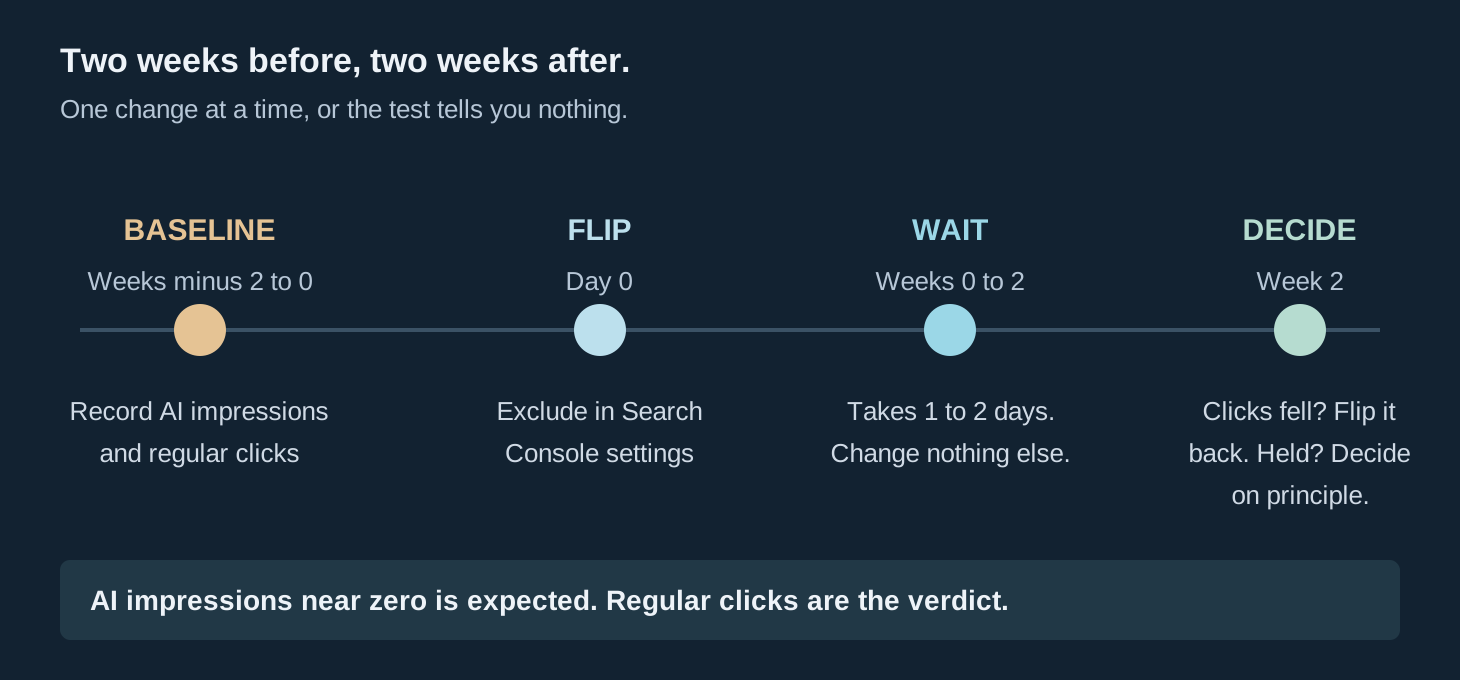
Start with a two-week baseline. Write down two numbers for the same pages: AI impressions from the generative AI performance report, and regular clicks from the normal Performance report. Same dates, same pages. If AI impressions are under 2 percent of your total, the test is cheap. If they are over 10 percent, do not flip anything on a hunch.
Then flip the switch. In Search Console, go to Settings, then Search generative AI, and change the property to exclude. Note the date. Exclusion generally takes one to two days, and some content takes longer, so give it a week before you read anything.
Wait two weeks, and change nothing else on the test pages. No new titles, no content edits, no other settings. A test with two changes tells you nothing.
Then compare the same two numbers. AI impressions should sit near zero. The question is what regular clicks did. If they fell while AI impressions were material, flip the switch back. The answer was doing more for you than the reports showed. If regular clicks held steady, the switch costs you little either way, and you can decide on principle instead of traffic.
Three things not to do. Do not put nosnippet across the whole site to make a point. You will strip your own snippets everywhere. Do not block Google-Extended and call it an AI search decision. That switch governs training, and your content will keep appearing in answers. Do not read one week of data and declare a verdict. Search is noisy at that scale, and a noisy verdict feels finished.
The publishers who walked out on Google in July made a different choice, and I covered what that walkout costs when it started. This is not that. Walking out is a statement. Flipping the Search Console switch is a setting, reversible in a day, testable in a month. Treat it like a setting, not a statement.
The answer is not going away. Your name inside it is a choice you can measure, and the measurement takes a month. Run the test before you give the name up, because the only number that settles this for your site is yours.