The fastest car in drag racing
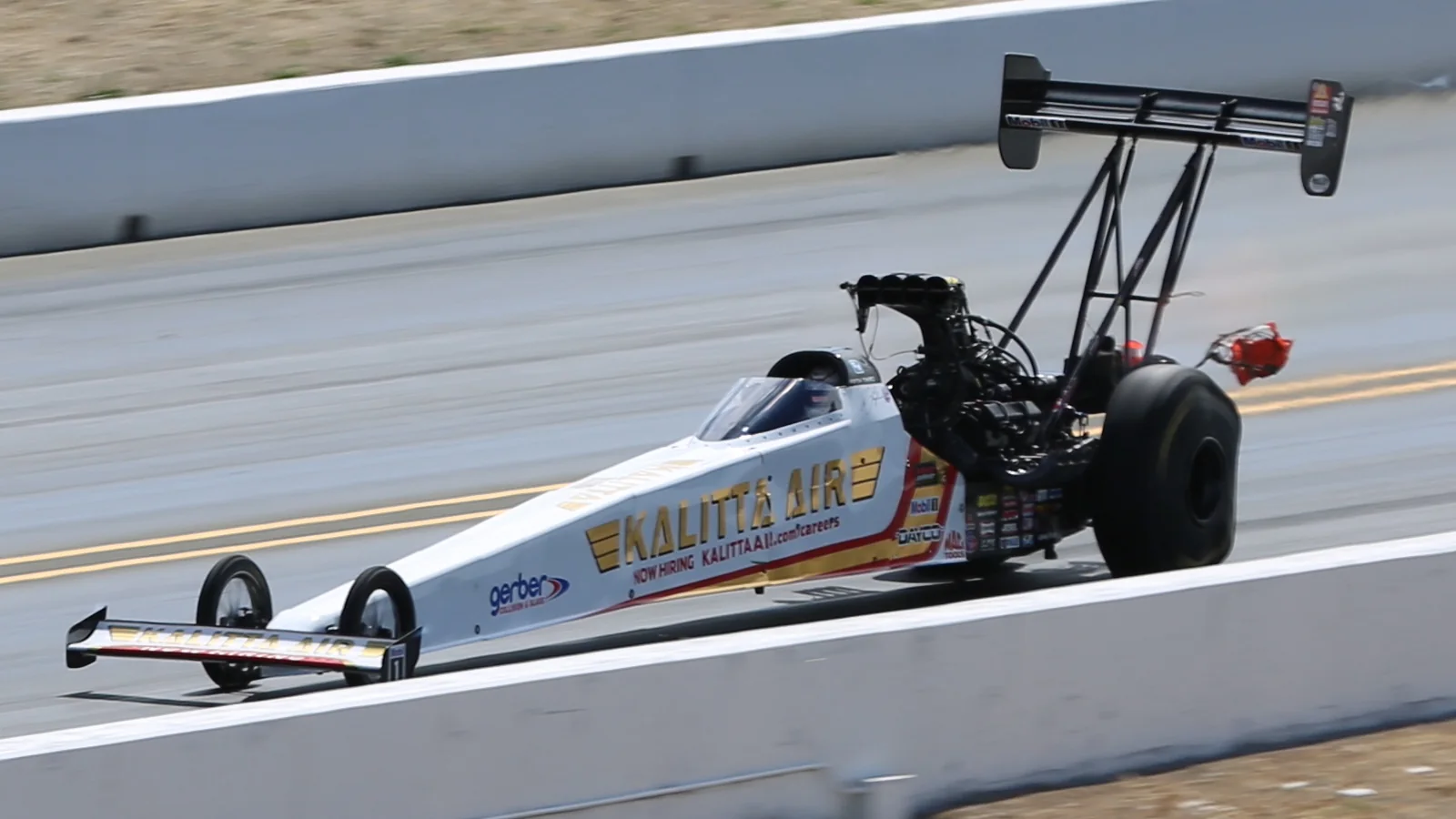
Langdon's Kalitta Air dragster at Sonoma in July 2026. Two months later it ran 346.95 mph at Martin, Michigan, and he said "it just goes to show it takes everything" (NHRA). Photo: TaurusEmerald, CC BY-SA 4.0, cropped.

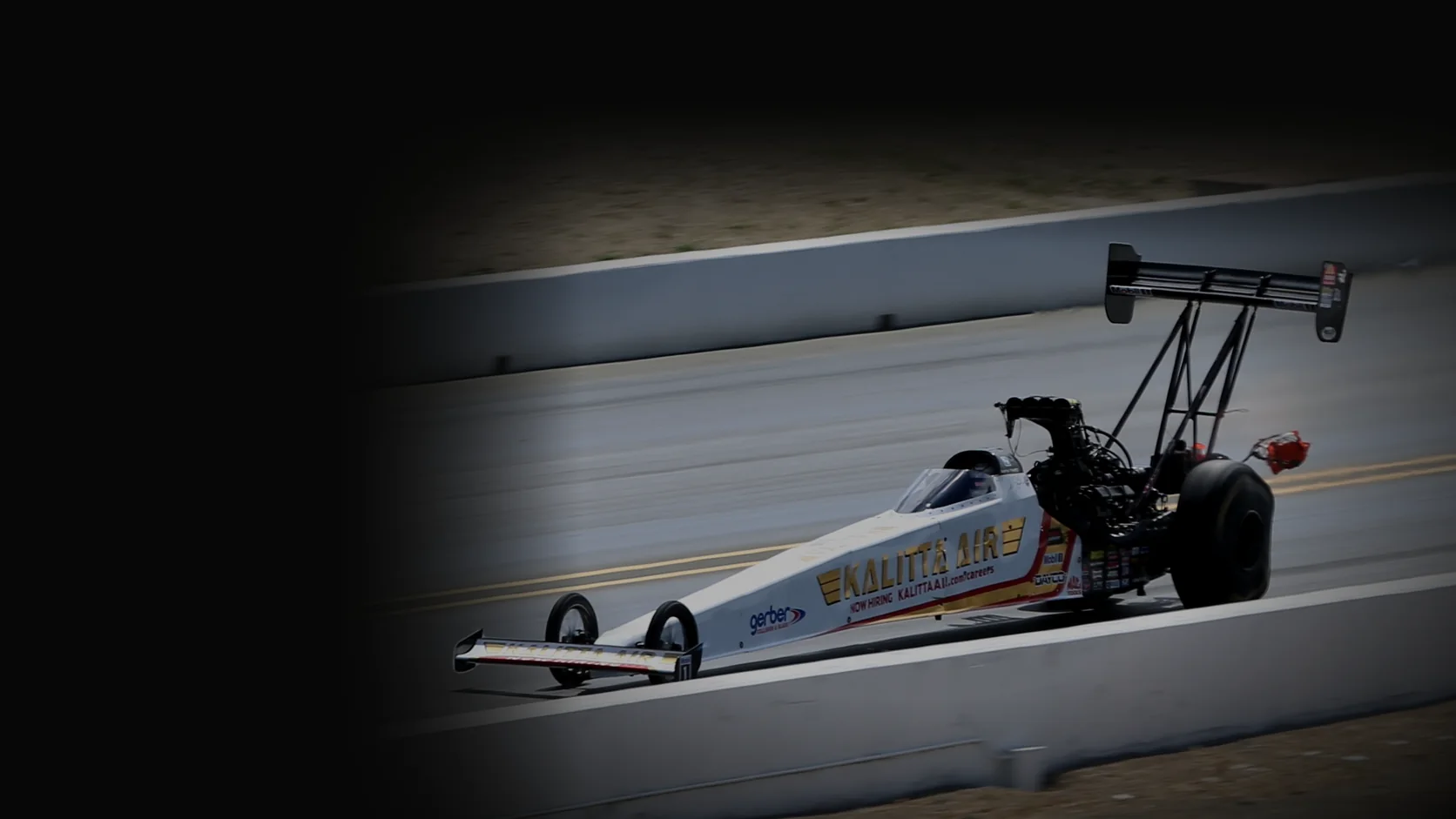
346.95 mph in 1,000 feet, the NHRA record since September 21, 2026. About 11,000 horsepower that no dyno can measure.
Photo: Shawn Langdon's car at Sonoma, 2026, by TaurusEmerald, CC BY-SA 4.0, cropped and darkened.
A Top Fuel dragster covers 1,000 feet in as little as 3.623 seconds verified, Brittany Force's NHRA national record from September 14, 2019, and reaches 346.95 mph verified, Shawn Langdon's record from September 21, 2026 (NHRA records). It passes 60 mph in about 0.5 seconds derived, worked out from a 0.816 s 60-foot time; nobody times 0-60 at an NHRA race.
Top Fuel hasn't raced a quarter mile since 2008, when NHRA cut nitro races to 1,000 feet after Scott Kalitta's fatal crash (ESPN). The last quarter-mile record was Tony Schumacher's 4.428 s at 327.98 mph in 2006 verified (Dragzine), and our race uses 4.42 s at 328 mph from that era. A 2026 car run to 1,320 feet would probably need about 4.26 s derived, but none races that far. NHRA calls them 11,000-horsepower cars, a figure that can only be an estimate because no dynamometer can hold one (NHRA).
Not the way you buy anything else in our race. Every other car is a model someone builds and sells; Top Fuel is a class: a set of NHRA rules that specialist chassis shops build to and race teams run. NHRA's own description is a 25-foot chromoly-and-carbon car weighing 2,330 pounds race-ready, with a supercharged 500-cubic-inch Hemi-based V-8 (NHRA).
Every figure carries its label. claimed means a team, engine builder or other maker said it. verified means an official body, here NHRA records and rules or Guinness. recorded is timed on an actual run: an instrumented test, a certified or verified record run, or a maker's own pass on a drag strip's timing system; records NHRA or Guinness list are verified. reported is press we couldn't trace to a primary source. derived is our math. estimate is modeled for our race because no published figure exists. Here's how we label numbers.
Each bar fills at the real speed of that car's 0-60 time, from the race's lineup. The dragster's 0.5 s is our arithmetic, not a timed figure; the others are makers' claims or timed runs.
Funny Car driver Scott Kalitta was killed in a qualifying crash at Englishtown, New Jersey, on June 21, 2008. Within weeks NHRA announced that Top Fuel and Funny Car would race to 1,000 feet "instead of the traditional 1,320-foot quarter mile," starting in Denver that July, as "an interim step" (SEMA eNews). It never went back. The cars still pass 330 mph; they just have 320 more feet to stop.
That makes old and new records hard to compare. Schumacher's 4.428 s quarter passed the 1,000-foot mark in 3.759 s reported; Force's record run did it in 3.623. Based on Force's 1,000-foot record, a 2026 car would need roughly 4.26 to 4.29 s for a full quarter derived, our estimate. Del Worsham, then a Funny Car driver, warned in 2008 that drivers would have to relearn where to lift: "You can't just look around at 290 or 300 mph, wondering where you are" (SEMA eNews).
The first two slides are real photos, the third a real photo cut out onto our studio background. The hero above is the first photo, cropped and darkened.
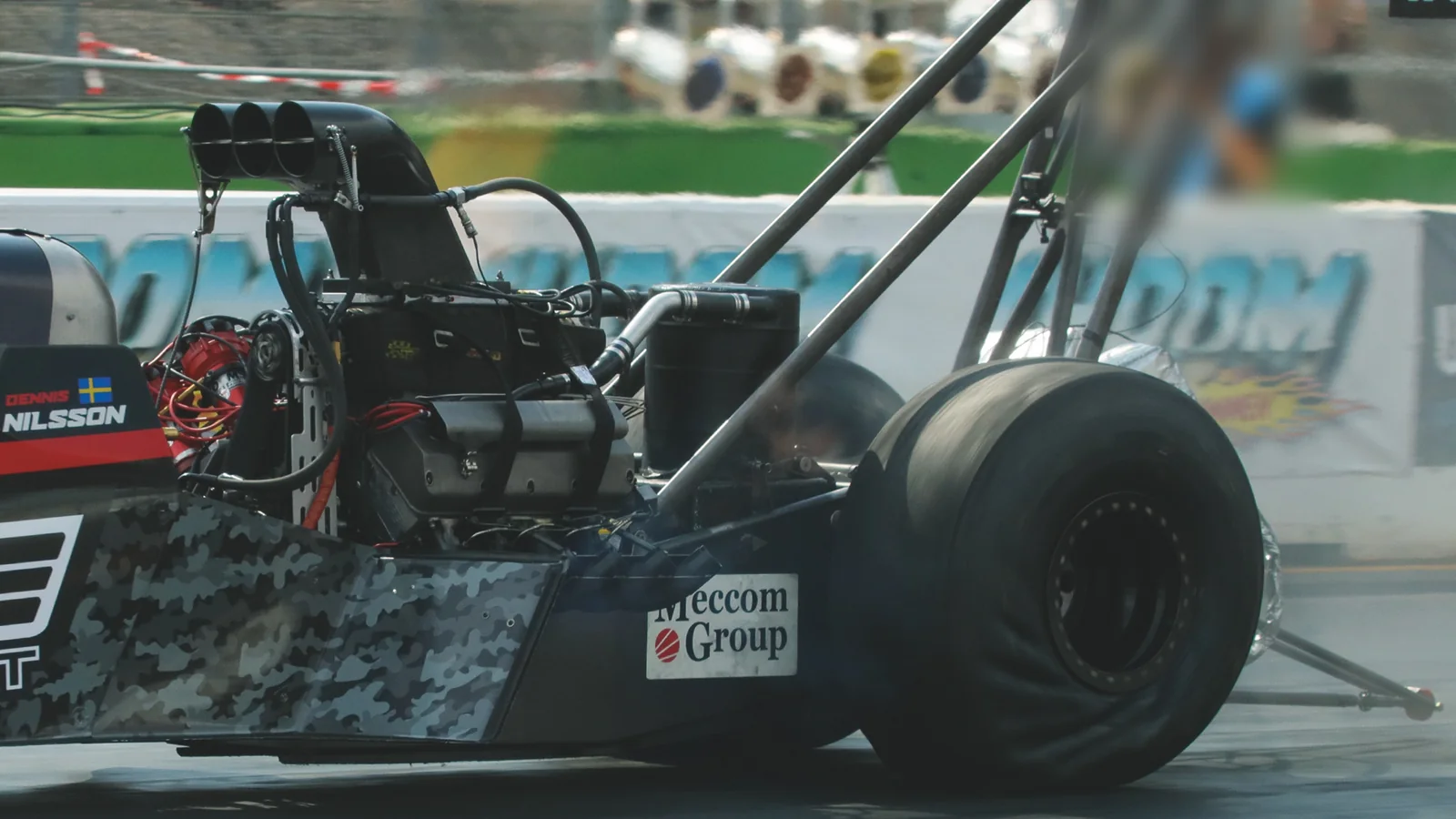
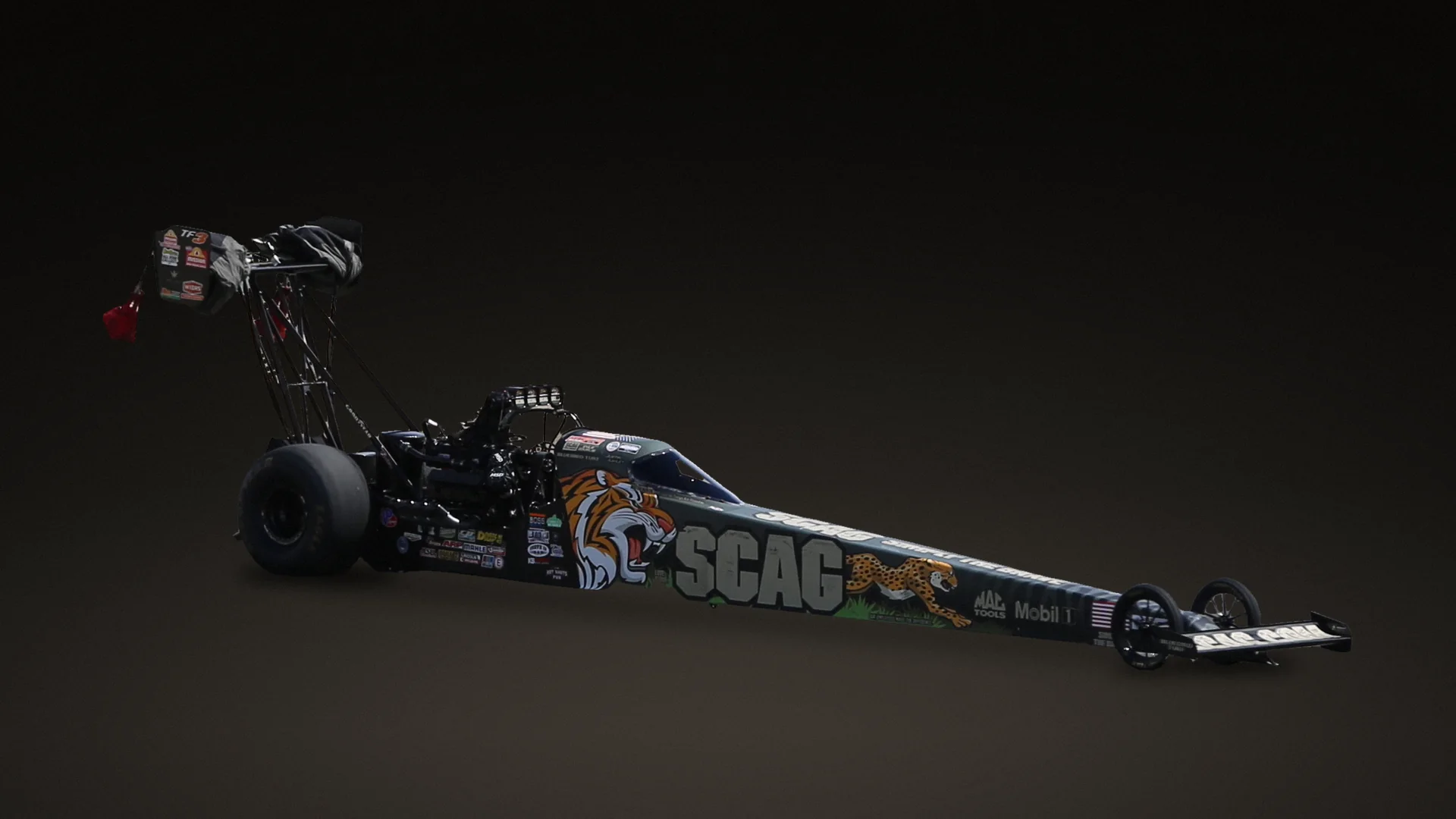
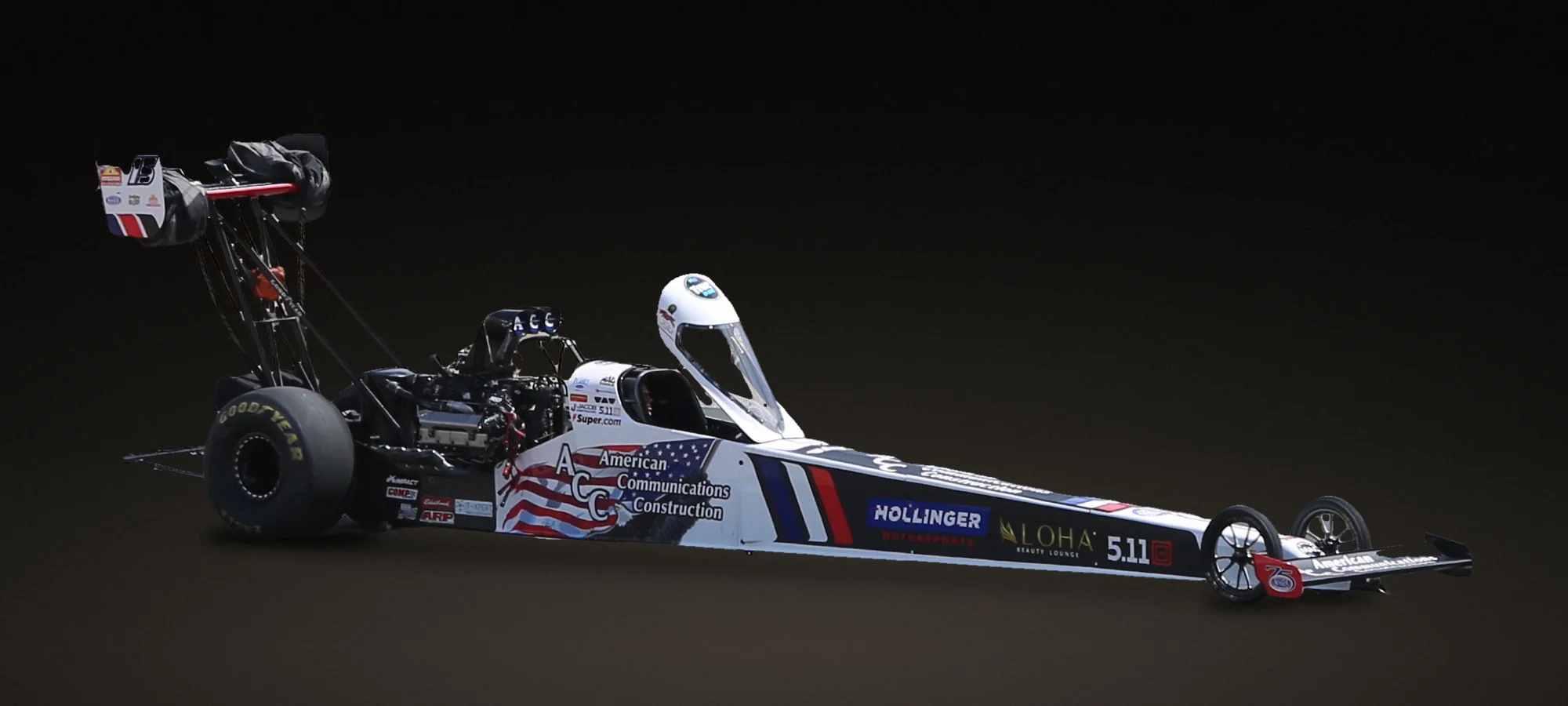
Tap a marker. The picture is Tony Schumacher's 2026 car, cut out from a photo by TaurusEmerald (CC BY-SA 4.0). Figures are reported unless marked otherwise.
Mounted high and behind the rear axle, it presses the slicks down with something like 12,000 pounds of force near 330 mph. The exhaust pipes, aimed up and back, add roughly another 1,000.
Packed on the wing struts and fired past the finish line. They do most of the stopping from well over 300 mph, before the brakes take over. Drivers describe the hit at several negative g.
A 14-71 Roots supercharger, belt-driven, needs about 1,000 hp to turn. A Kevlar blanket must cover it and a burst panel vents the manifold, because a backfire can split it. The hat on top feeds it air.
The driver sits ahead of the engine inside a roll cage, here with the canopy lifted. NHRA allowed enclosed canopies for regular use from 2012.
Goodyear rear tires about 36 inches tall and 17 wide, run at very low pressure so they wrinkle and grow at launch. The Drive reports they last about a mile and a half.
Spoked front wheels and skinny tires, with a small front wing ahead of them. At launch they carry almost no weight; the wheelie bar at the back keeps the nose from rising too far.
Our quarter-mile model needs a quarter-mile figure, and Top Fuel stopped producing them in 2008. So the race uses 4.42 s at 328 mph, the best of the last quarter-mile years: Doug Kalitta's 4.420 at 328.22 mph at Joliet in 2004, the quickest quarter-mile Top Fuel run ever but never a record, and Schumacher's national record of 4.428 at 327.98 at Pomona in 2006 (Dragzine). That's why the dragster wins our race by almost three seconds, and why its number is older than any other car's.
Speeds at 1,000 feet now beat the quarter-mile era: Langdon's 346.95 at 1,000 feet beats every quarter-mile speed ever run, including Dom Lagana's 338.35 mph over a full quarter at the same Michigan track in 2017, outside NHRA national-event rules (Dragzine). Asked about 350 mph, The Drive's Caleb Jacobs wrote that he imagines "today's cars could do it if they were allowed to run a full quarter-mile" (The Drive).
The fuel brings its own oxygen. Gasoline needs about 14.7 parts air to one part fuel; nitromethane needs about 1.7, so the engine can burn several times more fuel per breath. NHRA caps the blend at 90% nitro (NHRA), and a car burns up to 15 gallons a run (NHRA).
Nobody can put it on a dyno. "There's not a dynamometer in the world that can handle the high-horsepower output of a nitro-burning Top Fuel or Funny Car engine," NHRA wrote (NHRA). Estimates climbed from 2,000 hp in the 1970s to 8,000 in the 1990s. In 2015 crew chief Mike Green and AVL fitted a torque sensor between the clutch and the rear end of Schumacher's car and calculated a peak of 11,051 hp reported (EngineLabs). That's why every horsepower figure on this page is an estimate.
The clutch is the gearbox. There's one gear. A centrifugal clutch of six discs and five steel floaters slips on purpose, clamping harder as weighted levers spin up and timers step in, until it locks near the top end. It spikes to 3,700°F in the first tenths of a second. "Too soon and you might smoke the tires, too late and you might lose the weekend on a soft hit," Hot Rod wrote of the tuning (Hot Rod).
Then they take it apart. After every run the crew strips the engine, replaces worn parts and clutch discs, and rebuilds it before the next round. NHRA gave teams 75 minutes between rounds in 2006 (Hot Rod). Hagerty put a single pass at "upwards of $10,000 per run, and that's if the car stays in one piece" (Hagerty), and Speed Sport put a first-class nitro team at $3 million to $4 million a year (Speed Sport) reported.
The last quarter-mile year, the 1,000-foot cars of 2026, and the figures our race uses.
The last full seasons before the cut, and the record our race borrows.
NHRA cut nitro to 85% after Darrell Russell's fatal 2004 crash (Autoweek) and returned to 90% in 2008 (Wikipedia) reported.
Shorter track, quicker cars, and a speed record set five weeks ago.
Records verified (NHRA); power an estimate.
A quarter-mile model needs quarter-mile numbers, so it uses the 2004 to 2006 runs.
0-60 derived; quarter mile recorded. See the methodology guide.
Sixty-two years of speed barriers, one distance change, and a record chase still going. Scroll sideways.
Don Garlits makes NHRA's first official 200-mph run reported.
Garlits's rear-engine Swamp Rat XIV wins the Winternationals and the front-engine car fades out.
Kenny Bernstein makes the first 300-mph run, at the Gatornationals.
Doug Kalitta runs the quickest quarter mile ever at Joliet, but it never becomes the national record (Dragzine).
Tony Schumacher's quarter-mile speed, never beaten at an NHRA national event.
Schumacher needs a record to win the title and runs 4.428 s at Pomona verified.
The Funny Car driver is killed in a qualifying crash at Englishtown.
Top Fuel and Funny Car race the shorter distance from Denver on, for good.
Brittany Force sets the e.t. record in qualifying at Reading. It still stands.
Force makes the first 340-mph Top Fuel run reported.
Force jumps straight past 342. She steps away from driving after the season.
Shawn Langdon takes the speed record in the Kalitta Air car.
Langdon resets it at Martin, Michigan, backs it up at 346.15 and wins the event verified.
Antron Brown beats Langdon in the Texas FallNationals semifinal, ending his four-race win streak. Langdon still leads Doug Kalitta by 139 points, with Las Vegas and Pomona to go (NHRA).
Four running arguments in Top Fuel, quoted with links.
"It just goes to show it takes everything."Shawn Langdon, 2026, NHRA
Langdon credited the U.S. 131 track and his crew chief, Brian Husen. NHRA counted all four of his elimination runs at 342 mph or faster.
"We've run great mph lately, but our goal is always elapsed time, not mph."Brittany Force, 2025, NHRA
She said it right after setting the speed record at 343.16. Races are won on e.t., and her 3.623 s from 2019 still hasn't been beaten.
"You can't just look around at 290 or 300 mph, wondering where you are."Del Worsham, 2008, SEMA eNews
The 1,000-foot rule was announced as interim. Eighteen years on, writers still wonder what a modern car would run over the full distance.
"A nitro pass can cost upwards of $10,000 per run, and that's if the car stays in one piece."Hagerty, 2018, Hagerty
Speed Sport put a first-class nitro team at $3 million to $4 million a year, a fraction of a NASCAR or IndyCar budget but a lot of money for under four seconds a run.
The consensus: nothing with wheels accelerates harder, and nobody argues about the records, which NHRA timed and backed up. The arguments are about everything that can't be timed: horsepower that no dyno can confirm, a 0-60 that's arithmetic, and what these cars would run over the quarter mile they gave up in 2008.

NHRA · Sep 21, 2026 · 0:25

NHRA · Sep 21, 2026 · 1:20

NHRA · Sep 14, 2019 · 0:39

NHRA · Jul 25, 2025 · 0:38

NHRA · Oct 28, 2014 · 3:16

NHRA · Feb 24, 2026 · 1:52

Engineering Explained · May 6, 2015 · 3:58

Hagerty · Sep 12, 2018 · 7:32

Car and Driver · Jul 10, 2012 · 13:49

Goodyear · Jul 10, 2020 · 1:01

NHRA · Oct 5, 2016 · 0:16
Doug Kalitta's 4.420 s in 2004 beat Schumacher's record 4.428 s but never became the national record, which needs a backup run within 1% at the same event.
Schumacher had to win the 2006 Pomona final and set the e.t. record to take the championship. He did both on the last run of the season.
U.S. 131 in Martin, Michigan, saw Lagana's 338.35 mph over a full quarter in 2017 and Langdon's 346.95 at 1,000 feet in 2026.
Turning the 14-71 supercharger takes roughly as much power as a Demon 170 makes in total, before any reaches the tires.
The discs spike to 3,700°F in the first tenths of a run. Crews throw out the steel floaters every time because the heat leaves them brittle.
NHRA bans real-time computer control of ignition, so crews program timer steps before the run and live with the result.
Force's 3.623 s from 2019 is the oldest of NHRA's pro e.t. records except Funny Car's 3.793 from 2017, even as speeds kept rising.
At 73, Bernie Plourd earned his NHRA Top Fuel license in September 2026, possibly the oldest first-time Top Fuel licensee, and planned his debut at Las Vegas.
The mph on the scoreboard is an average over the last 66 feet before the line, not a peak. Cars are still accelerating as they cross.
In our quarter-mile model the Top Fuel dragster finishes first of 21, nearly three seconds ahead of the next car. Nothing is quicker, so here are the next two cars:
About half a second. NHRA doesn't time 0 to 60, so that figure is our arithmetic from Brittany Force's record run, which reached 60 feet in 0.816 seconds.
The last NHRA quarter-mile record was 4.428 seconds at 327.98 mph, set by Tony Schumacher at Pomona in November 2006. Doug Kalitta ran a quicker 4.420 seconds at 328.22 mph at Joliet in 2004, but it never became a record. The fastest quarter-mile speed at an NHRA national event was Schumacher's 337.58 mph at Brainerd in 2005. Top Fuel has raced 1,000 feet since July 2008.
NHRA shortened Top Fuel and Funny Car races from 1,320 feet to 1,000 feet in July 2008, starting at the Denver event, after Funny Car driver Scott Kalitta was killed in a crash at Englishtown on June 21, 2008. It was announced as an interim safety step and became permanent. The cars still pass 330 mph, with more shutdown room left.
NHRA describes them as 11,000-horsepower cars, but that is an estimate. No dynamometer can hold a nitro engine at full power, so the number comes from calculations and from a torque sensor between the clutch and the rear end, which logged a peak of 11,051 horsepower on Tony Schumacher's car in 2015.
Hagerty put it at upwards of $10,000 per run if nothing breaks. The engine is torn down and rebuilt between rounds and the clutch discs are replaced. Speed Sport reported that a first-class nitro team costs about $3 million to $4 million a year to run.
Not as a car you could drive on the road. Top Fuel is a class built to NHRA rules by specialist chassis shops and run by race teams, and the cars have no lights, plates or onboard starter. You can buy a team's equipment: in October 2026 three-time champion Larry Dixon Jr. listed his complete Top Fuel operation, with a Hadman dragster, spare engine parts, a truck and a 56-foot trailer, for $595,000. Racing it also takes an NHRA Top Fuel license earned through observed licensing runs.
Labels. Claimed: a team, engine builder or other maker said it. Recorded: timed on an actual run: an instrumented test, a certified or verified record run, or a maker's own pass on a drag strip's timing system; here, a named driver's run at a named event. Verified: an official body lists or confirms it, here NHRA national records and rules, or Guinness. Reported: press we couldn't trace to a primary source. Derived: our arithmetic from published data. Estimate: modeled for our race because no published figure exists. Both are explained in the methodology guide. NHRA clocks don't start until the front tire leaves the stage beam, after the car has already rolled about a foot, so like every drag-strip number they leave that rollout out. Our 0-60 is worked out from the same clock, so it leaves it out too. The race lineup and all other cars are in the cars hub. Sources disagree in three places: NHRA's records table lists Force's 3.623 at "Brownsburg, IN," though every race report places it at Reading, Pennsylvania; Dragzine gives that run's speed as 332.92 mph where RACER, the Reading Eagle and Guinness give 331.61; and NHRA's video titles Langdon's run 346.96 where its record table says 346.95. We use Reading, 331.61 and 346.95.
Images. Studio side view: Tony Schumacher's 2026 car from a photo by TaurusEmerald; carousel and closing studio view: Justin Ashley's 2026 car from a photo by TaurusEmerald; both cut out onto our dark background. Hero and first carousel slide: Shawn Langdon's car in a photo by TaurusEmerald; the slide is cropped, and the hero is cropped, darkened and faded into a dark background on the left. Engine photo: Auge=mit, cropped, color converted, a photographer blurred. All four are CC BY-SA 4.0, and our edits are shared under the same license. Team liveries and sponsor names appear because they're on the cars; none of these teams or sponsors is involved with this page.