
On November 12, the Interactive Advertising Bureau published the first shared answer to the question AI attribution has been dodging all year: who gets credit when an AI shapes or completes a purchase? The AI-Era Attribution Blueprint sorts every sale into one of three buckets, Human-Owned, AI-Assisted, or AI-Executed, and then draws the line the whole industry has been avoiding. A claim is not credit. It is the right to be evaluated for credit, and only with the evidence the sale requires.
The numbers behind the release explain why it landed now. In the IAB's September outlook study, 45 percent of ad buyers named comparing AI-driven and traditional customer journeys their top measurement challenge, and 44 percent said they rely on branded search and direct traffic as stand-ins for AI influence they cannot track. Put plainly, nearly half the industry is grading AI with numbers that belong to other channels.
That proxy habit is the problem the blueprint exists to fix. Pew Research Center tracked 900 American adults in March 2025 and found people clicked a traditional result on 8 percent of visits when a Google AI summary appeared, against 15 percent without one. Links inside the summary drew a click on about 1 percent of visits. Ziff Davis told investors this month that organic Google referrals fell about 37 percent year over year. And 61 million Americans, 23 percent of the country, now name AI as their main starting point when researching a retail purchase. The click did not just get thinner. The journey it used to prove moved somewhere the dashboard cannot see.
I wrote in June that AI Overviews were draining attribution by answering the question before the click ever happened. That diagnosis still holds. What changed on November 12 is that the industry stopped describing the problem and started naming the replacement.
The Click Stopped Being Proof
Attribution worked for twenty years because the click was a receipt. Someone searched, clicked, landed, bought, and the dashboard took a bow. AI answers broke the chain at the second link. The search still happens. Your content still supplies the answer. The visit never happens, and the receipt never prints.
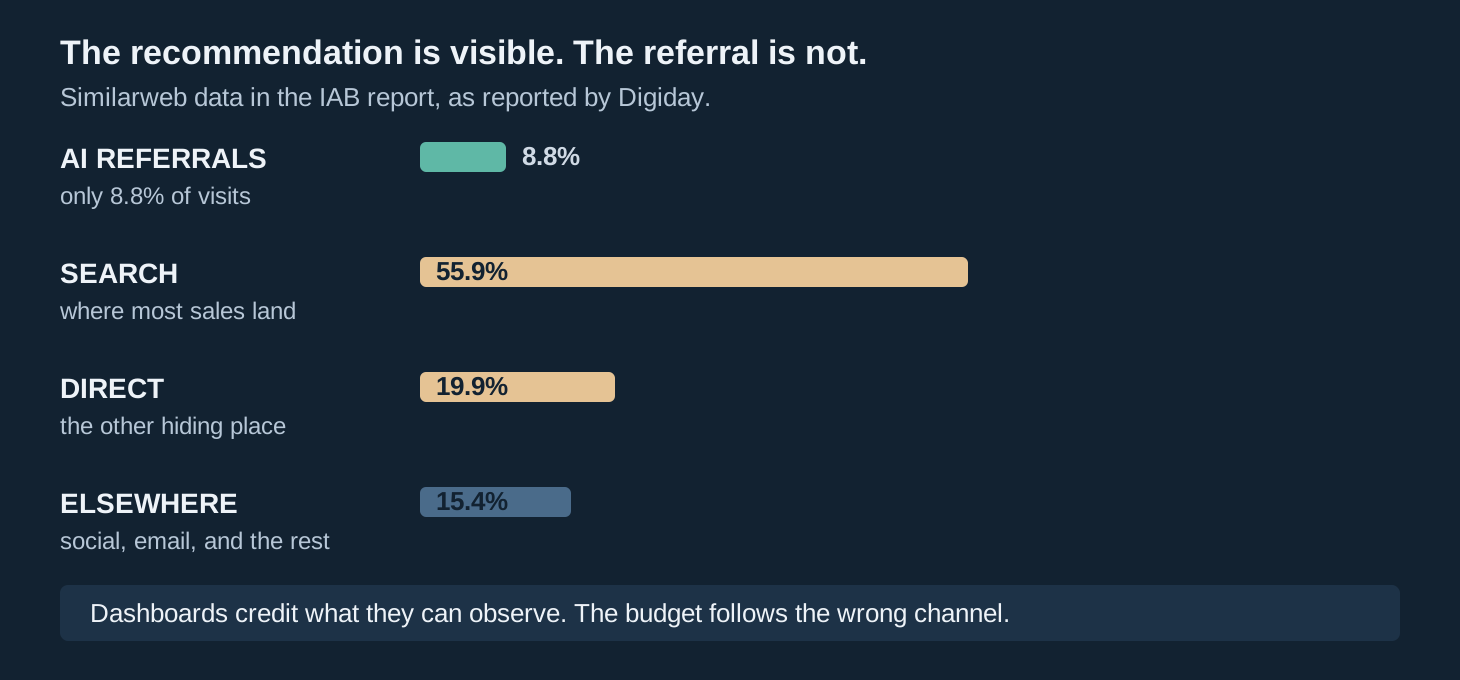
The sale does not vanish. It arrives wearing the wrong uniform. Similarweb data inside the IAB report, as Digiday reported, shows only 8.8 percent of visits after an AI brand recommendation arrive as AI referrals. The rest land as search, 55.9 percent, or direct, 19.9 percent. Your analytics sees a healthy search channel. What it is actually seeing is AI influence dressed up as the channels you already fund.
The IAB says it straight in the release. AI-influenced sales are sometimes reported as search or direct traffic, which can send the next marketing investment to the wrong channel. That sentence is the whole blueprint in one line. The danger is not that AI sales go uncounted. The danger is that they get counted for someone else, and the budget follows the wrong name.
The first platform-side numbers back it up. Search Engine Journal claimed its business in OpenAI's Business Hub and reported 353,356 mentions and 2,663 website clicks between October 14 and November 10, a click rate near 0.75 percent. The gap is not a rounding error. It is the new shape of demand, visible for the first time because a platform finally showed its own count.
That gap is why winning a citation is not the same as winning the customer. A citation puts your name in the answer. A click means the answer left something unsolved that only your site can finish.
Three Buckets for Every Sale
The blueprint starts with three questions at the point of conversion. Who or what created the intent? Who or what made the decision? Who or what completed the purchase? The answers sort the sale into one of three pathways.
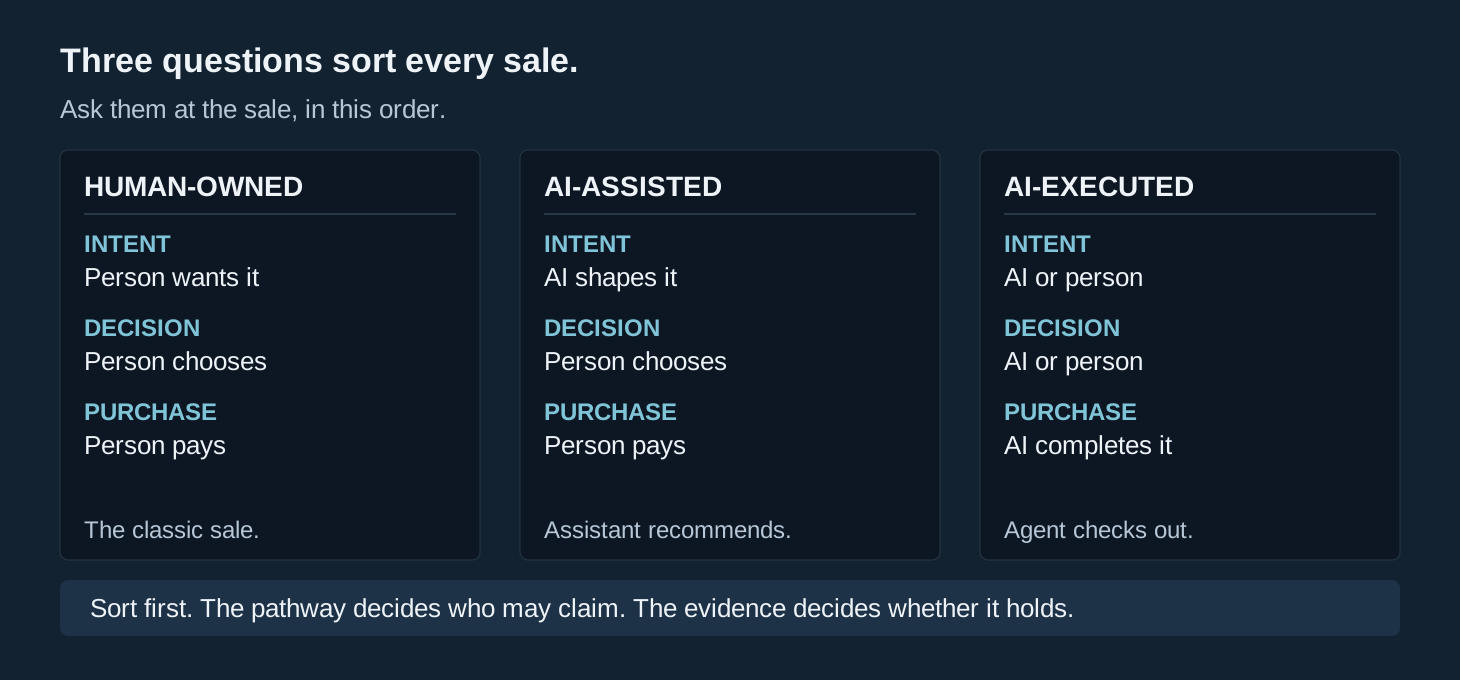
Human-Owned is the sale as it used to work. A person creates the intent, makes the decision, and completes the purchase. AI may have been present in the room, but it did not shape the intent or the final choice. If AI did not contribute to either, the blueprint records no new AI claim at all.
AI-Assisted is where most AI influence lives today. AI helps shape the journey, but the human still makes the final decision. Someone asks an assistant for the best running shoes for flat feet and buys one of the named shoes a day later. The assistant shaped the shortlist. The person chose. The sale belongs in this bucket, and the assistant's role is real but partial.
AI-Executed is the bucket that changes the argument. AI completes the transaction, whether or not a human made the underlying decision. An agent that reorders your usual coffee or checks out with the card on file is executing. The purchase happened because software finished it. Who decided is a separate question, and the blueprint keeps it separate on purpose.
Classification comes before credit. That order is the discipline most teams skip. They argue about who deserves the sale before sorting a single one. The blueprint refuses that argument. Sort first. The pathway decides who is even eligible to make a claim, and the evidence decides whether that claim holds.
A Claim Is Not Credit
Two kinds of claim exist in the blueprint, and the difference is deciding versus helping. A decision claim belongs to the party that influenced or made the purchase decision. A contributory claim belongs to a party that helped shape the outcome without deciding. The pathway decides which kind each party may make. The evidence decides whether it can be substantiated.
The blueprint's clearest test is a bag of dog food. An agent reordering the dog food a consumer already selected is performing a service. Execution alone earns no claim. An agent choosing which dog food to buy may qualify for a decision claim, while publishers whose reviews informed that choice may qualify for contributory claims.
The publisher example is where this gets uncomfortable. Someone asks an answer engine for the best product in a category. The answer draws on a publisher's review. The reader never clicks the citation and buys from the retailer, which records a search or direct sale. The report's line, via Digiday: the review shaped the sale, and the publisher is eligible for a contributory claim.
Then comes the honest part, in the report's own words: until that link exists, the contributory claim cannot be fully substantiated. Content used in training is generally not traceable from outside the model. A citation is more observable, but a citation alone does not show how much the content influenced the answer. Publishers have a right to be evaluated and no way yet to pass the evaluation. As Bombora's Jaime Schultheis put it, publishers are feeding the answers but they do not have the receipts.
That gap is why the blueprint reads like a call to action instead of a standard. It asks AI platforms to disclose whether recommendations are paid or organic and what sources informed them, and to label AI-originated traffic consistently. It asks agencies to apply one claim and evidence standard across platforms, and to separate platform-reported claims from independently verified ones. A number a platform reports about itself is not the same as a number an independent check confirms.

The honest shrug inside the framework is its strength. Most industry documents pretend the data exists. This one says plainly that much of it does not, and invites the ecosystem to help make AI's role in commerce more observable, verifiable, and measurable.
Sort Your Own Sales This Week
The blueprint is useful the moment you stop reading it as industry news and start using it as a worksheet. The IAB's own call to action for brands is to estimate the share of conversions in each pathway. That takes an afternoon, not a vendor.
Take your last 30 days of conversions and ask the three questions about each one. Who created the intent, who made the decision, who completed the purchase? Sort them into Human-Owned, AI-Assisted, and AI-Executed. You will not get a perfect split. You will get a shape, and the shape is the point. If a quarter of your sales are AI-Assisted and your reports show none of them, your measurement is not slightly off. It is describing a different business than the one you run.

Next, for the AI-Assisted and AI-Executed share, write down the claim each party could make and the evidence you actually hold. If the evidence is a GA4 report that says direct, you hold no evidence. Direct is where AI influence goes to hide. If the evidence is a ChatGPT Business Hub count over 28 days, you hold a start, but the Hub keeps no history, so write the numbers down yourself.
Then run the budget test. If your AI-Assisted share is growing while your search budget is justified by search-attributed sales, you are funding the wrong channel. The money is not following the influence. It is following the receipt. The measurement reset I wrote in August makes the same point from the other side: build the system backward from the decision, not forward from whatever a platform happens to report.
One more habit belongs on the list. Stop letting a single count stand for progress. Share of model is the same trap in a different costume. A count of how often the model says your name feels like momentum, but only if the next number moves with it. The blueprint sorts the sale first and asks about credit second. Do the same with your own reporting: the pathway, then the claim, then the evidence. Never the count alone.
The audit trap I wrote in July warned that rebuilds fail when teams measure what they can instead of what matters. The blueprint is the industry's answer to that trap, a shared standard for what counts as a claim and what counts as proof.
What to Watch Next
Three things will decide how far this goes, and all three are already moving.
Platforms owe the disclosure first. The blueprint asks them to say whether a recommendation was paid or organic, name the sources that informed it, and label AI-originated traffic the same way everywhere. Until that happens, every AI claim is an argument without an exhibit. Watch for the first platform that discloses paid placement inside its answers.
The second is the calendar. Google owes UK publishers click data for its AI search features by December 3, under the competition authority's requirement. Trade Desk chief Jeff Green is also teasing an open measurement product for later this quarter, built on the argument that last-click directs budgets toward platforms that capture purchases while undervaluing the advertising that creates demand. And eMarketer forecasts agentic media transactions past 5 billion dollars in 2027, reaching 10 percent of US programmatic display spending by 2028. The AI-Executed bucket is about to get much bigger, and the money moving through it will need claims attached.
The third is measurement hygiene. Google's November core update started November 10 and runs about two weeks. Google also made Gemini 4 Hydrogen the default model in AI Mode on November 12. And Google confirmed a November 9 to 11 logging error that understated impressions in the Search Console Generative AI performance report. Do not judge any ranking, citation, or AI visibility number on this window. Log the dates and compare the week after the rollout against the week before it started.
The blueprint does not settle who gets paid. It settles what the argument is about. Start sorting your sales into its three buckets now, and the next budget meeting stops being a fight over a dashboard and starts being a decision about evidence.