
The Silent Killer of AI Agent Economics
The economics of AI agents have a hidden problem: token cost per request. A well-architected agent with a 5,000-token system prompt, access to 20 tools, retrieval context, and conversation history runs at scale only if you cache aggressively.
Anthropic's prompt caching feature lets you cache expensive prefill tokens and reuse them across requests. The cost difference is brutal. One brand using Claude without caching pays $3 per million input tokens. With caching, cached tokens cost $0.30 per million. That is a 90% reduction.
At scale, this difference determines who wins the AI marketing race and who goes broke trying. The brands building this infrastructure now will own the 2026-2027 advantage.
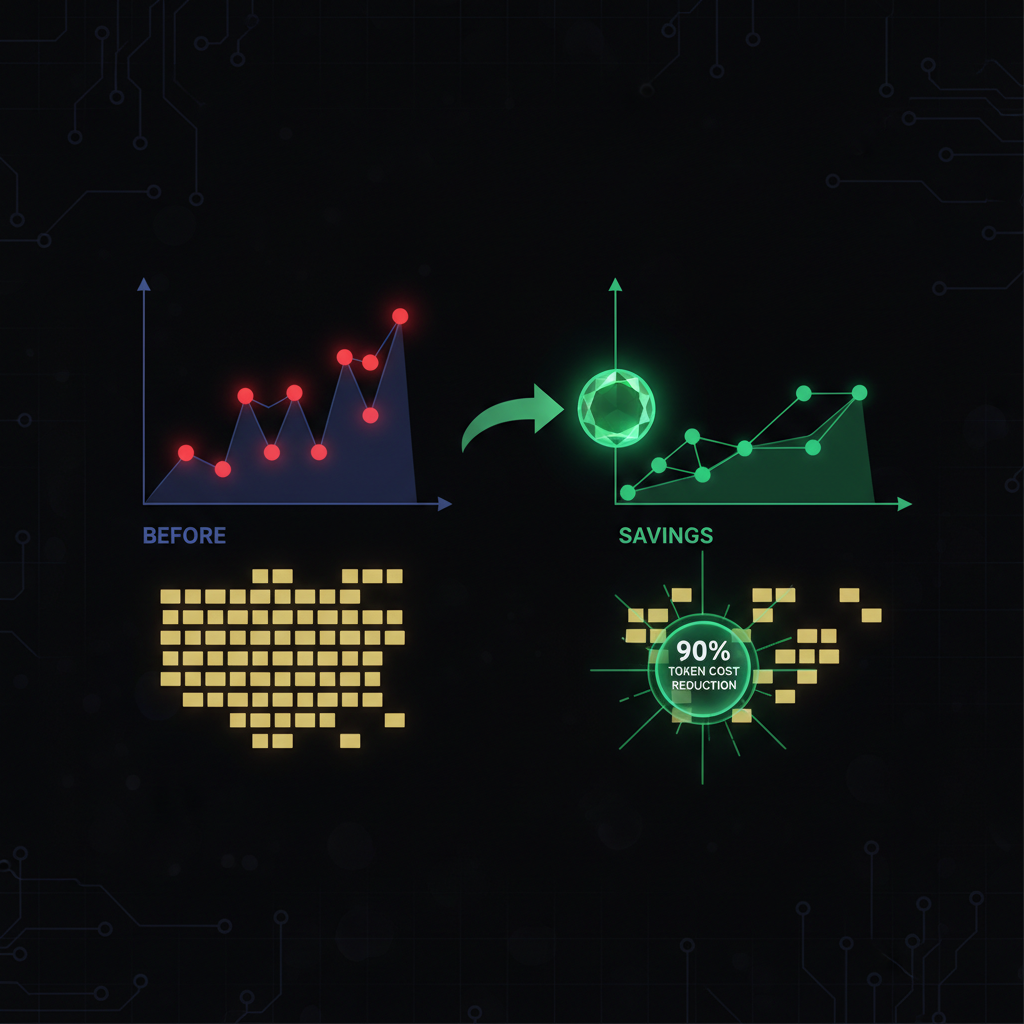
The Token Economics Problem
Every AI agent call has a fixed cost structure. Your system prompt (the instruction set that defines how the agent behaves) gets tokenized, sent to the model, and processed. Your tool definitions get tokenized. Your retrieval context gets tokenized. Your user input gets tokenized. The model generates a response, and you pay for every output token.
The problem is the prefill. If your system prompt is 2,000 tokens, your tool definitions are 1,500 tokens, and your retrieval context is 1,500 tokens, that is 5,000 tokens of pure overhead on every single request. At $3 per million tokens, that is a fraction of a cent per request. But run 1 million requests per month? That is $15,000 in pure overhead.
The math at enterprise scale
10 million requests monthly without caching: $150,000 in wasted prefill costs alone.
Prompt caching solves this by allowing you to cache prompt blocks. If you send the same system prompt, tool definitions, and retrieval context in request one and request two, the second request resumes from the cached state instead of reprocessing everything. The first request pays full prefill cost. Requests two through one million pay 90% less. For marketing teams running AI agents at scale, this is not a nice-to-have. It is the difference between viable unit economics and a product that hemorrhages money.
Where the Cache Hits Happen
Prompt caching works best when you have consistent system prompts, consistent tool definitions, and consistent retrieval contexts. That is the reality of every well-built marketing agent.
Take a customer support AI agent that handles inbound inquiries. The system prompt defines tone, values, and escalation rules. The tool definitions include access to the CRM, knowledge base, ticket system, and billing APIs. The retrieval context includes product documentation, pricing, compliance policies, and FAQs. This prefill context stays identical across thousands of customer inquiries.
Prompt caching says: cache that prefix on day one. Every customer inquiry after that reuses the cached context. The first customer query pays full prefill. The next 999 queries pay 90% less on that identical prefix.
HIGH-VOLUME AGENT EXAMPLES
- ● Content generation: Product descriptions across 5,000 SKUs monthly. Cost per description drops 80-90% with caching.
- ● Paid search: Ad copy optimization across 50,000 variants monthly. Same system prompt and tools, only variant data changes.
- ● Email campaigns: Personalization across 100,000 prospects. Cache hit rates of 85-95% depending on your request cadence.

Why Most Teams Are Not Building for Cache
Prompt caching is relatively new. Anthropic rolled it out in late 2024, OpenAI followed, and by mid-2026 it is becoming table stakes. But adoption among marketing and product teams is still low. Most teams treat caching as a nice bonus rather than a core architecture decision.
The teams that are building for cache are seeing cost reductions that translate directly to margin. They are running more agents, more frequently, at lower cost per request. The teams that are not are burning through budgets on redundant prefill processing.
There is also a psychological barrier. The cost savings feel small on a per-request basis. You are saving fractions of a cent. But multiply by millions of requests and it compounds. A team running 10 million AI agent requests monthly without caching spends $30,000 on prefill alone. With caching, that drops to $3,000. That is $27,000 per month in pure savings. On a $5 million annual marketing budget, that is margin recovery worth fighting for.
How to Build Cache Into Your Agent Stack
1. Identify Static Contexts
System prompts, tool definitions, and retrieval context that do not change between requests are cache candidates. Segment your agents by which prefix blocks stay constant.
2. Organize for Caching
Split your system instructions into cacheable blocks. The portion defining tone and brand voice is static. The portion changing based on customer segment is not. Cache what you can.
3. Benchmark Before and After
Measure current API costs, latency, and cache hit rates. After implementation, input token costs drop 60-90% on cached portions and latency drops 20-80%.
4. Plan for TTL
Claude caches blocks for 5 minutes by default. If requests come faster than 5 minutes, you maintain cache hits. Understand your request cadence and plan accordingly.
5. Monitor Cache Hit Rates
Track what percentage of requests hit the cache. If below 70%, your architecture is not optimized. If above 90%, you have built a moat.
The Structural Advantage
Brands that implement prompt caching early will have a cost advantage that is hard to compete with. If Brand A runs their customer support agent with 90% caching efficiency and Brand B runs without caching, Brand A pays a fraction of what Brand B pays for the same service.
Brand A can either keep the savings (improving margin), reinvest into more frequent agent runs and more sophistication, or underprice competitors. Brand B is stuck. They either spend months rearchitecting for cache or they lose the economics game.
This is why caching is a moat. It is not a feature. It is a structural advantage built into the cost basis of AI operations. Every dollar you save on prefill is a dollar your competitor has to spend. At scale, those dollars compound into a competitive advantage that is difficult to overcome.
Bottom Line
Prompt caching turns AI agents from a cost center into an efficiency engine. The 90% cost reduction on prefill tokens is not theoretical. Brands are seeing it in production right now.
The moat is not hard to build. It is hard to build retroactively. Architect for cache from the beginning and you will own the economics game while competitors wonder why their AI budgets are spiraling. The best time to implement caching was yesterday. The second best time is now.
RELATED TOPICS
Caching is becoming the price of admission for scaled AI operations
Back to Blog