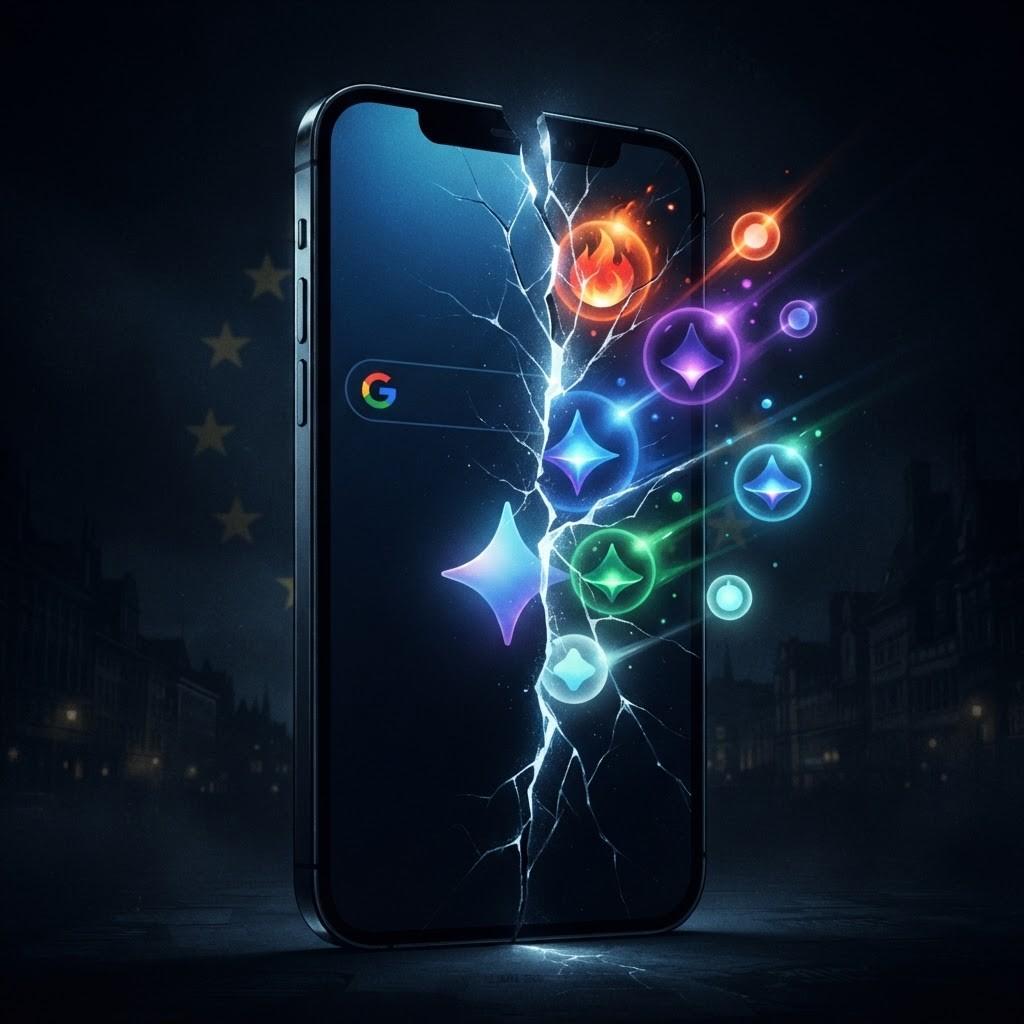
On July 16, the European Commission did something no competitor has ever managed. It ordered Google to open the two assets that make the company nearly unbeatable: default placement on two billion Android phones, and twenty years of search behavior data that nobody else can replicate.
Two binding decisions under the Digital Markets Act. One forces Google to let rival AI assistants operate as deeply integrated system tools on Android, with the same voice activation, cross-app access, and hardware capabilities that Gemini enjoys. The other requires Google to share anonymized search ranking, query, click, and view data with competing search engines and AI chatbots on fair, reasonable, and nondiscriminatory terms.
Search data sharing starts January 2027. Android interoperability is due by July 2027. Non-compliance carries fines up to 10 percent of Google's global annual turnover.
This is not a fine. It's a structural reshaping of who gets to reach consumers on the world's most widely used mobile operating system, and who gets to learn from the world's largest search dataset. For marketers, the implications go far beyond regulatory trivia.
The Android Crack
Here's what changes on Android. Right now, Gemini is preinstalled and deeply integrated. It responds to "Hey Google," works across apps, accesses the camera and sensors, and operates as a system-level assistant. Competing assistants like ChatGPT, Claude, and Perplexity exist as apps, but they're walled off from the system plumbing that makes an assistant feel native.
The EU's decision opens 11 Android feature groups to certified third-party assistants. That means a user could set ChatGPT or Perplexity as their default assistant, and it would get the same voice activation, cross-app capabilities, and hardware access as Gemini. Google still controls certification and can block access on security grounds, but the default advantage disappears.
Think about what that means for discovery. Today, when someone picks up an Android phone and asks a question, Google answers. After July 2027, that same person might be asking ChatGPT, Claude, or Perplexity. The assistant layer becomes a choice, not a default. And the data generated by those interactions flows to whoever the user picked.
This is already happening at the browser level. People are switching their default search engine to AI-native options. But the Android decision accelerates it dramatically by removing the friction that keeps most users on whatever comes preinstalled. The EU just made switching cost nearly zero.
The Data Spigot
The second decision is arguably more consequential, even though it sounds technical. Google must share anonymized search data, including ranking signals, query data, click data, and view data, with eligible competitors on FRAND terms. The EU explicitly included AI chatbots as qualifying services, since they increasingly function as search engines.
This matters because Google's search data is the single biggest training advantage in consumer AI. Two decades of behavioral signal showing what people click, how they reformulate queries, which results satisfy and which don't. No competitor has anything close. OpenAI trains on web text. Anthropic trains on web text. Nobody trains on Google's click graph.
Starting January 2027, they can. Not the raw, personally identifiable data, but anonymized ranking and behavioral data that's still enormously valuable for training and tuning models. Google will share it on FRAND terms, meaning competitors pay a reasonable rate and get comparable access.
Google's president of global affairs Kent Walker pushed back hard, arguing the decisions "risk undermining privacy and security guardrails for millions of Europeans." The EU said Google can still vet which services get deep Android access and that there are limits on how search data can be used.
The privacy argument is real but selective. Google collects more behavioral data than almost any company on earth. The concern about sharing it feels less like principled privacy advocacy and more like defending a moat.

Why This Lands Harder Right Now
The timing is brutal for Google. The same week the EU cracked open its distribution moat, Gemini 3.5 Pro reportedly missed its shipping target for the third time. Google is reportedly exploring a stopgap Gemini 3.6 Flash release to put something in market while the flagship gets fixed. No official model card, pricing, or benchmarks have been published.
One delay is engineering discipline. Three misses suggest something structural. And while Google's flagship model is stuck, the EU is dismantling the distribution advantage that was supposed to compensate for bad model weeks. Distribution has been Google's quiet answer to every competitive threat: sure, the model might not be the best, but it's the one on two billion phones.
Brussels just put a timer on that answer.
Meanwhile, the competition is getting harder, not easier. China's Moonshot AI shipped Kimi K3, a 2.8-trillion-parameter open model that took the top spot on a major coding leaderboard. GPT-5.6, Claude, and Grok 4.5 are all shipping. Enterprises evaluating frontier models this quarter are signing contracts with anyone but Google, because Google has nothing to sign for.
This compounds with the broader pressure on Google's search business that we've been tracking. Publishers are preparing to walk out on Google entirely, with Cloudflare blocking Google's crawler by default starting September 15 and USA Today exploring delisting. Google's search index is getting thinner at the same time its model is getting later and its distribution moat is getting breached.
What This Means for Marketers
The practical implications for marketing teams are immediate, even though the deadlines are months away.
Your search strategy is about to fragment. Today, "search" means Google. You optimize for Google's algorithm, buy Google Ads, track Google rankings, and measure Google Analytics. After these changes take effect, search splits across multiple AI assistants, each with its own ranking logic, its own data inputs, and its own user base. Optimizing for Google alone won't cover the full discovery surface.
This builds on the visibility problem we've already documented. Google AI Overviews are already generating content about your brand with zero input from you. Now imagine three or four AI assistants, each drawing on different data sources, each potentially trained on Google's shared search data, each giving different answers about your products. The fragmentation is exponential.
The data sharing piece changes how you think about competitive intelligence. If competitors can access Google's search behavioral data, the gap between companies that invest in search and those that don't narrows. The strategic advantage shifts from "we have better search data" (because everyone will) to "we have better first-party data and better content."

What to Do Before January 2027
Start treating AI assistant visibility as a distinct channel, not a subset of SEO. The companies that win the next phase of search won't be the ones with the best Google rankings. They'll be the ones whose brand, content, and structured data show up consistently across ChatGPT, Perplexity, Claude, and whatever assistant becomes the default on a billion Android phones.
Audit your structured data and entity presence now. AI assistants don't rank pages, they recommend entities. Your company, products, and key people need to be clearly defined in structured data, knowledge graphs, and high-authority sources that AI models can cite. This is the same shift we covered when looking at why CMOs can't run the AI they bought. The tools are changing faster than the teams using them.
Build first-party data assets that don't depend on Google. Email lists, community platforms, direct traffic, owned content. Every channel that doesn't route through Google's ecosystem is a channel that survives fragmentation. This isn't new advice, but the urgency is. When search data flows to competitors and discovery splits across assistants, the only data you fully control is what you collect directly.
Watch which assistants apply for Android certification first. The companies that move fastest will shape the default experience for millions of users. If Perplexity or ChatGPT gets certified and ships a compelling Android integration before Google's own model recovers, the switching costs that kept users on Gemini disappear.
The EU's bet is that competition produces better outcomes than defaults. They might be right. But for marketers, the transition period between now and 2027 is going to be messy, expensive, and full of blind spots. The brands that start preparing now will be the ones that show up in the answers, no matter which assistant is asking the questions.