We have quietly slipped past the event horizon of the chatbot. For the first half of this decade, we treated artificial intelligence as a stationary oracle enclosed within a browser tab — a disembodied brain waiting patiently for our prompts. But as we navigate early 2026, the epistemological boundary between “thinking” and “doing” has collapsed. Welcome to the era of the “Executor.” AI has been granted hands, and it is now roaming your desktop.
This transition from passive Q&A to autonomous action has not been peaceful. It has birthed a fascinating dichotomy — a proxy war for the future of personal computing fought between two heavyweights with fundamentally incompatible philosophies. On one side: Claude Dispatch, Anthropic's highly polished, walled-garden solution. The “it just works” option for the masses, promising a seamless 60-second setup via a simple QR-code scan. On the other side: OpenClaw — the open-source rebel that runs perpetually on your own hardware.
The Great Blocking
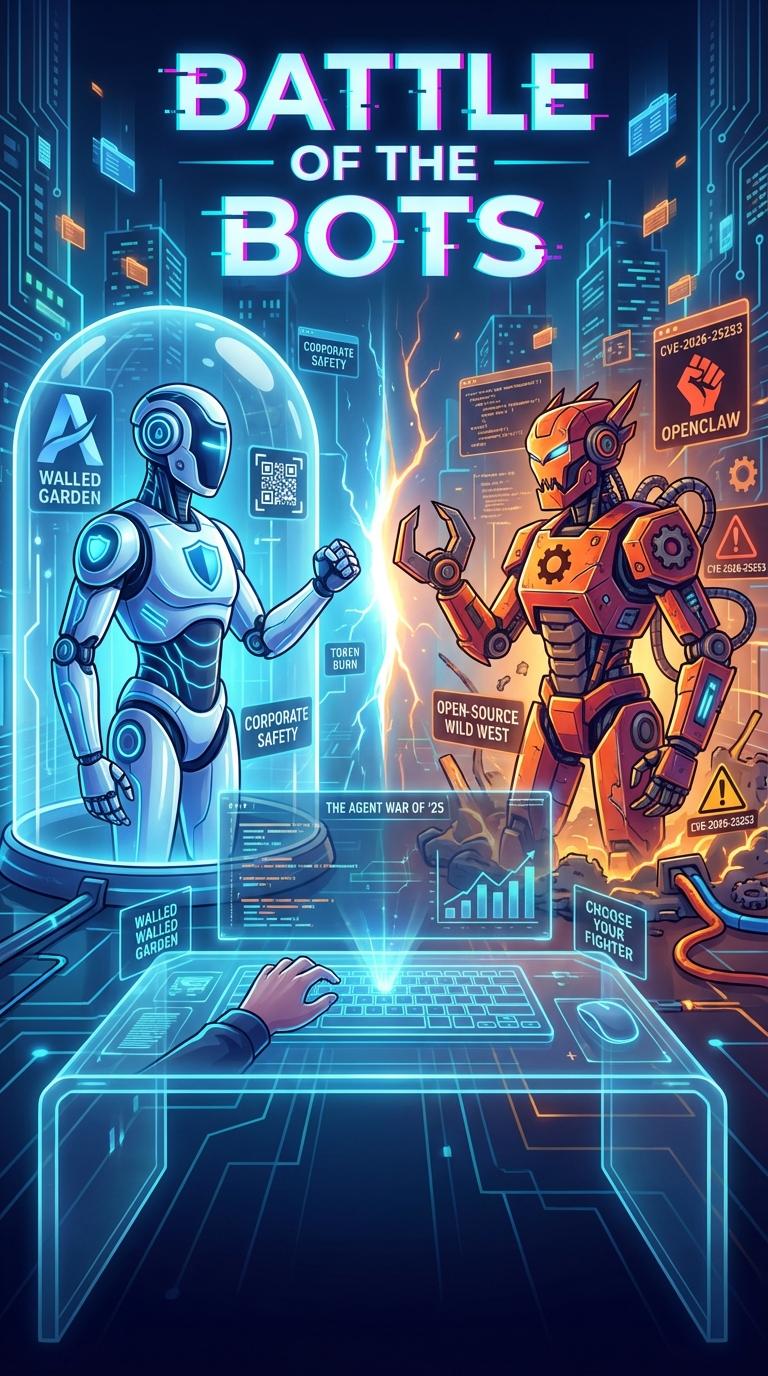
To understand the current landscape, one must look back at the chaotic history of the Agent War of '25. It was a classic clash of paradigms: the sanitized safety of corporate oversight versus the anarchic freedom of the open-source “Wild West.” The breaking point culminated in what the community now calls “The Great Blocking.” In an overnight purge, Anthropic summarily nuked the workflows of thousands of Pro users who dared to pipe their accounts into OpenClaw's infrastructure.
This technical crackdown was accompanied by a bitter legal skirmish over nomenclature. When Anthropic's lawyers deployed cease-and-desists to crush the project's original moniker, Clawdbot, the community engaged in a masterclass of digital defiance — rebaptizing it as OpenClaw, a name that thumbed its nose at the corporate mothership while cementing its identity as an independent, unkillable hydra.
The 2026 Landscape
CVE-2026-25253
The “Nightmare” bug effectively turned OpenClaw agents into wide-open backdoors for hackers, prompting the Chinese government to mandate that municipal workers strip the software from their machines entirely.
The “MacBook Tax”
The “Shenzhen Surge” saw engineers lining up for offline machines, driving a price surge on secondary markets.
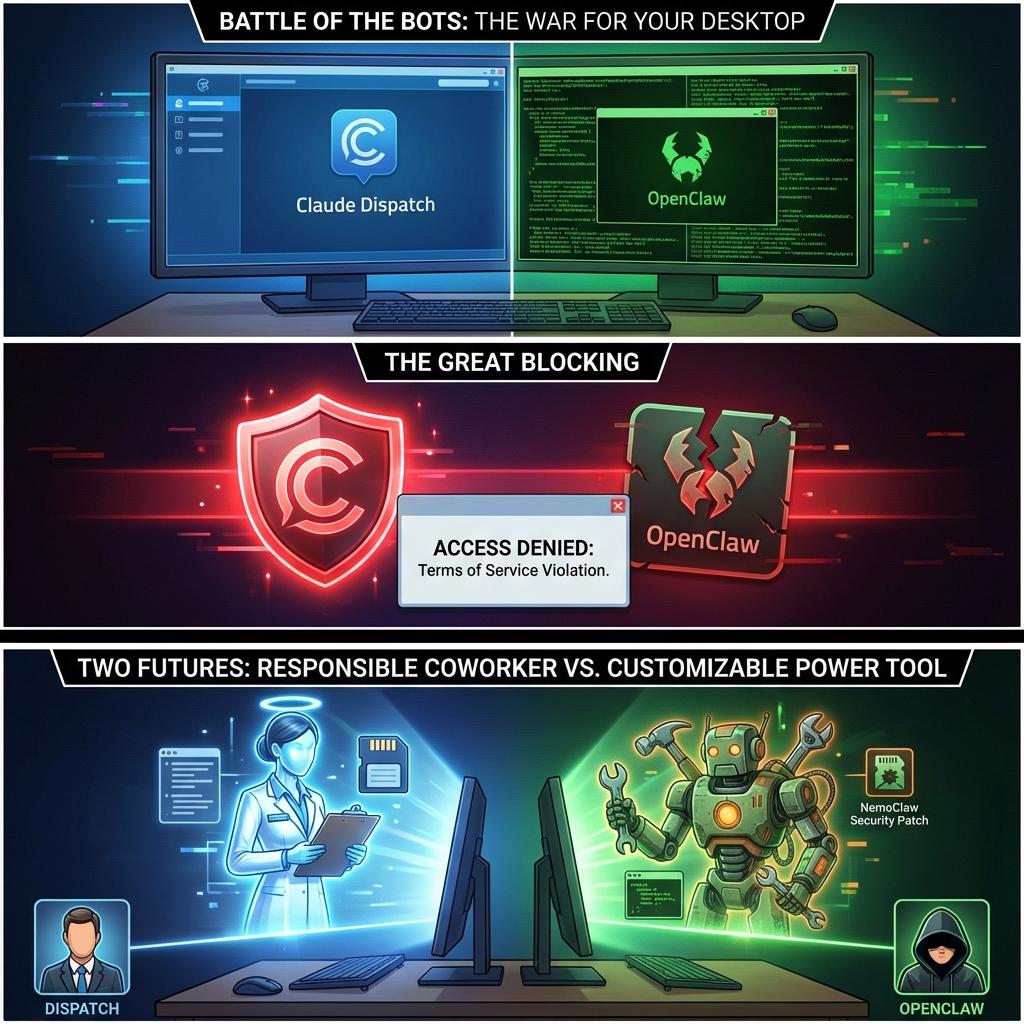
Dispatch is for Managers
It is the bourgeois appeal of sandboxed reliability. The business crowd overwhelmingly gravitates toward Anthropic's official suite because it offers zero-maintenance security. It is the digital equivalent of a leased company car — safe, insured, and thoroughly monitored.
OpenClaw is for Hackers
It remains the darling of the developer class, who view Anthropic's ecosystem lock-in as an existential threat to computing freedom. For them, the risk of a zero-day exploit is an acceptable price to pay for the sheer power of triggering complex workflows via a Telegram ping.
Looking ahead, the trajectory of our digital coworkers is splitting into two distinct futures. The OpenClaw community is aggressively pursuing the vision of a “Sovereign Jarvis.” The immediate priority is the “NemoClaw” security patch — a desperate bid to stem the bleeding of the nightmare exploits. Beyond survival, they are building ClawHub, a decentralized marketplace for agent scripts.
Anthropic, meanwhile, is refining “The Coworker.” Dispatch is slated to finally escape its macOS exclusivity and launch on Windows, officially ending the “MacBook era” of agentic AI. But more philosophically intriguing are their roadmap milestones: Life-Memory and Project Souls.
“As we stare down the remainder of 2026, the question is no longer whether you will employ an AI executor, but which master it will serve.”
Will you opt for the “Responsible Coworker” — curated, manicured, and paternalistically restricted by a megacorp? Or will you wield the “Customizable Power Tool” — dangerous, inefficient, but entirely, unequivocally your own?