
Google just told us, in its own awkward way, that AI search is not one thing. On Alphabet's third-quarter earnings call, chief business officer Philipp Schindler said AI Mode queries carried "lower monetization" than regular search. Search revenue growth slowed anyway, and the stock took a beating the next day. Days later, Google expanded ads in AI Mode to ten more countries and switched on multiturn ads in the United States, so a sponsored placement can follow a shopper into the second and third question, not just the first.
Read those two moves together and the strategy is plain. Google earns less per AI answer, so it will sell more of the answer itself. More placements inside the answer, more follow-up placements, more shopping handled without a click out. That is the part most coverage stopped at. The part nobody priced in is the split inside the answer. A new study shows AI Mode treats a product question and a service question like two different searches, with two different winners.
That split is the whole post. Sell a product, and your fight is now inside Google's storefront. Sell a service, and your fight is still for a link out. Run the wrong playbook and you will optimize perfectly for a surface that was never going to send you traffic.
The Split, in One Study
The numbers come from Findrix, an AI visibility platform, in a study reported by Search Engine Land on October 29, 2026. Findrix tested 18,400 buyer questions across 35 US markets from October 14 to 17, collecting 55,198 answers from ChatGPT, Gemini, and Google AI Mode, one answer per question per platform. The findings measure links shown in AI answers, not clicks or purchases. That limit matters, and I will come back to it. The direction of travel is still hard to ignore.
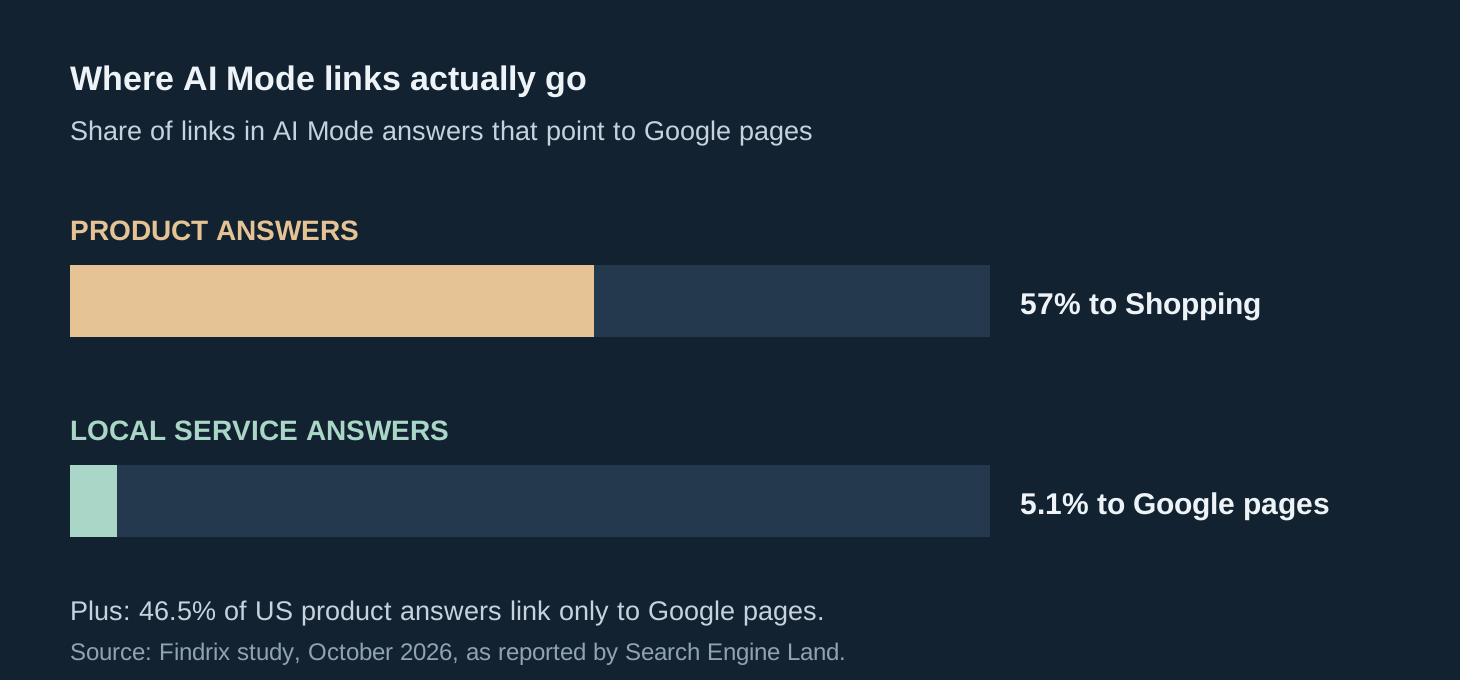
For product questions, 57 percent of the links in Google AI Mode answers pointed to Google Shopping product pages. In 46.5 percent of US product answers, every link pointed to a Google-owned page. Fashion and beauty led that pattern. In swimwear, 60.4 percent of answers linked only to Google pages. In women's everyday fashion, the figure was 57 percent.
For local service questions, plumbers, lawyers, dentists, and the like, only 5.1 percent of AI Mode links went to Google pages. The rest went somewhere else. Somewhere a business could actually own.
Stop and hold those two numbers side by side. 57 percent against 5.1 percent. Same answer engine, same week, opposite behavior. A product answer is a shelf Google stocks itself. A service answer is still a set of directions to someone else's door. The reason is not a mystery. Findrix co-founder Yosif Merman pointed to Google's product database, with prices, ratings, and inventory in one place, which lets AI Mode build a product answer with fewer links out. Services have no equivalent database, so Google still has to point.
Where Products Actually Go
Here is the trap inside the product number. Seeing that 57 percent of links go to Shopping, a brand might assume a strong Shopping presence means a strong AI Mode presence. It does not. A separate Productrise study, covering more than 2 million listings across 100,000 search results pages from August 9 to 31, 2026, found only 1.28 percent of products in the traditional Google Shopping carousel also appeared in AI Mode for the same query on the same day. AI Mode showed an average of 3.9 products per query. The traditional carousel showed 27.8. Google confirmed both surfaces draw from the same Shopping Graph, but it has not verified the study's figures.
The carousel is a warehouse aisle with room for everyone. The AI answer is a shelf with room for four. Your product can be in the warehouse and still never make the shelf. Worse, when a product did appear in both, the first-listed seller differed 49.6 percent of the time, and AI Mode showed the higher price in 68.4 percent of cases where prices differed, with a median gap of 22.2 percent above the carousel price.
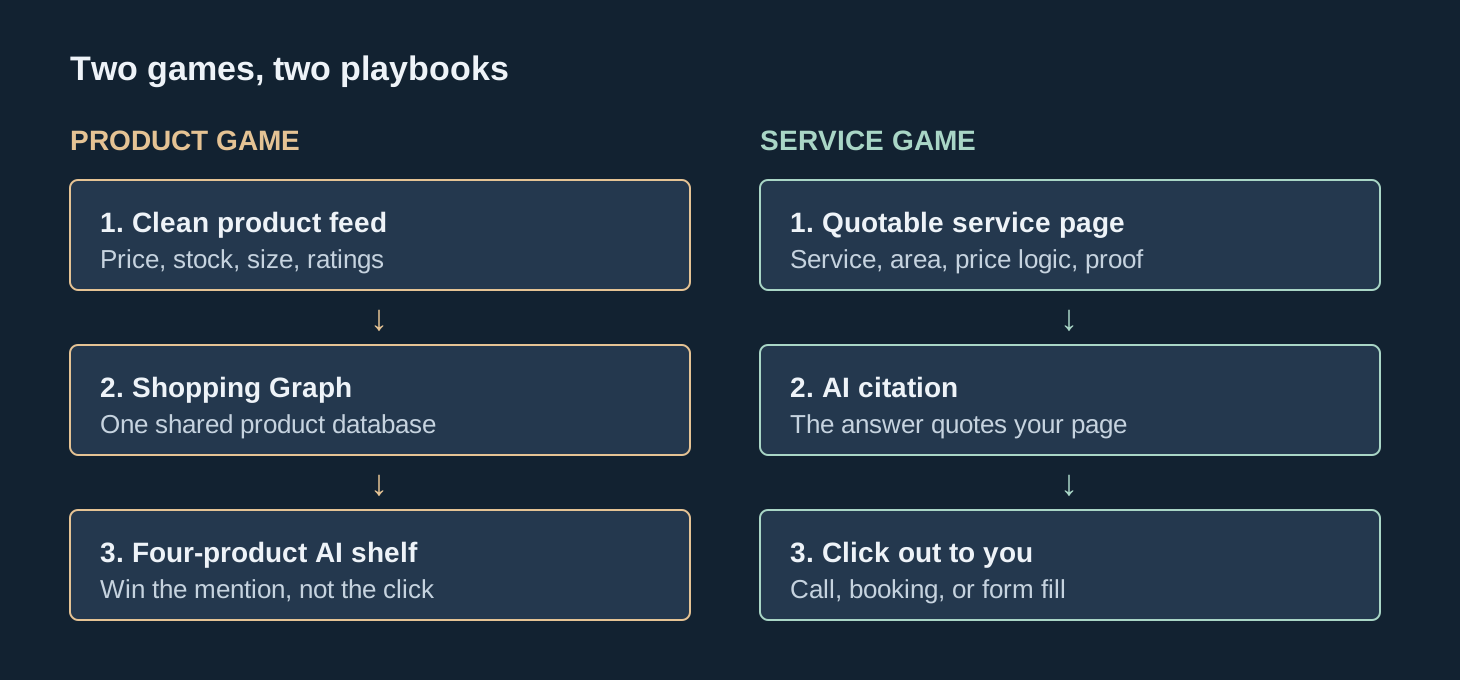
So the product game is not "rank in Shopping." It is "get picked for a four-product shelf, at a price and seller you control." Feed health stops being a back-office chore and becomes the listing itself. A disapproved product, a stale price, or a missing size can quietly remove you from a shelf that only holds four items. And because the answer engine does the comparing, the product page has to match the feed exactly, or the engine has a reason to pick the seller whose numbers agree.
I wrote recently about how the auction moved inside the AI answer, and this is the product version of that shift. The click used to be the contest. Now the contest is the mention, and for products the mention often lives on a Google page, not yours.
The shopper here is not browsing your site. She is comparing inside an answer. For a product brand, that answer is now the storefront.
Where Services Still Win Links
Services get the opposite problem, which is a better problem to have. AI Mode cannot stock a plumber. It has to cite someone. That is why 94.9 percent of local service links in the Findrix study went somewhere other than a Google page. The link is still alive in the service game. The catch is that the link goes to the page the answer can quote, not the page the owner likes best.
A service page built for the old search game leads with a hero, a slogan, and a form. A page built for the answer game leads with the facts the answer needs: the exact service, the area served, the price logic, what is included, what breaks the quote, and proof the work happened. If your page makes the engine guess, it will cite the competitor whose page did not.
This is also why the small click study from last week deserves attention, with its limits stated plainly. SEO consultant Cyrus Shepard ran a one-site test and measured about a 0.9 percent click rate from AI Overviews and AI Mode. One site is not a benchmark, and Shepard said so himself. The interesting part was the second finding. Opting out of the AI features also lowered clicks on regular organic results. There is no clean exit. You cannot refuse the answer game and keep the old game intact. You can only choose which game you play well.
For a service business, that means the page is the asset again, but for a different reason than it was three years ago. Not because it ranks, but because it is quotable. Write the page so a stranger could answer the customer's question from it, in one paragraph, without calling you first. That paragraph is what gets cited. The call comes after.
The service sale still starts with a conversation, and the AI answer still has to point to someone who can have it.

The Second Question Decides It
There is a third piece, and it applies to both games. Google said AI Mode queries run about three times longer than regular searches, and that most of them are extra searches, not replacements. People are not just asking once and leaving. They are asking, then asking again. Multiturn ads exist because the conversation continues. That makes the follow-up question the new homepage.
The first question is usually broad. "Best waterproof hiking boots under $150." "Plumber near me for a leaking water heater." The second question is where the buyer gets specific, and where most pages go silent. Which boots hold up on wet rock. Whether the water heater repair needs a permit. What the warranty covers. What breaks first. What it costs when it breaks at night.
Most content stops at the first question, because that is what the keyword tool shows. A product page that answers only the spec sheet loses the follow-up to the review or the competitor page that answered the durability question in plain words. A service page that answers only the service list loses the follow-up to the page that stated the price logic and the response time.
Build for the second question on purpose. Take your ten best-selling products or your ten most-booked services. For each one, write down the three questions customers ask after the first answer. Then check whether your page answers all three in its first screen of facts, not buried in a blog post from last year. That check decides whether the answer engine keeps your name in the conversation or swaps in someone else's when the buyer gets serious.
Run Two Playbooks, Not One
Here is how I would split the work, by game, starting this week.
If you sell products, audit the shelf before you buy more traffic. Pull your top 20 products by revenue. Check each one in Merchant Center for disapprovals, price mismatches against the live page, and missing attributes, especially size, color, availability, and ratings. Then ask AI Mode the buying question for each one and record three things: does your product appear, at what price, and from which seller. Fix the feed first, because a feed error removes you before any ad or content can help.
If you sell services, audit the citation before you buy more traffic. Pull your ten most-booked services. For each one, check whether your page states the service, the area, the price logic, what is included, and one piece of proof, in facts a stranger could repeat. Then ask AI Mode the service question and record who gets cited, and what sentence it quotes. If the quote comes from a directory or a competitor, your page did not give the engine a better sentence. Write one.
For both games, stop grading AI search by click rate alone. For products, grade it by shelf presence: how often your product appears, at the right price, from the right seller. For services, grade it by citation: how often your page is quoted, and whether that quote brings a call, a booking, or a form fill.
One more warning, from the earnings call itself. Google earns less per AI answer, and it just added more ads inside answers to fix that. Expect the line between a sponsored product slot and an organic product slot to get harder to see, not easier. Google already says click rates are similar for sponsored and organic product listings inside AI Mode, using its own internal US data. Similar click rates do not mean similar value. Watch your own numbers, product by product, before you trust the platform average.
Pick Your Game
AI search did not kill marketing. It split it. Products now compete for a shelf inside Google, where the feed is the listing and four slots is the whole contest. Services still compete for a citation, where the page that answers the question gets the introduction.
The brands that waste the next quarter will run one AI strategy for both games, grade both by clicks, and wonder why the product traffic never arrives and the service page never gets quoted. The brands that gain will pick their game on purpose, then do the work that game rewards: clean feeds for products, quotable facts for services, and follow-up answers for everyone.
Ask AI Mode your own buying question tonight. See which game you are already in, and whether you are winning it.