
Basis released its fourth annual AI and the Future of Marketing report this morning, and the headline number is 61.4%. That is the share of marketers who now use generative or agentic AI in their work every day, nearly double the 33.6% who said the same a year ago. The survey, fielded in August among 184 marketing and advertising professionals, found AI use has gone universal. 98.4% use it in some form.
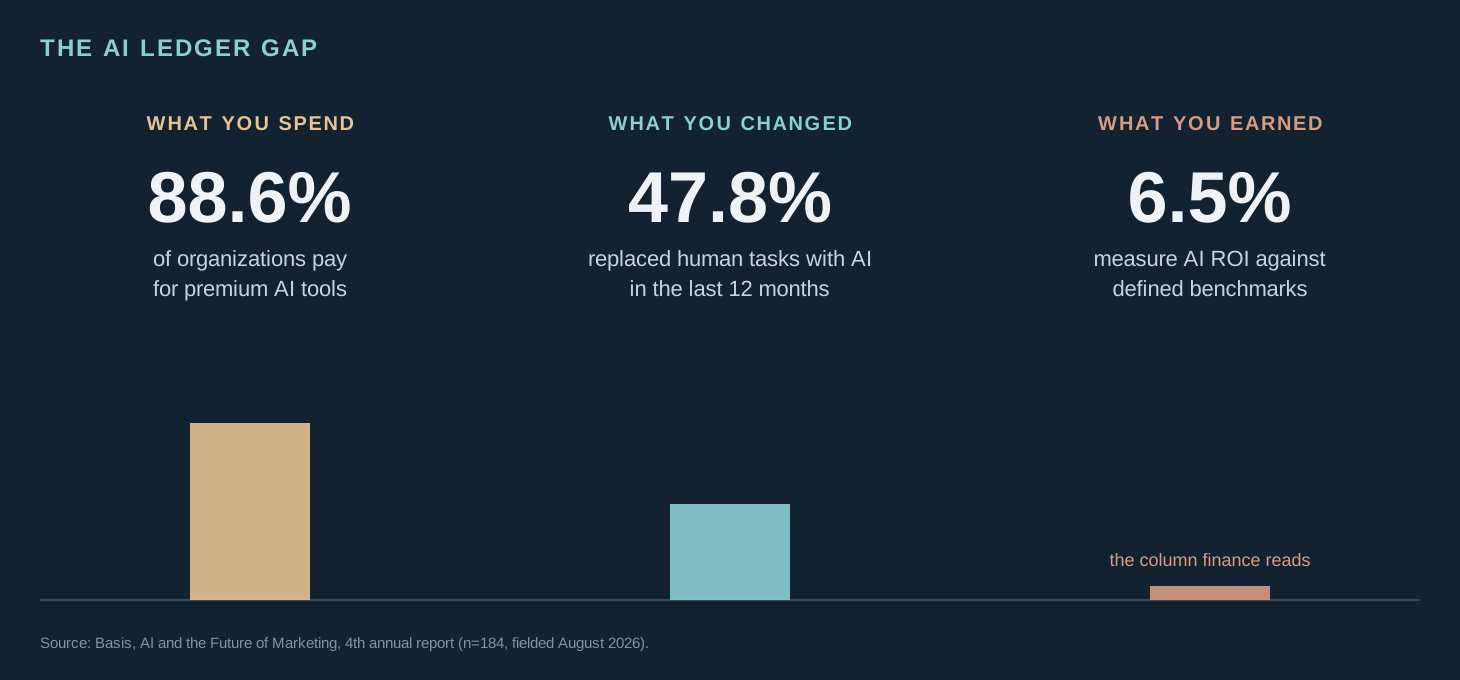
The number that matters is 6.5%. That is the share of marketing organizations that measure the ROI of their AI investments against defined benchmarks. Almost two-thirds, 65.1%, either do not measure it at all or are not sure anyone in their organization is doing so.
Read those two facts together and you get the real story of this report. Marketers bought the tools before they built any way to know if the tools work. That is an accountability crisis dressed up as an adoption victory, and it has an expiration date: the next budget review.
What the Basis Survey Actually Says
Start with the spending, because it is the part finance will ask about first. 88.6% of organizations now pay for premium AI tools, up from 65.7% last year and 44.0% in 2024. 43.5% run a custom or semi-custom AI model, up from 28.5% a year ago. This is real money leaving the building every month.
The usage runs deeper than last year's, too. 47.8% of organizations replaced human tasks with AI solutions in the past 12 months, up from 27.9% a year ago and 10.4% in 2023. AI agent use surged 155.5% year over year, with 51.1% of organizations now deploying agents for work like reporting and analytics (72.3%), campaign brief creation (56.4%), and content creation (45.7%). Most of it still sits at the front of the campaign lifecycle: 85.9% use AI for research, 83.2% for ideation.
Then there is the platform flip nobody saw coming. Anthropic's Claude posted the sharpest one-year gain of any platform, used by 72.3% of marketers, up from 17.9% in 2025. ChatGPT fell to 74.5% from 88.6%. Marketers changed horses mid-race without measuring either horse.
Two more numbers deserve your attention. 76.6% of marketers say AI-generated content still falls short of their organization's human-generated work. And 100% agree that AI poses a brand safety and misinformation risk, even as half the industry hands work to agents that operate with limited human oversight.
One caveat before we go further. This is a vendor-published survey of 184 people, and Basis sells a unified media platform. Its framing, that the industry's next stage is data foundations for accountability, serves its product. The sample is small. But the gap is so wide that the sample size barely matters. You do not need 10,000 respondents to see the shape of 6.5% against 88.6%.
Write down what each task costs before AI touches it. That note is the whole measurement program.

The AI Ledger Gap
The AI measurement gap is the distance between how fast marketing teams adopt AI and how slowly they build ways to prove it works. Basis put a number on each side of it: 61.4% use AI daily, 6.5% measure the return.
Think of it as a ledger with three columns nobody reconciles.
Column one is what you spend: premium seats, API bills, the custom model your agency built, the agent subscriptions nobody remembers approving. Column two is what you changed: tasks replaced, hours returned, briefs drafted by machines. Column three is what you earned: revenue moved, costs cut, performance improved.
Most marketing teams keep the first two columns in their heads and leave the third one blank. That works right up until finance asks the question finance always asks: what did this earn? A benchmark is just the answer you wrote down before the question arrived.
Why the Unmeasured Tools Die First
Budgets do not get cut by philosophy. They get cut line by line, and the lines with no number attached go first.
Here is the part that stings. The teams that measured modest gains will keep their tools. The teams claiming huge unmeasured gains will lose theirs. A CFO can defend a 12% efficiency gain with a log behind it. Nobody can defend "it feels faster" against a 20% budget cut.
There is a second reason to care, and the survey buries it. Every single respondent agreed that AI poses a brand safety and misinformation risk, while half the industry runs agents with limited human oversight. Measurement and governance are the same muscle. Both require writing down what the machine did and checking whether it was right. I wrote earlier about decision chains for agentic systems, the proof you owe regulators when an autonomous system acts. The measurement ledger is the proof you owe your CFO. Same discipline, different audience. The same applies to the evidence binder behind your published AI claims. Marketers are learning to document AI everywhere except the one place that decides their budget.
How Do You Measure ROI on AI Marketing Tools?
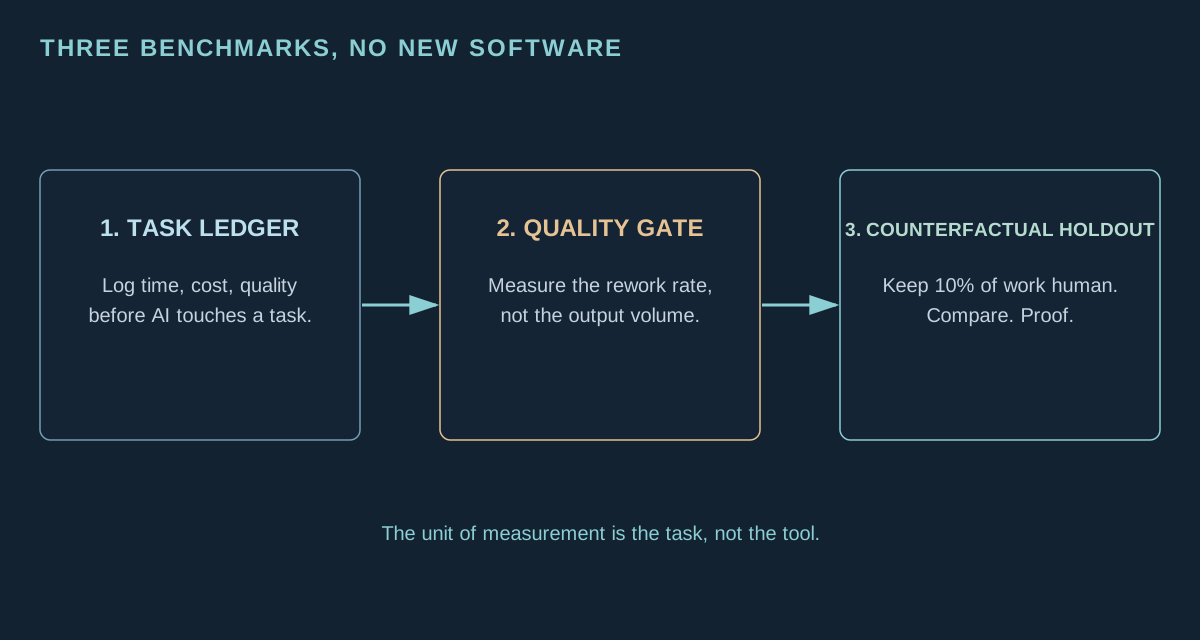
You do not need a data science team to measure AI marketing ROI. You need three benchmarks, and you can start all of them this week.
First, the task ledger. Pick the three tasks where AI does the most work. Before the tool touches anything else, write down the baseline: how long the task took, what it cost in people-hours, and what good output looked like. Then log the same three numbers with AI in the loop. The unit of measurement is the task, not the tool. A seat license tells you nothing. A task ledger tells you everything.
Second, the quality gate. Measure the rework rate: what share of AI output ships as-is, and what share gets rewritten, corrected, or thrown out. Remember that 76.6% of marketers say AI content falls short of human work, so this is where most teams will find their real number. An AI draft that needs 40 minutes of rework did not save 40 minutes. It cost them.
Third, the counterfactual holdout. Keep a slice of the work, say 10%, done the old way, by people, with no AI assistance. Compare conversion, engagement, or satisfaction against the AI-assisted slice. Without a holdout, every claim about AI's impact is a guess dressed up as a result. Marketing has run holdouts against media for decades. The AI stack gets no exemption. Media teams already know the pain of spending on inventory nobody measured properly. The tool stack is making the same mistake with better branding.
None of this needs new software. A spreadsheet and the discipline to fill it in will do.
Keep one lane human. The comparison is the only proof that counts.

What to Do This Week
Write down three tasks. Write down what each one costs today. Give yourself thirty days and a spreadsheet. That is the whole program, and it is more measurement than 93.5% of the industry has.
Basis will publish this report again next year. The adoption number will be bigger. The interesting question is whether the measurement number moves with it. The teams that start their ledgers now will have an answer when finance asks. The rest will have a feeling, and feelings do not survive budget season.