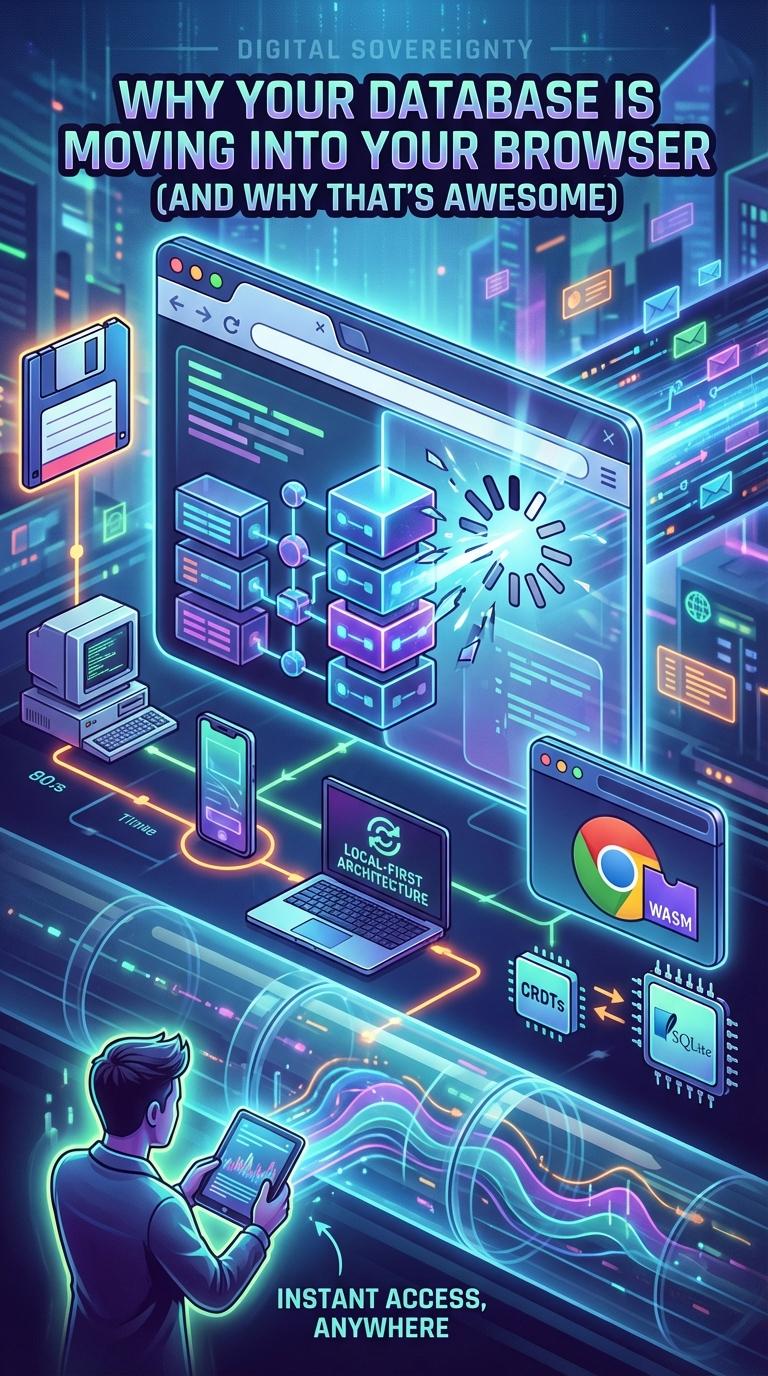

The Death of the Loading Spinner
Consider the loading spinner. It is the ultimate symbol of our modern technological fragility. One moment, you are bathed in the seamless grace of perfect Wi-Fi; the next, you step into an elevator or a concrete stairwell, and your application is reduced to a frozen, useless brick. We have accepted this latency as a law of nature, a necessary toll paid to the almighty Cloud. But what if it isn't?
The solution to this modern malaise lies in a paradigm shift known as Local-First Architecture. At its core is a piece of technology that many previously relegated to “small stuff” or mobile contacts apps: SQLite. Through a fascinating convergence of technologies, SQLite is no longer just a lightweight storage file — it is a robust database engine living natively inside your phone and, crucially, directly within your web browser.
Imagine interacting with a web application that responds at the speed of your local solid-state drive, utterly indifferent to whether you are on a gigabit fiber connection or deep inside a subway tunnel. The data is already there. The interface doesn't wait for permission from a server in Virginia to render your thoughts. It simply reacts.
Back to the Future
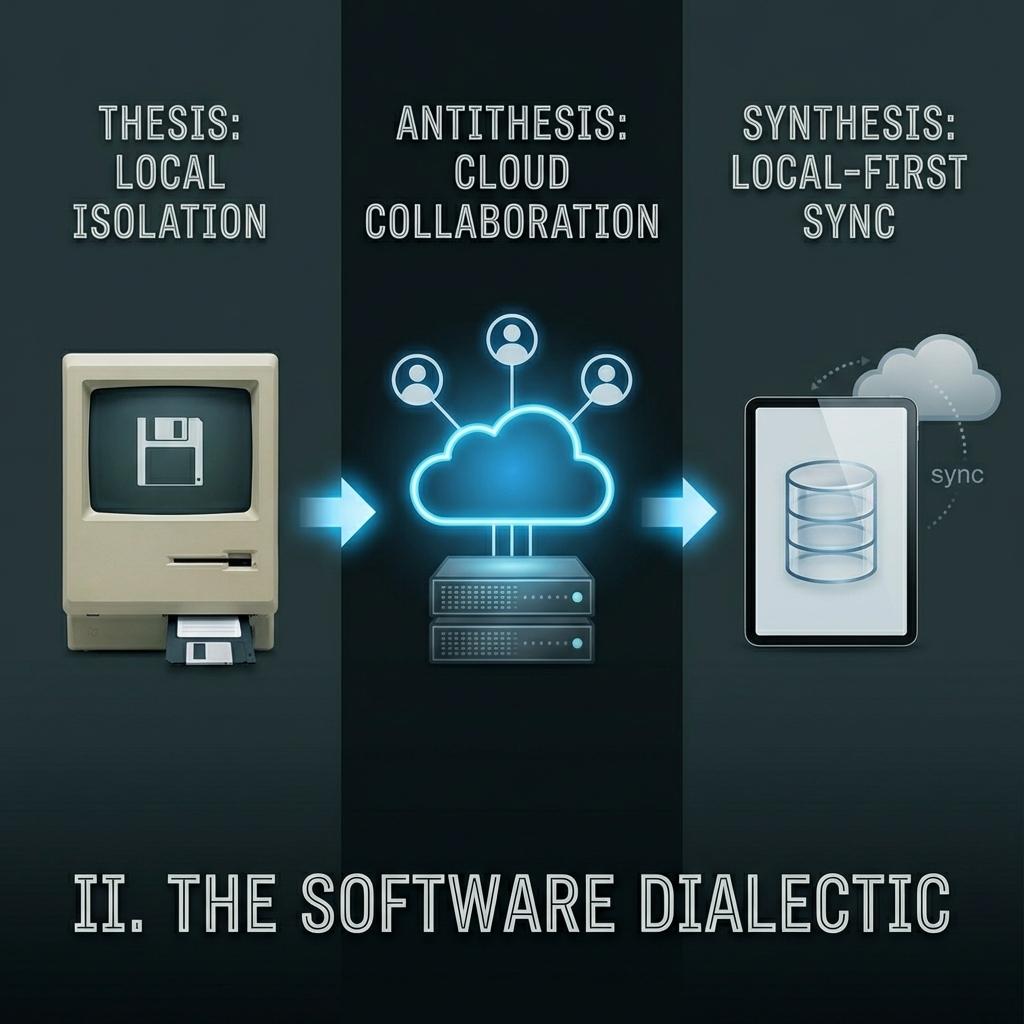
To understand the magnitude of this shift, one must view software history as a Hegelian dialectic.
“The synthesis is Local-First. The groundwork for this was laid decades ago by Linus Torvalds with Git — arguably the original local-first tool, where every developer possesses a complete, independent copy of the repository.”
The thesis was the software of the 1980s and 90s. When applications lived on floppy disks and local hard drives, software was fast, and you fundamentally owned your data. The fatal flaw, of course, was isolation. Sharing a document meant emailing a file named draft_final_v3_ACTUAL_FINAL.doc.
The antithesis was the Cloud era. Tools like Google Docs and Figma emerged to solve the collaboration problem, ushering in an age of real-time multiplayer productivity. Yet, in this Faustian bargain, we surrendered our “offline” rights. We became digital tenants, renting access to our own thoughts, locked out the moment the connection severed.
The “Invisible Backend” and the Magic of WASM
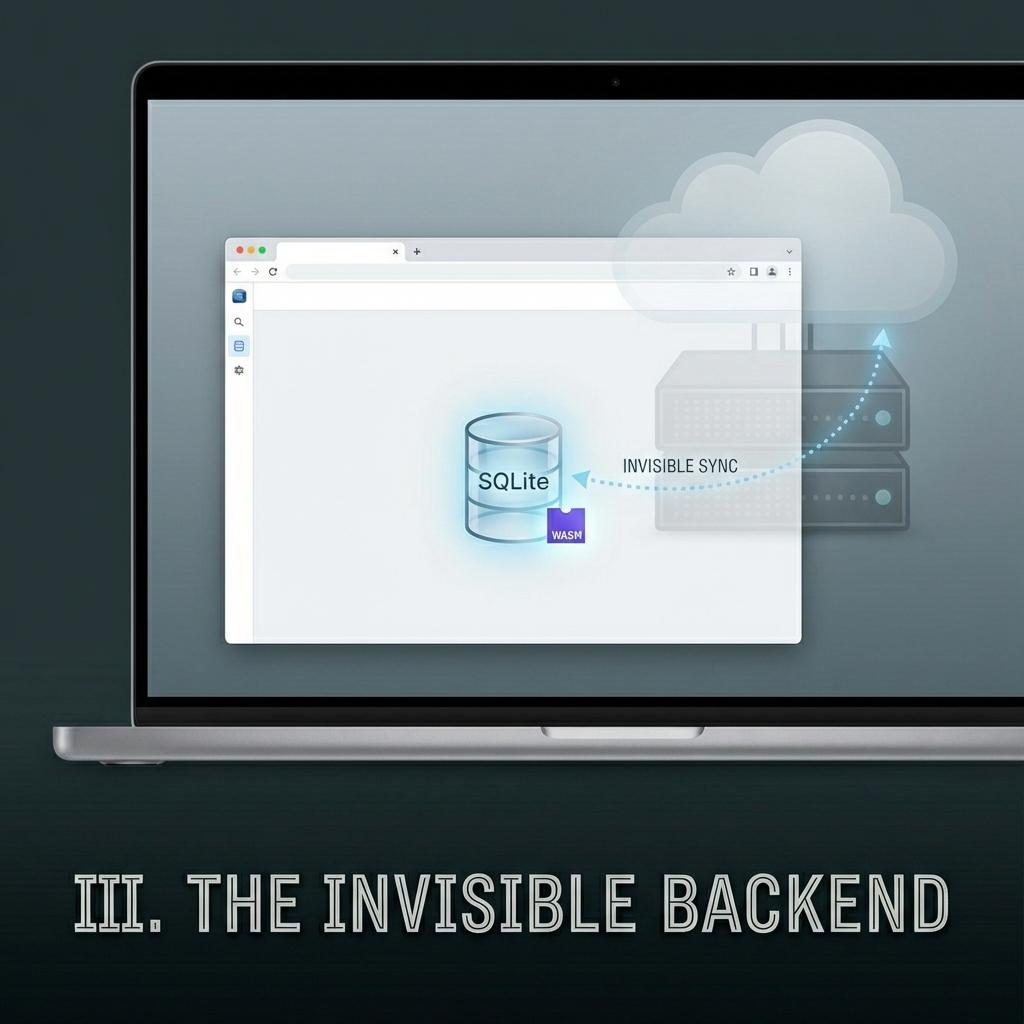
We are currently witnessing a fundamental shift in how applications handle state: moving away from the slow, imperative act of “fetching” data, toward the reactive, ambient process of “syncing” data. In a local-first world, the backend becomes practically invisible to the user.
The unsung hero making this possible on the web is WebAssembly (WASM). WASM allows us to run high-performance, compiled C-code — like the SQLite engine — directly inside a browser tab at near-native speeds. The browser is no longer a mere document viewer; it is a localized operating system.
The Spicy Part: The Great Sync Debate
Of course, no architectural revolution is without its ideological schisms. The transition to local-first has birthed a fascinating debate between the idealists and the pragmatists.
On one side, we have the proponents of “Pure CRDTs.” They argue for total decentralization, where mathematical algorithms resolve conflicts peer-to-peer. On the other side are the pragmatists advocating for “Server-Authoritative Sync.”
Reality Check
As an intellectual exercise, local-first is flawless. In engineering reality, it encounters the unforgiving physics of data. The most glaring obstacle is the “Fat Client” problem. A modern enterprise database might hold 50 terabytes of historical data. You cannot fit that into the storage constraints of an iPhone.


The Crystal Ball
The most compelling frontier is AI at the Edge. With extensions like sqlite-vector, developers are now storing vector embeddings directly in the local browser. This means you can run complex semantic AI searches over your personal data without ever sending your private life to a centralized cloud API.
VII. The Bottom Line
The era of the “Cloud-First” application, which shatters like glass the moment a user steps into an elevator, is coming to an end. It is time to stop building fragile web interfaces.