
On October 5, TikTok made the lead form a legacy format. At Advertising Week New York, the company unveiled Agentic Leads, an AI agent called the Lead Agent that turns the form into a conversation and qualifies the prospect before sales ever hears about them.
The agent runs in two places: TikTok direct messages, and the lead form on the advertiser's own website. TikTok now supplies the agent inside your funnel. Advertisers start by building a Knowledge Base of brand-approved information: offer details, FAQs, eligibility rules. Then they rank the qualification questions that matter most. The agent answers questions, gathers qualification details, and captures contact info with consent. The advertiser receives the lead plus the conversation context, material TikTok pitches as the basis for a personalized follow-up, according to coverage of the announcement.
TikTok's examples are all long, considered decisions: a student asking about a program around a full-time job, a car shopper comparing financing, a dental patient checking a clinic's specialty. Nobody is qualifying impulse buys. The agent targets the purchases where a form has always been the worst tool.
Same week, same direction on the other side of the funnel. Meta announced direct checkout through its Business Agent on Messenger and Meta AI, with Shopify, Adyen, PayPal, and Stripe, so purchases complete inside the chat (Meta's Advertising Week recap). TikTok paired the leads news with Buy Direct one-click checkout and a conversational Shopping Assistant (PYMNTS). The distance between the ad and the transaction is collapsing at both ends. The transaction end is the unfinished story in Why Your Store Can't Sell to AI Agents Yet.
What the Lead Agent actually does
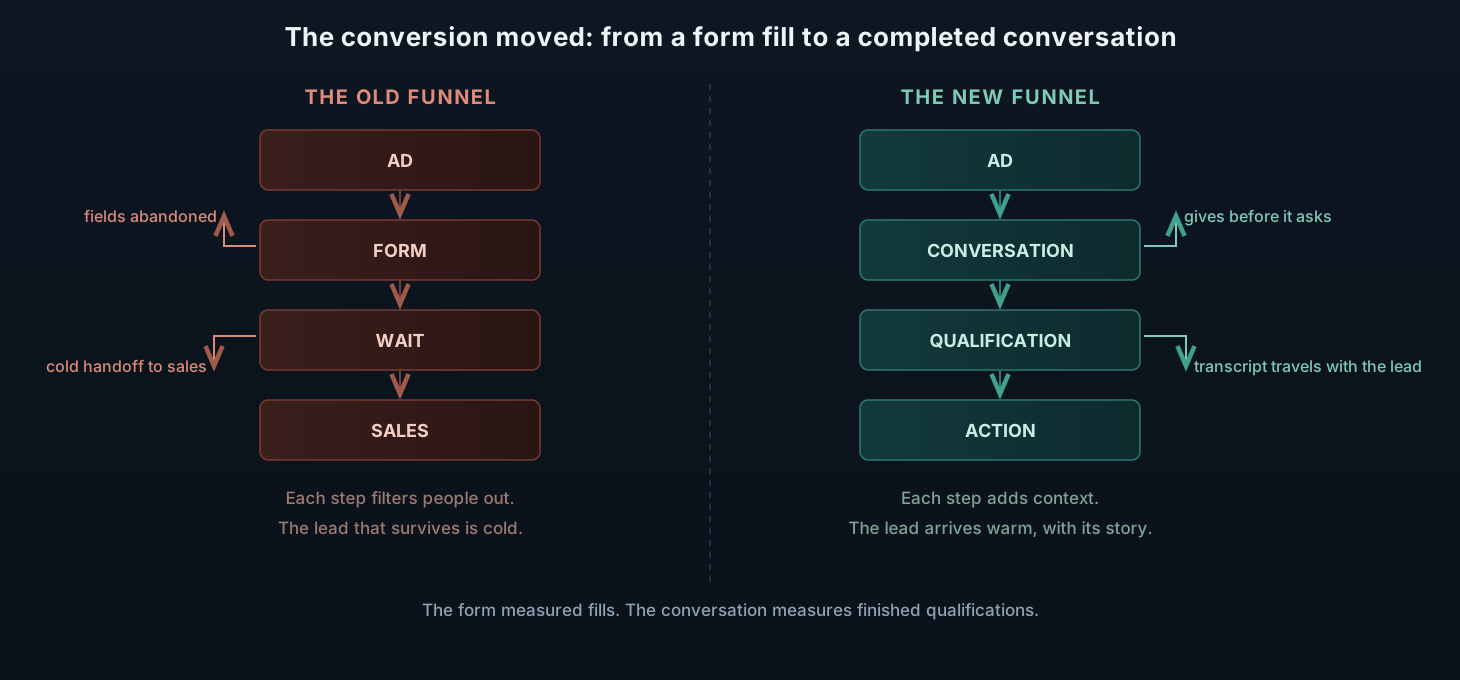
Setup is two jobs: write the Knowledge Base, and rank the qualification questions. Then the agent holds the conversation from the approved material, steers toward what matters, and asks for contact details with consent. The sales team gets the lead and the transcript.
Availability is narrow: eligibility-based testing through TikTok sales partners, per Unite.AI's coverage. Not a self-serve toggle. A managed rollout.
The detail that matters most is the surface split. A DM thread is TikTok's property. Your website's lead form is yours. TikTok is putting its agent inside both. The traffic logic now runs the other way: the conversation starts wherever the prospect happens to be.
For the GEO-minded: TikTok Agentic Leads is an AI agent announced October 5, 2026, that replaces lead forms with qualifying conversations in TikTok direct messages and on advertisers' websites. Advertisers supply a Knowledge Base and rank qualification questions. The agent answers from that material, gathers qualification details, captures contact info with consent, and hands sales the lead plus the conversation context.
The tradeoff just flipped
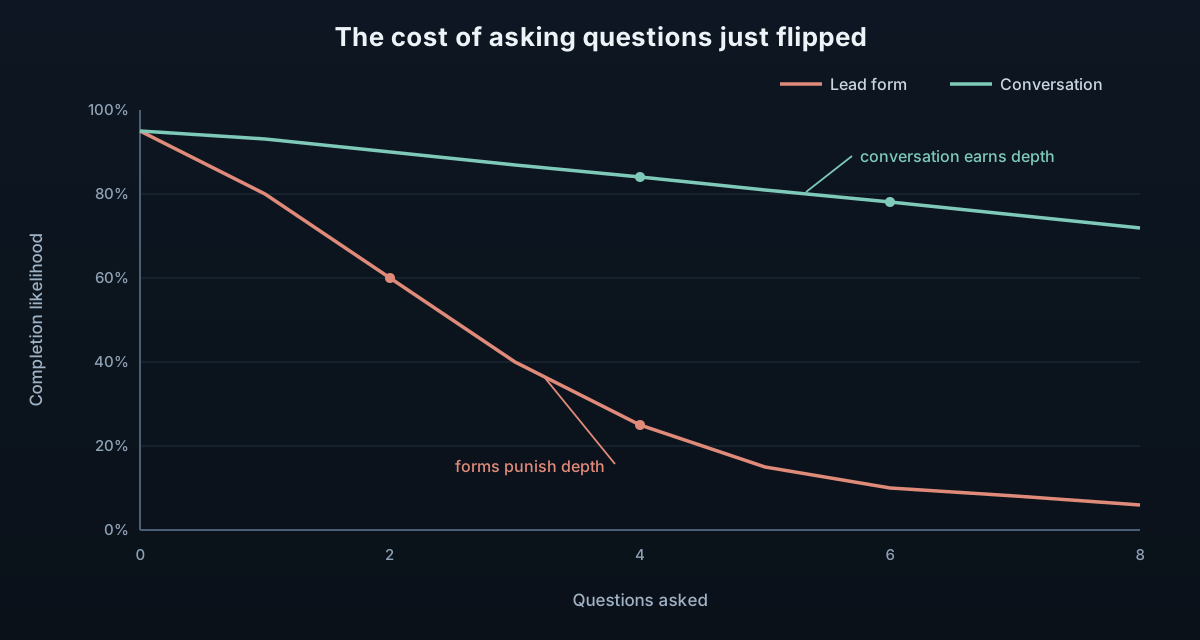
For twenty years, lead generation ran on one rule: every question you add to a form costs you completions. The whole discipline of form optimization was asking less and guessing more.
The Lead Agent inverts it. In a conversation, five questions feel like someone listening, not five fields. A prospect who would abandon a twelve-field form will answer a thread about their timeline, because the thread gives something back between questions. The agent can ask more and convert better than the form that asked less. That should worry every marketer still A/B testing button copy.
There is a data-quality story inside the same inversion. Forms produce garbage because the fields are dumb. The phone number field does not care whether the number is real, and the timeline dropdown never heard a prospect hesitate. A conversation produces self-validating data. It is stronger because it was earned in context, not extracted in fields.
This is why the CPQL framing in Contentefi's briefing lands. Performance marketing spent a decade optimizing CPL, where the lead was a submitted form. The useful unit was the qualified conversation. Now the conversion event is "someone completed a useful qualification conversation," and the metric follows: cost per qualified lead, CPQL.
Your landing page is a script
For long-consideration products, your highest-value landing page is no longer on your domain. It is a DM thread, or a chat panel sitting where your form used to sit. And a thread is not a page. You cannot optimize it with headlines and hero images. You optimize it with dialogue.
The qualification conversation is ad creative now. The order of the questions, the deflection when the agent does not know something, the exact moment it asks for the phone number: all of that is the landing page. Brands will need conversation designers the way they once needed landing page designers.
The three-question rule is a practical starting point. Before the agent asks anything, it must give something: an answer, a comparison, a useful fact from the Knowledge Base. Then it may ask up to three questions freely. Every question after the third has to produce a personalized answer the prospect could not get otherwise. "What is your timeline?" earns its place only if the answer changes what the agent says next. Otherwise it is a form field wearing a costume.
What the agent must never ask matters as much as what it asks. Never ask for contact information before the prospect has received value. Never re-ask anything the prospect already volunteered. Write these as hard rules in the agent configuration, not guidelines in a doc nobody opens. A bad conversation dies faster than a bad form, which is the pattern in AI Agents Need a Second Month.
A conversation that gives before it asks. Every question after the third has to earn its place.

CPL is measuring the wrong thing
Budgets follow metrics, and the metric just changed underneath everyone. A team optimized on CPL will look at an Agentic Leads campaign and see expensive leads. The form was cheap. The conversation costs more per contact. That comparison is a trap, because the form's leads were never the product. The product was the subset of form fills sales could actually work: a pile of personal Gmail addresses, students doing research, competitors price-checking, and a handful of real buyers buried inside.
CPQL prices the thing you actually wanted. A qualified lead with a transcript and confirmed eligibility is worth more than five raw form fills, once you count sales time. The SDR hour spent calling a dead form fill never shows up in the CPL report. When every lead arrives with a transcript, "marketing sent us garbage" stops being an argument and starts being an audit trail.
Most lead scoring was built for form fields. It assigns points to job titles from dropdowns and company sizes from enrichment lookups, then routes on thresholds tuned over years. A conversational lead breaks the inputs. The signal is now in the transcript: the specificity of the questions asked, the urgency in the timeline language, the match between the stated problem and the product. Teams will need to rebuild scoring around conversational signals, and the first version will be worse than the old model. The old model was precisely wrong about the thing that mattered.
None of this kills the form overnight. Short, low-consideration conversions will keep their one-click paths. But for the considered purchases TikTok is targeting, the form is now the worse experience and the worse data source at once. Formats do not survive that combination for long.
What sales actually receives
The handoff is where these projects will live or die. Today, sales receives a row in a CRM: name, email, company, source, score. The rep opens cold, which is why the first call feels like an interrogation. The prospect answered everything once, to a form, and now answers it all again, to a person.
"You asked about financing for the hybrid model and whether the program runs evenings" is a different first sentence than "So, what brings you in today?" The follow-up can be personal, because the prospect volunteered the context minutes ago. That is the least hyped and most valuable claim in the announcement.
This demands a handoff format, and nobody has published one yet. A workable version has four parts: the prospect's stated problem in their own words, the confirmed qualification facts, the questions the prospect asked, and the next step the agent already suggested. Push that into the CRM as the lead record, not as an attachment. If the transcript lives in a separate tab the rep never opens, you built a form with extra steps.
The risks are real and should be priced in. Your Knowledge Base is now a public-facing product. Stale pricing becomes a promise the agent makes on your behalf. The agent runs on TikTok's rails inside your own funnel: the qualification layer of your demand engine would sit on infrastructure you do not control. That dependency belongs to a larger shift I covered in Agent-to-Agent Marketing: How AIs Are Selling to Each Other. And consent capture has to be airtight, because a transcript is richer personal data than a form row ever was. None of these are reasons to wait. Treat the KB like a product feed, with owners, reviews, and expiry dates.
The transcript is the lead record. If sales opens a new tab to find it, you built a form with extra steps.