
The Synthetic Data Backfire
Every major AI company promised synthetic data would solve the training data crisis. Cheaper than real user data, no privacy violations, infinite scale. Sounds perfect. Except it's already a disaster.
Synthetic identity fraud jumped 311% between Q1 2024 and Q1 2025. LexisNexis's 2026 Cybercrime Report found synthetic identities and AI-generated bots are now the fastest-growing fraud vector. But here's what matters: if you trained your model on synthetic data to avoid privacy liability, and that model gets breached or fails to detect fraud, the FTC will ask questions. The kind with subpoenas attached.
The paradox is brutal. Use real data and you face privacy liability. Use synthetic data and you face negligence liability. Companies are walking into a regulatory trap disguised as efficiency.
The Synthetic Data Promise (2024-2025)
Scale without permission. That was the pitch. Generate fake customer profiles, fake transactions, fake behavioral patterns. Train your models. Zero privacy violations because the data is fabricated.
It worked for a while. Meta, Google, OpenAI all moved toward synthetic data for training efficiency. The narrative was simple: synthetic data scales faster and costs less.
But the internet is already contaminated. According to ACM research on model collapse, 70% of large enterprises plan AI expansion while their training pipelines are increasingly polluted with AI-generated content from previous cycles. When you train on synthetic data made by other AI systems, then use that output to train the next generation, you're feeding the loop. Quality decays. Patterns become artifacts. Models break.
And then brands get blamed.
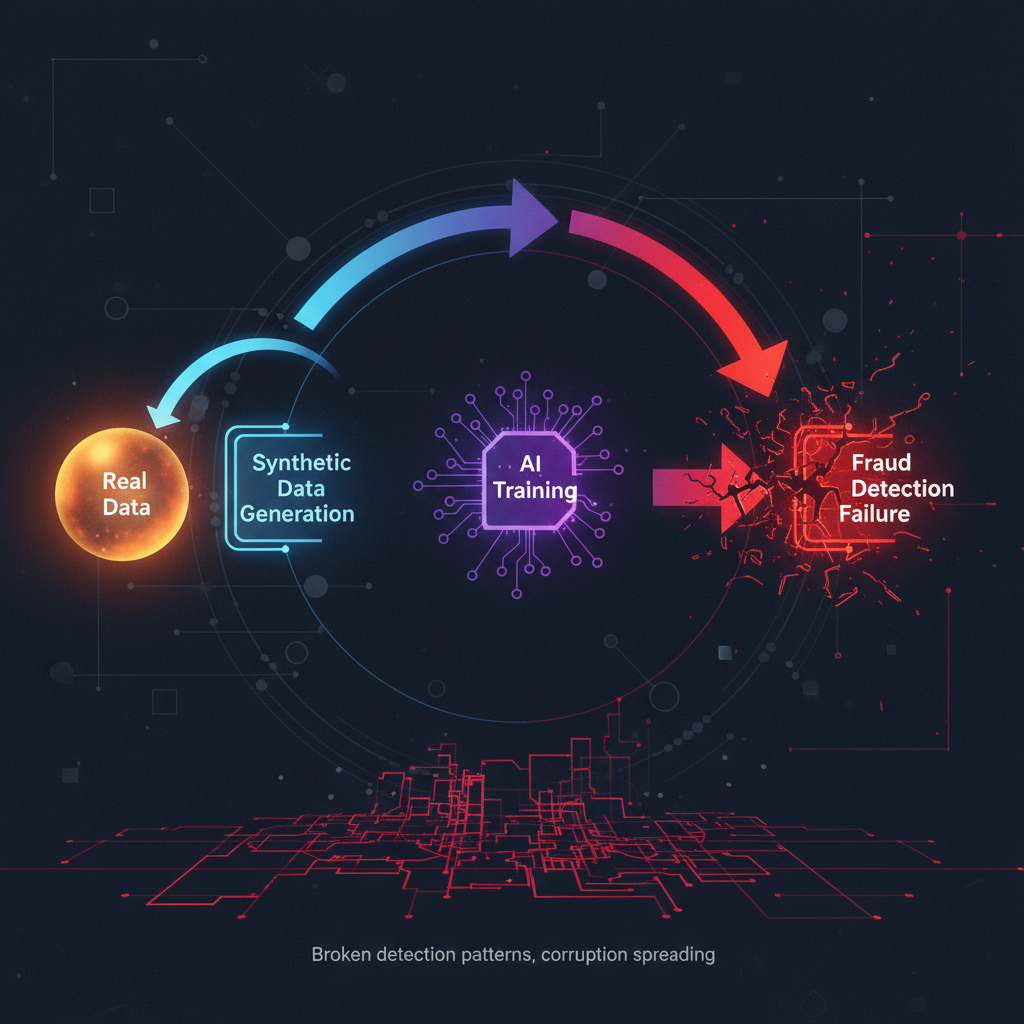
Why Synthetic Data Became a Liability Trap
Three reasons. First: synthetic data doesn't prevent fraud. Second: it creates detection evasion vulnerability. Third: regulators now treat it as negligence.
REASON 1: Synthetic Data Doesn't Prevent Crime When you generate fake customer data, criminals use the same tools. They get better at evasion faster. Synthetic identity fraud isn't prevented by synthetic training data, it's accelerated by it. You're both using the same technology. The difference is they're actively trying to evade your defenses, and your model is trained on patterns that never existed.
REASON 2: Detection Evasion at Scale By June 2026, fraud detection evasion using AI is commoditized. Bad actors don't trick your model, they train against it. They use synthetic data to reverse-engineer your detection logic. They generate attacks that synthetic-data-trained models miss because those models were never trained on real-world adversarial patterns.
The 2026 MRC Global Payments and Fraud Report found synthetic identity fraud absorbing over $5M in annual losses for companies. The trend is accelerating. Why? Because fraud detection built on synthetic data is worse than detection built on real, messy, human patterns.
REASON 3: Regulatory Liability The FTC's Operation AI Comply has signaled that deceptive or negligent AI practices carry consequences. The agency cracked down on companies that misrepresented training data, overstated accuracy, and skipped due diligence on what trained their models.
Here's the trap: if you used synthetic data to avoid privacy liability, and then someone gets defrauded because your model performed poorly, the FTC will ask why you knowingly chose a lower-quality training approach. You can't argue "privacy concerns" because you're admitting you built a worse model. That's negligence disguised as compliance.
One FTC enforcement action already came down on an AI company for misrepresenting their training data. They overstated accuracy. The FTC's logic was straightforward: you knew your data was synthetic. You knew it was insufficient. You sold it as sufficient anyway. That's deception.
Now extend that logic to fraud detection, customer analytics, or lending models. Companies built entire systems on synthetic data, marketed them as reliable, and are now sitting on regulatory bombs.
The Brands Already Caught in This
Three categories are most exposed.

FINTECH AND E-COMMERCE Companies built fraud detection on synthetic transaction data. They're now seeing real fraud rates they can't explain. Models work fine in the lab but collapse in production where real adversaries operate. Already absorbed millions in fraud losses. Can't upgrade without admitting the approach failed.
IDENTITY VERIFICATION Companies selling AI-powered identity verification to banks and fintech. They trained on synthetic documents because real documents are regulated. Now regulators ask: did you test this against real adversarial attacks? Did you know synthetic training doesn't prepare you for actual patterns? If not, that's negligence. If yes, why use it?
PERSONALIZATION AND RECOMMENDATIONS Consumer brands used synthetic behavior data to train recommendation engines. The synthetic data showed certain patterns correlating with purchases. Real customers don't follow those patterns. Recommendations degrade. Click rates drop. Brands blame models. Models blame data. Everyone's stuck.
Why Regulators Are Now Watching
The FTC's 2025-2026 enforcement priorities are explicit: deceptive AI claims, especially around training data and model accuracy.
Synthetic data deployments now have three liability layers:
- Privacy law (if you misrepresented how much real data was used)
- Consumer protection law (if the model performs worse than claimed)
- Sector-specific regulation (fraud detection, lending, healthcare)
The FTC enforcement pattern is consistent: companies that used synthetic data to scale without real oversight are treated as negligent. If your model fails and regulators ask about training data, saying "it was synthetic" doesn't help. It hurts. It shows you made an informed choice to use lower-quality data.
One brewing case involves a major fintech using synthetic financial transaction data to train lending models. The models systematically denied credit to certain demographics at higher rates than real-world performance justified. The FTC's question: did you know synthetic data wouldn't capture real-world biases accurately? Why use it then?
There's no good answer.
The Uncomfortable Math
Companies now face three paths:
OPTION 1: Keep synthetic models and accept the fraud and accuracy losses. Cost: recurring fraud, customer churn, potential regulatory action if losses go public.
OPTION 2: Revert to real data training and accept privacy liability. Cost: immediate regulatory scrutiny, GDPR fines in EU, state-level enforcement in US.
OPTION 3: Rebuild on real data with proper safeguards, differential privacy, federated learning. Cost: 6-18 months, $2M-$10M, complete retraining.
Nobody survives option 1. Option 2 is worse. So companies quietly choose option 3 and hope nobody notices the AI capability gap while they rebuild.
That gap is real. It's expensive. And it's why AI ROI is collapsing across industries. Companies promised synthetic data would solve scalability and cost. It didn't. Now they're paying to undo it.

What This Means for Your Brand
If you use any AI system trained on synthetic data, you're exposed. Not tomorrow. Now.
The exposure has three vectors.
FRAUD AND ACCURACY EXPOSURE Your model is provably worse than one trained on real data. If it fails, regulators will know why. If it succeeds, you got lucky. Scale that luck and it breaks.
REGULATORY EXPOSURE If your model causes harm and you used synthetic data to avoid privacy oversight, that's gold for regulators. The agency argues you knowingly chose a negligent path. That's harder to defend than "we didn't know."
MARKET EXPOSURE As competitors migrate away from synthetic data training, they'll market that fact. "Built on real data," "trained with authentic patterns," "tested against real-world fraud." Your synthetic-trained models will look cheap. Because they are.
The move: audit your models now. Find out what trained them. If it's synthetic, start migrating. The FTC doesn't care how many companies took this gamble. They care about prosecuting the ones that didn't fix it when they knew better.
The Bottom Line
The synthetic data era in AI is ending. It promised scale and privacy. It delivered neither. What it delivered was a generation of models that are provably worse than real-data-trained alternatives, and regulatory liability for brands built on top of them.
Companies that move fast toward real data training with proper safeguards will own the next phase. Companies defending synthetic data will become case studies in why cutting corners on training data doesn't work.
Companies are stuck between two impossible scenarios as covered in why companies can't measure AI ROI. The rebuild cost hides in engineering budgets, making the ROI trap even worse.
Your board is asking when you'll unlock AI's ROI. The honest answer: not until you fix the training data problem. And that costs real money.