
Salesforce signed a definitive agreement on October 20 to acquire Braze for $5.66 billion in enterprise value, paying $47.50 in cash per share. That is a 58% premium to Monday's $30.04 close. Braze shares jumped 52% on the news. Salesforce barely moved.
The coverage will fixate on the deal math and the synergy quotes for the next week. If you are a marketer, the interesting part is not what Salesforce paid. It is what changed hands: your vendor contract. The Salesforce Braze acquisition folds roughly 2,770 customer relationships into the largest marketing cloud on earth, and the close is expected in 2027. That gives every Braze customer a narrow window where they still negotiate with Braze, not with Salesforce.
What the $5.66B Deal Actually Says
Three numbers in this deal deserve more attention than the press release gave them.
First, the premium. $47.50 per share is 58% above where Braze traded Monday. Braze closed Tuesday at $45.57, within 4% of the offer price, which tells you the market thinks this deal gets done.
Second, the discount nobody mentions. Braze went public in 2021 at $65 a share and has fallen 51% since. So the 58% premium is real, and the buyer still paid less than the IPO price. Both facts can be true. Public investors priced Braze at 3.7x trailing revenue the day before the deal, and marketing software as a category trades around 3x. Salesforce paid 6.8x, per SaaStr's math on roughly $834 million of trailing twelve-month revenue. HubSpot and Klaviyo sat at about 3.1x. Adobe at 3.8x. Sprinklr at 1.1x.
Third, the gap between those multiples. A strategic buyer who needs your customer base will pay roughly double what public markets will. Salesforce is not buying $834 million of revenue. It is buying 2,770 enterprise relationships, Canva, Dairy Queen, Equinox, Instacart, Urban Outfitters, Venmo, and the right to sell Data 360 and Agentforce into every one of them. Braze is growing 26% with positive free cash flow, which makes it exactly the kind of asset a platform buys at the bottom of a category reset.
The read for marketers: this is consolidation bought on sale. Your stack is more likely to be rearranged by somebody else's M&A than by your own RFP. Plan accordingly.
The contract you signed with Braze transfers to a new owner in 2027. Read it before it does.

The Acquisition Handoff
When your vendor gets acquired, three things change hands even though nothing about your account changes on paper. Call it the acquisition handoff.
Your price is first. Braze signed you at Braze's economics. Salesforce sells at Salesforce's economics, and Salesforce has a long history of harmonizing acquired products into its own pricing structure. Any renewal that lands after the close gets priced in a different world. The negotiation you do not have now is the one you will wish you had.
Your roadmap is second. Bill Magnuson said Braze will keep building as Braze and invest in the Braze community. That is what every acquired CEO says the week the deal is announced, and sometimes it is even true for a while. But the product direction now answers to a portfolio strategy built around Data 360, Customer 360, Agentforce, and SIForce. Features that help Braze sell more of Salesforce's platform will ship. Features that compete with the platform will not. Your product requests now compete with a roadmap written in San Francisco, not New York.
Your bargaining power is third. Today you are a customer of a 2,770-account company where your logo matters. After the close, you are one line item inside a customer base measured in the hundreds of thousands. Your account team turns over. Your escalation paths reset. The relationship you cultivated becomes a record in a bigger CRM. This is not malice. It is arithmetic.
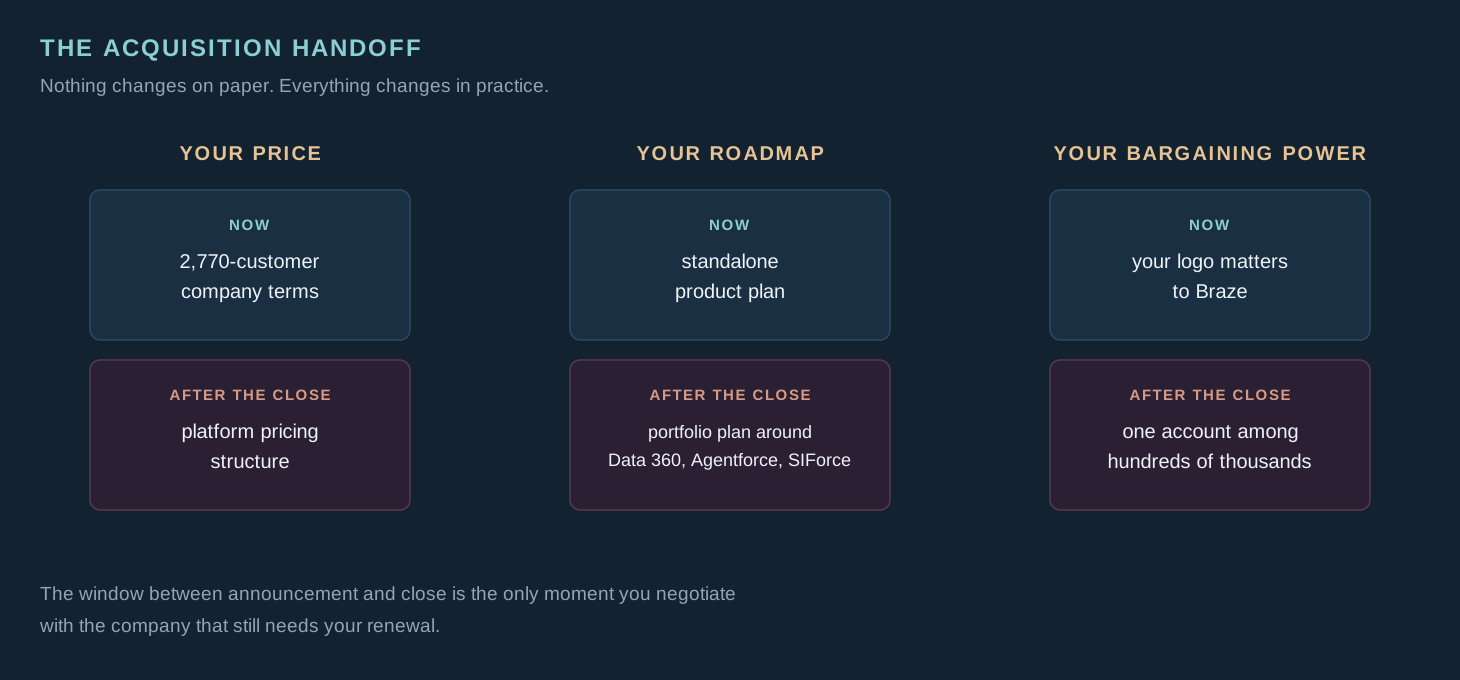
None of this is an argument against the deal. Salesforce buying Braze could make the product better and the company more stable. The argument is about timing. The window between announcement and close is the only moment when you have information the future does not: you know exactly what your current contract says, and you know who will own the other side of it.
The Five-Move Pre-Close Playbook
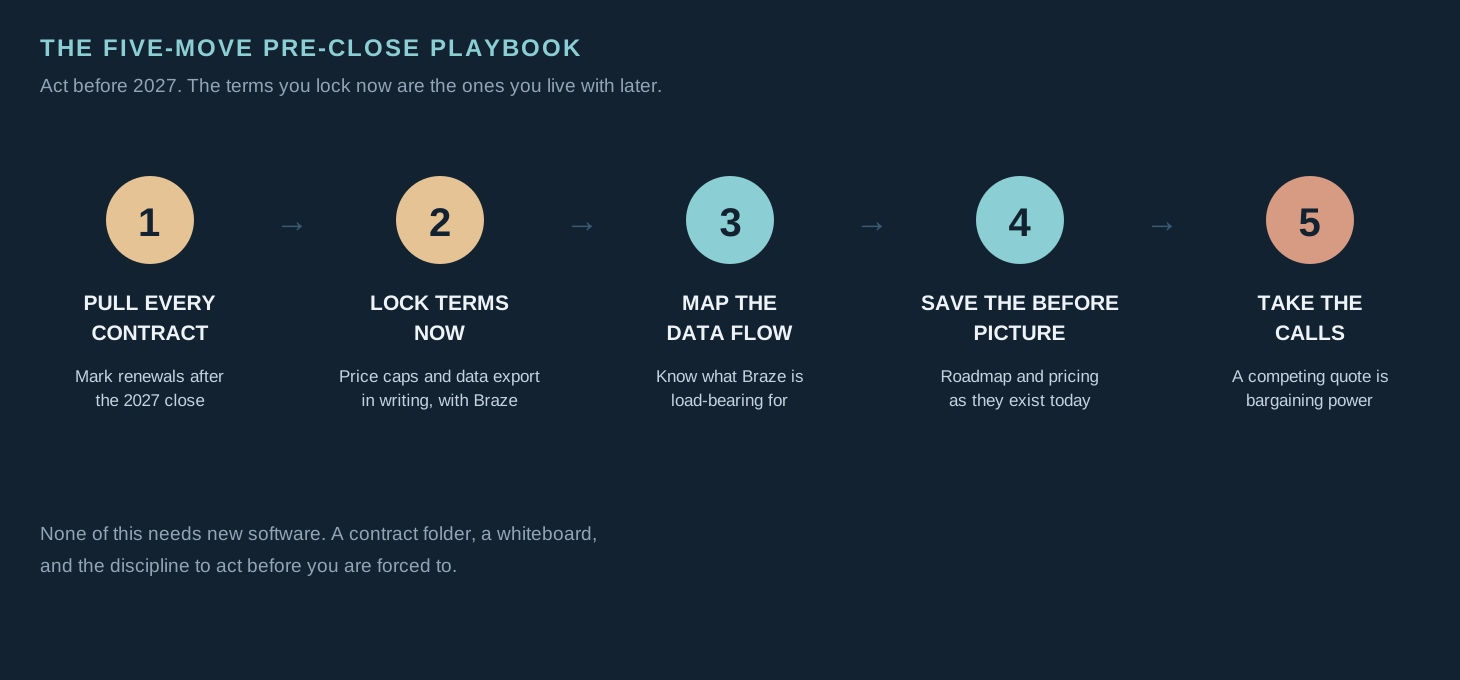
The close is expected in 2027, subject to shareholder and regulatory approval. Between now and then, five moves.
First, pull every Braze contract you have. Find every renewal date, every price protection clause, every auto-renewal. Mark anything that renews after the expected close. Most teams will discover they do not actually know where their Braze paperwork lives. Fix that this week.
Second, lock price caps and data export terms while Braze still signs as Braze. Negotiate multi-year pricing before the counterparty changes. Get your data export rights in writing, specifically event-level behavioral data, not just reports. Ask about warehouse connectors and API access staying intact post-close. You will never have more bargaining power over these terms than you have right now, because right now you are negotiating with a company that still needs to close its customer base intact.
Third, map where Braze sits in your data flow. Draw the actual picture: which events stream in, which systems consume the segments, which messages depend on real-time triggers. The marketers who can diagram their Braze dependency in an afternoon will negotiate from strength. The ones who discover Braze is load-bearing only when something breaks will negotiate from panic.
Fourth, watch the roadmap, and keep the receipts. Save the current product roadmap, the pricing page, and the BrazeAI feature announcements as they exist today. If features get folded into a Salesforce SKU after the close, you want the before picture to price the after. This is the same discipline I have written about for stack compression in general: fewer tools sound smarter until you find out what got merged away.
Fifth, use the moment. Competitors smell blood in the water after every acquisition. Klaviyo jumped nearly 12% on this news, and its sales team is absolutely calling Braze customers this week. Take the calls. Get the quotes. You do not have to switch to benefit from the existence of an alternative. A competing offer is the cheapest bargaining chip you will ever own, and it expires the day you sign.
None of these moves requires new software. A contract folder, a whiteboard, and the discipline to act before you are forced to.
Map the dependency while it is still optional. After the close, it is infrastructure.

Why Your Stack Will Not Be Chosen by You
Step back from Braze for a second, because this is bigger than one deal. This is the second big Salesforce move of the year after the $3.6 billion purchase of Fin in June, and it comes with an Anthropic partnership and an AI agent platform to feed. The pattern is a platform buying its way out of every feature gap, and Braze's event-streaming architecture plus BrazeAI decisioning is the piece that turns live behavior into messages across every channel.
Public markets value marketing software at roughly 3x revenue because they expect AI agents to eat into the seat counts and campaign work these platforms sell. Strategic buyers pay 6.8x because they are buying the customer base, not the multiple. As long as that gap exists, more of your vendors will get acquired. The question is never if your stack gets rearranged. It is whether you see it coming.
The marketers who treat this as someone else's deal will wake up in 2027 with a Salesforce renewal quote, a migrated contract, and no plan. The ones who act now will have locked pricing, mapped dependencies, and options. Same deal. Different outcome. The difference is about eighteen months and the willingness to read your own paperwork.
I have written before about the vendor-side consolidation wave, the companies getting bought and buried. This is the customer-side companion: what to do when the consolidation finds you. Your next vendor migration will probably be chosen by a board in a deal announcement. Make sure it is not a surprise.