Multi-Touch Attribution IsCollapsing
Multi-touch attribution adoption hit 47% but models are silently failing. CMOs with no validation skills are making bigger budget bets on broken data.
Dellon S.
June 2, 2026 • 9 min read
The numbers look good on paper. Multi-touch attribution adoption jumped from 31% in 2023 to 47% by mid-2026. Your martech stack supports it. Your analytics dashboard displays it. Your CMO's quarterly update mentions it proudly.
The problem: the models are breaking down in real time, and most teams won't realize it until they've already burned through next quarter's budget on channels that looked good in the data but weren't actually moving the needle.
47%
Teams adopted multi-touch
18%
Improved ROI with it
70%
CMOs say AI is critical yet unprepared
The Attribution Illusion
Multi-touch attribution models come in three flavors: rules-based (first-click, last-click, linear), data-driven (algorithmic), and algorithmic with ML overlay. Each has built-in assumptions about how customers move through your funnel.
But in 2026, those assumptions are cracking. First, the data itself is degraded. Third-party cookies are extinct. First-party data collection is spotty. You're working with 40-60% of the actual customer journey. Your model sees Google search, email, then conversion. It doesn't see the Reddit thread that started the conversation, the Discord recommendation, or the word-of-mouth mention.
You're optimizing based on a silhouette of the real journey.
Second, AI is now injecting signal where none exists. Many platforms use LLM-based inference to "fill in the gaps." This sounds powerful. In practice, it's hallucination dressed as science. The model guesses plausibly. You treat the guess as data. You reallocate budget. The cycle repeats.
Why It's Worse Than Last-Click
Single-touch attribution has obvious limitations. Everyone knows last-click overweights the final touchpoint. It's dumb, but transparently dumb.
Multi-touch attribution feels sophisticated. Your dashboard shows nuanced credit distribution. Your reporting looks professional. It feels like you've upgraded from a flip phone to a smartphone.
Except the smartphone is running on a degraded network, feeding you partial data, and using AI to hallucinate the parts you can't see.
This is worse than last-click because it creates false confidence. You'll make bigger budget moves. You'll shift spend away from channels that actually drive value. You'll double down on channels the model loves but that don't move the needle.
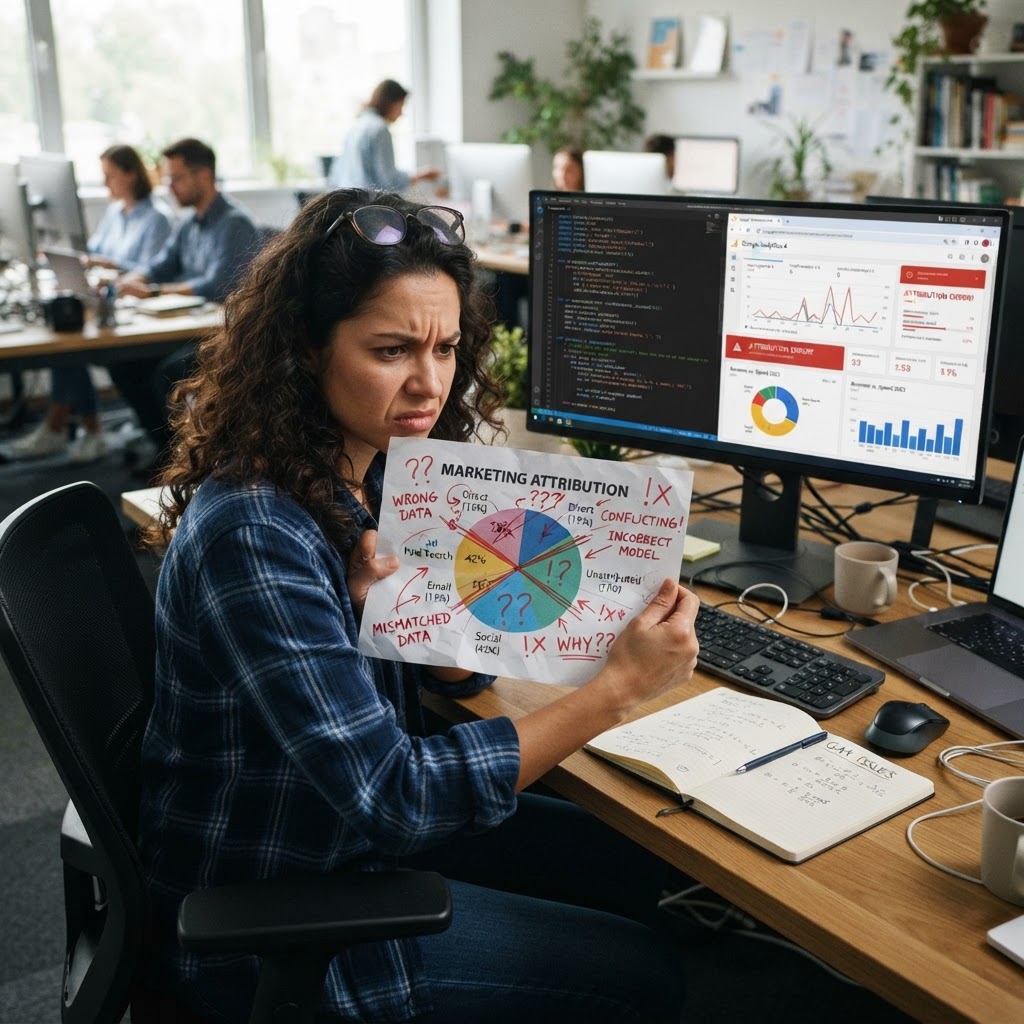
The CMO Skills Gap
70% of CMOs say becoming an AI leader is essential in 2026. Exactly 70% also admit they're not operationally ready to deliver on it.
Multi-touch attribution with ML overlay requires understanding: how much training data is sufficient, what bias exists in historical data, when a model has degraded enough to need retraining, what inference hallucination looks like in practice, how to validate predictions against holdout tests.
Most CMOs don't have this skill set. So what happens? The vendor owns the model. The CMO trusts it. The budget flows. The measurement looks good.
Until it doesn't. Usually six months in, when the model has drifted so far from reality that recommendations produce negative ROI. Then everyone pretends the market shifted, competition got tougher, or the audience changed.
The model didn't fail. It was already failing. You just didn't have the diagnostic skills to notice.
The Real Gap: What You Need
CMOs actually need five things in 2026 to make attribution work:
1. A validation framework. Every quarter, test your model's predictions against holdout groups. What did the model say drives conversions? Measure it directly. Does it match?
2. Data quality audits. You need someone checking for gaps, bias, and real-time degradation.
3. Model versioning. When the vendor updates the algorithm, measure whether the new version improves accuracy or just makes the dashboard prettier.
4. Healthy skepticism. Ask "Does this insight make intuitive sense?" If the model says email drives 40% of conversions but your email open rate is 18%, something is wrong.
5. Experimentation as ground truth. Multi-touch models are useful for hypothesis generation. Controlled experiments are the only reliable way to measure true channel impact. If a channel looks good in the model but performs poorly in a test, trust the test.
Most teams have zero of these five things. They have a dashboard. They call it strategy.

"If a channel looks good in the attribution model but performs poorly in a controlled experiment, trust the experiment."
What Happens Next
If the market doesn't shift fundamentally, here's the trajectory:
Q2-Q4 2026: Teams continue adopting multi-touch attribution. Models degrade silently. Teams feel confident.
Q4 2026-Q2 2027: Budget reallocation produces obvious ROI underperformance. Teams lose confidence in models.
Q2-Q4 2027: Major martech players launch "attribution verification" as premium service. It works because it's just rigorous experimentation underneath.
Q4 2027+: Multi-touch models bifurcate. Models with real validation become reliable. Models without validation become liabilities.
CMOs who build validation skills now will own this transition. CMOs accepting what their dashboard tells them will be explaining negative ROI to their CFOs.
The Bottom Line
Multi-touch attribution is the right idea executed on degraded data, with hallucinating AI filling gaps, while CMOs lacking validation skills make large budget bets based on the results.
It's not that multi-touch attribution is bad. It's that execution is almost universally broken, and complexity perfectly hides the breakage.
If you're using multi-touch attribution right now, ask one question: Can you prove not assume that the model's recommendations improve ROI compared to random allocation?
If you can't, you're operating on false confidence. That's a bigger problem than attribution. That's a strategic vulnerability.
Read more on related topics: CMO AI Readiness Gap and AI Agents Audit Trail Blindness.