I'm Not Actually Here:
The Wild New World of Licensed Artist DNA
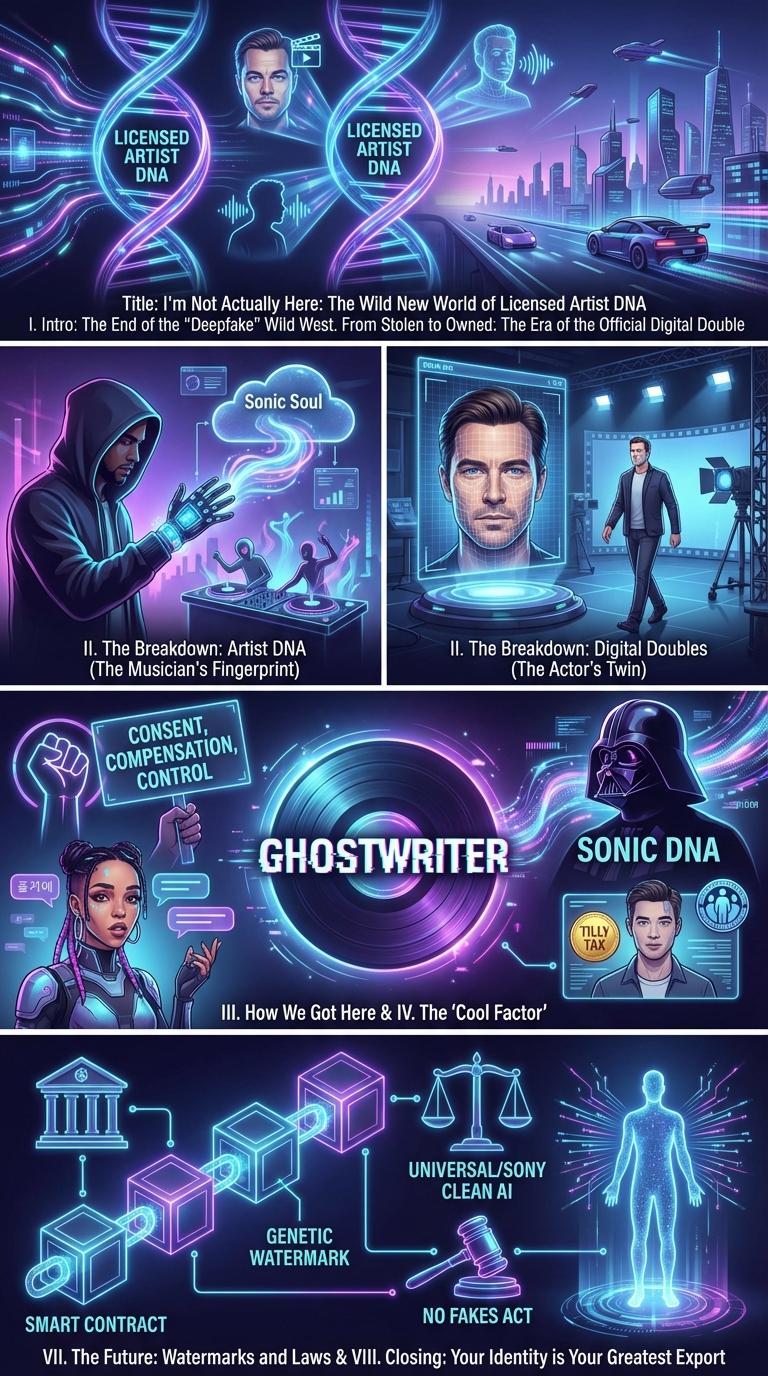
We have quietly slipped past the chaotic, lawless frontier of the “deepfake” and arrived at a far more fascinating — and perhaps unsettling — destination. Forget the sketchy, unauthorized AI Drake covers of a few years ago. The era of the “stolen voice” was merely a symptom of technological adolescence. Today, we have entered the era of the official Digital Double.
Imagine the metaphysical implications: being in two places at once, flawlessly speaking five languages you have never actually studied, and accumulating capital while you sleep.
Artist DNA vs. Digital Doubles:
The New Cartesian Split
The Mind
“Artist DNA” — the musician's fingerprint. An algorithmic capturing of an artist's “sonic soul”: unique vibrato, rhythmic idiosyncrasies, and overarching aesthetic vibe.
The Body
“Digital Doubles” — the actor's twin. High-definition somatic replicas for film. The transformation of the self into a scalable, infinitely monetizable asset.
From Panic to Progress: How We Got Here
Progress is rarely born from tranquility; it usually requires a rupture. In the music industry, that rupture was the 2023 chaos induced by “Ghostwriter,” the anonymous creator whose fake Drake and The Weeknd collaboration nearly broke the institutional music apparatus.
In Hollywood, the reckoning took the form of the historic 2023–2025 SAG-AFTRA strikes. While the media often framed the dispute in purely economic terms, it was fundamentally a philosophical stand for human sovereignty.
The “Cool Factor” & Immortal Icons
FKA Twigs recently conceptualized “AI Twigs,” a digital iteration of herself capable of interacting with fans and handling social media in fluent Korean and French, bypassing the clumsy mediation of Google Translate.
James Earl Jones formally retired from acting but licensed his “Sonic DNA” to Lucasfilm, ensuring that the menacing baritone of Darth Vader will outlive the man who originated it. The biological limitations of the human vocal cords have been transcended.
The “Tilly Tax”
Perhaps the most fascinating development of 2026 is the implementation of the “Tilly Tax.” Whenever a studio uses a purely synthetic actor, they must pay a tax to the human union. We are literally taxing the imaginary to subsidize the biological.
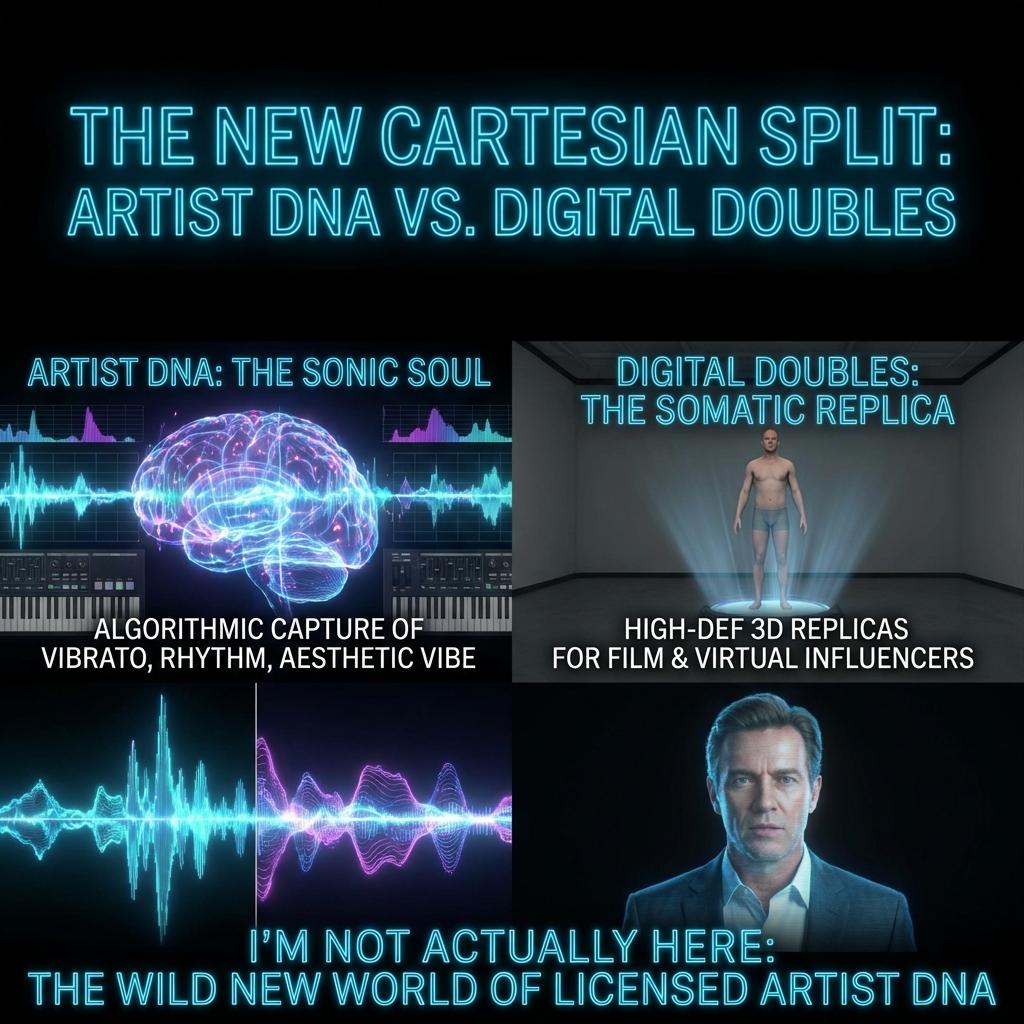
Conceptual: The Volumetric Capture Process of 2026
Passive Income or Existential Threat?
Established musicians are embracing a utopian vision of passive income. By licensing their vocal DNA to platforms like ElevenLabs, they effectively outsource the labor of creation to their fans. The artist ceases to be merely a creator and becomes a platform.
However, working-class actors and background extras face a bleaker reality. The “Three C's” — Consent, Compensation, and Control — are the new battleground. The risk is that big studios will offer one-time buyout fees for perpetual digital likenesses, leaving performers without residual income as their digital ghost keeps working.
The Tea: Navigating Recent Controversies
The Scarlett Johansson “voice theft” incident provided a crucial legal precedent: that a public figure's voice is their intellectual property, even before formal licensing agreements exist. The ethical bright line has been drawn — consent is not optional. The broader question of how AI systems handle truth and identity is one worth understanding — AI deception runs deeper than most people realize.
Watermarks, Laws, and the Future
The “NO FAKES Act”
This impending legislation seeks to establish a fundamental digital human right, making the theft of anyone's likeness — not merely the rich and famous — a federal crime.
You, But Better?
We are crossing the threshold into an era where your “identity” is no longer just who you are — it is your greatest exportable commodity. The tools driving this shift are evolving fast; see how the leading AI platforms stack up in 2026. The boundary between the biological self and the digital asset has irrevocably dissolved.
Would you license your own “DNA” if the price was right?