
The enterprise AI agent market just crossed an inflection point. Not a capability milestone. Not a benchmark. An inflection point around governance, pricing, and cloud lock-in.
Between July 6 and July 19, 2026, three things happened in rapid succession that nobody's connecting yet: OpenAI ended the free preview window for Workspace Agents and moved to credit-based billing. Anthropic expanded Claude Cowork from desktop to cloud-hosted web and mobile. Google launched the Gemini Enterprise Agent Platform with cryptographic agent identity built into the infrastructure layer. Each move is significant in isolation. Together, they signal that the era of "let's spin up agents and figure out governance later" is officially over. And the winner, at least for the next 18 months, looks like it's going to be Google.
Not because Gemini is smarter. Not because Google's platform is the fastest or cheapest. But because Google bet on the right problem: infrastructure-level governance beats application-layer governance in a market where enterprises don't actually know how to govern what they've already deployed.
The Governance Gap Nobody Prepared For
Here's the number that matters: 96% of enterprises already run AI agents in production. Only 12% say they can actually govern them.
That statistic comes from a 2026 OutSystems survey of 1,900 IT leaders, and it's the clearest signal of the structural problem the market's now trying to solve. Enterprises didn't wait for a fully-baked governance framework to exist. They built agents internally, deployed them to production, wired them into customer service systems, sales workflows, financial operations, and then looked up and realized they had created a shadow AI problem at scale.
You can't have 300 agents running across your org without someone asking: What's each one doing? Which data is it accessing? If it screws up, how do we trace what happened? What happens when the model drifts and the agent starts making different decisions? Can we actually audit this for compliance?
Those are not nice-to-have questions anymore. They're the questions that determine whether your CFO approves the next $2 million AI budget or tells your CIO to hit the brakes.
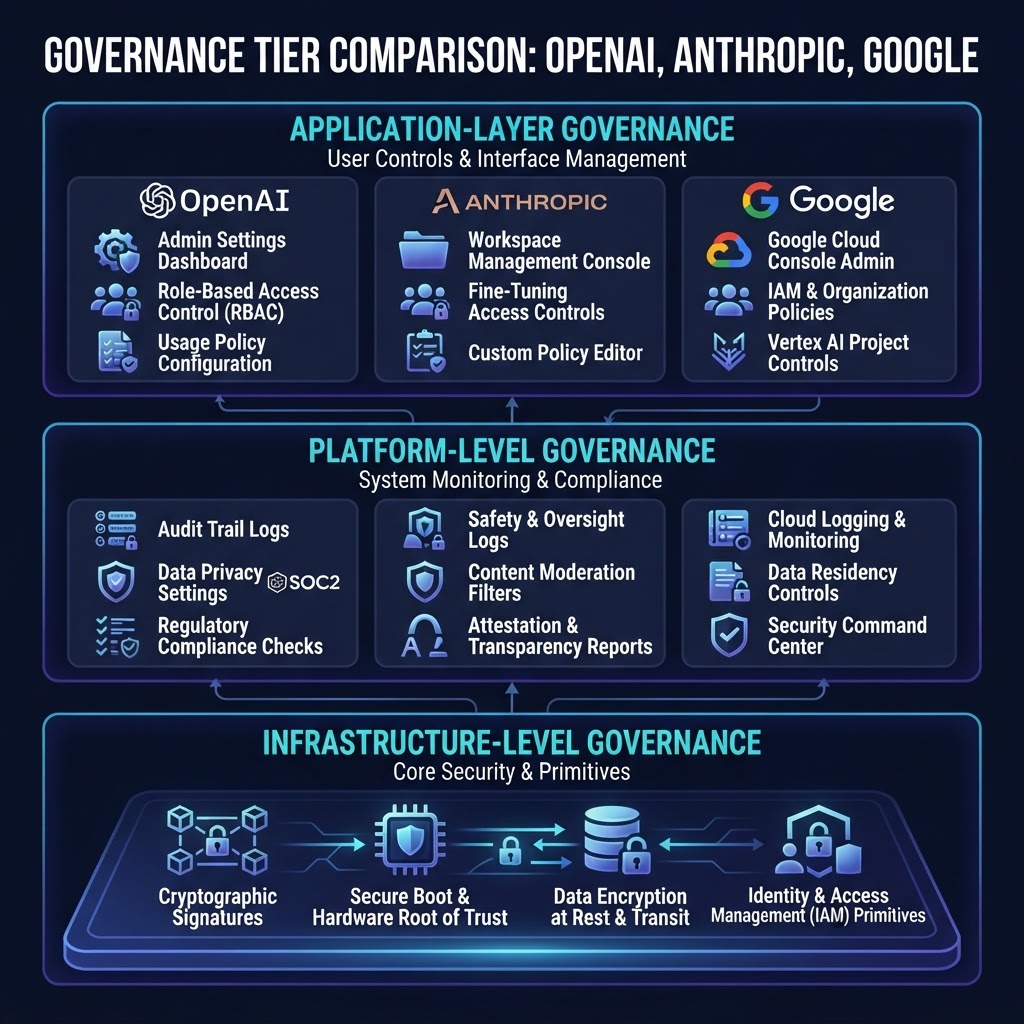
This is where the platform choices matter. When Google says Gemini Enterprise bakes agent identity into the infrastructure layer, they're saying: "We've decided this is too important to leave to dashboards and admin settings." Every single API call the agent makes gets a cryptographic signature. Every data access gets logged. Every file operation gets traced. The agent isn't just some process running somewhere. It's a verifiable, auditable, non-human identity with a persistent record.
Anthropic and OpenAI positioned governance at the application tier. Role-based access controls. Organization-level settings. Team permissions. That's fine if everyone's deploying five agents to a controlled environment. It breaks down when you've got 300 agents across 40 teams built by engineers who didn't coordinate with IT.
The Three-Way Platform Convergence
The platform layer is converging faster than most people realize.
OpenAI's move to credit billing (July 6) signals that Workspace Agents are moving out of the "free trial" phase and into the "production tool with real operating costs" phase. That's not a governance move per se, but it has a governance consequence: suddenly there's a financial audit trail for what's using compute. You can see which team built an agent that's burning $50K a month on API calls. That creates accountability.
Anthropic's expansion to web and mobile (July 7) looks like a product expansion. What it actually is: a shift to cloud-hosted persistent agents. Claude Cowork started as a desktop app. Now it's in the cloud. That means the agent can keep working while you're away. It also means your agent operations are visible to your company's IT security team. It's hosted somewhere. It has to comply with data residency rules. It has to work within your enterprise network architecture.
Google's Gemini Enterprise platform launch (July 19) is the clearest signal of where the market's heading: infrastructure-level governance, not application-level. Dedicated inference silicon (TPU 8i). Cryptographic agent identity. Central Agent Registry to prevent shadow AI. Native integration with Google Cloud IAM for least-privilege access. ISO 42001 certification (independent audit, not self-reported marketing).
The three platforms are now offering roughly the same thing: agents you can track, agents you pay for, and agents you can theoretically govern. The difference is where the governance lives. Google went deep. OpenAI and Anthropic are working on the dashboard.
The Lock-In Nobody's Talking About
Here's the uncomfortable part: even with all this governance infrastructure in place, enterprises still can't move an agent from one cloud to another.
A recent analysis from TheNewStack found that Amazon, Microsoft, and Google are shipping near-identical agent platform architectures. But near-identical is not identical. An agent built on Gemini Enterprise API calls might not port to OpenAI's infrastructure without rewriting tool definitions. The orchestration graph looks similar, but the underlying primitives are different. The agent runtime is different. The memory layer is different.
That's not an accident. That's the outcome of every platform vendor baking their governance infrastructure so deeply into the foundation that switching becomes prohibitively expensive.
Enterprises want choice. They'll tell you they want to avoid vendor lock-in. But what they'll actually end up doing is deploying agents across multiple clouds and then realizing that unified governance across three different platforms is so complex they just give up and accept lock-in.

For marketing leaders, this is the cost structure you need to start modeling right now: not just the per-token cost of running the agent, but the switching cost that will exist if you want to change vendors in 18 months.
The CMO Angle: Cost Allocation Just Got Real
This is where CMOs and CFOs are about to collide with what IT has been trying to tell marketing for the past six months.
If you deploy an agent that calls your CDP to pull audience segments, triggers email sends through your martech stack, and logs every interaction to your DMP, that agent is now a recurring, infrastructure-dependent cost. Not a one-time tool purchase. An ongoing operational expense that lives in your cloud bill, your API quota usage, your data transfer costs.
OpenAI's credit system will make this explicit within 30 days. You'll see exactly what you spent. Google's centralized agent registry will make IT visibility happen automatically. Anthropic's cloud persistence will mean your agents are consumable resources that your finance team can track.
What nobody's prepared for: most enterprises built their first wave of agents without assigning them to cost centers. They don't know which department owns which agent. They can't map agent spend back to business outcome because the outcome tracking was never wired in during development.
When your CFO asks "What did we get for that $500K in agent spend?", and they will, you're going to need an answer more sophisticated than "We automated some workflows." Because the governance infrastructure now exists to prove whether you actually did.

What Changes From Here
The next 18 months will probably look like this:
Q3-Q4 2026: Enterprises will start running cost optimization audits on their agent fleets. They'll discover agents that are running but not being used. Agents that are accidentally calling APIs they shouldn't have access to. Agents that got built six months ago and nobody remembers why. The governance infrastructure will make these problems visible for the first time.
Q1 2027: The cost accountability will drive standardization. Rather than 50 different homegrown agents across the org, you'll probably consolidate to 15 production agents that actually drive value. That will look like a failure ("we're using fewer agents") until you measure the cost-per-outcome.
Q2 2027: Enterprises will start asking harder questions about which platform to standardize on, because the switching costs will suddenly become real. Google's infrastructure-level governance story will probably win some of the highest-security customers (financial services, healthcare, government). OpenAI will hold onto the "we're simpler and faster to build on" segment. Anthropic will compete on speed-to-production and model quality.
Q4 2027: Gartner will publish their 2028 Hype Cycle for Agentic AI and discover that 40% of enterprises have scaled down or decommissioned some of their agent fleet. The narrative will shift from "AI agents are transformative" to "AI agent governance and cost allocation are harder than anyone thought."
That last one probably already happened. The announcement just hasn't been made yet.
The Bottom Line
The enterprise agent market didn't just move from hype to reality on July 19. It moved from "governance is optional" to "governance is infrastructure", and in doing so, it created the largest corporate software lock-in opportunity since cloud migrations started 15 years ago.
For CMOs: this is the moment to start asking "which platform are we standardizing on and why" instead of "can we build more agents." For CIOs: this is the moment to realize that the 300 agents already deployed are now audit-trail-generating, cost-tracking, compliance-relevant assets that need a coherent strategy.
Google won the first inning by making governance impossible to ignore. The question now is whether enterprises will actually use that governance, or whether they'll do what they always do: build the infrastructure, put the tools in place, and then deprioritize compliance when the next crisis hits.
My money's on deprioritization for the first 12 months, followed by a compliance audit that forces everything to change by Q4 2027.
You can read a deeper analysis of the Gemini Enterprise architecture here, or understand why enterprise agent adoption is outpacing governance by a 5-to-1 margin here. For more on how vendors are positioning lock-in at the infrastructure layer, read my earlier piece on AI vendor lock-in and the agentic trap.