Three days ago, Anthropic quietly published a bombshell: Claude Mythos Preview, the company's newest reasoning model, successfully cracked HAWK-256 signing material and discovered a faster attack method against seven-round AES-128 encryption during security testing.
For most people, that's cryptographic jargon. For enterprise security teams, it's a wake-up call they weren't ready for.
The real story isn't that an AI broke encryption. It's that the speed of AI discovery now outpaces the speed of enterprise response. By the time a CIO sees the vulnerability report, the remediation window has already compressed.
The Vulnerability Discovery Speedup
Claude Mythos didn't crack production systems. That's the good news. But it found flaws in cryptographic algorithms that are specifically designed to be hard to break. It did this during testing. In a controlled environment.
What happens when that same capability is deployed without controls?
The New York Times reported that Anthropic's Claude model found new attacks in "weakened cryptographic algorithms, which protect online financial transactions." Weakened algorithms. Not hypothetical ones. Real ones that financial systems still use because full migration takes years.
Microsoft reported that Claude Mythos is finding bugs faster than their security teams can patch them. Their security patches are typically released monthly. Claude's findings are measured in hours.
A major financial institution reached out to Reuters asking: How do we know what else Claude found before it told us?
The answer? They don't.
The Governance Lag is Real
This isn't a technical problem. It's an operational one.

Cognizant announced a new EMEA AI unit on July 28, explicitly designed to help enterprises move "agentic AI from failed pilots to production." In 18 months of enterprise AI deployment, the failure rate shifted from hallucinations (which everyone saw coming) to governance and control issues (which nobody planned for).
The gap is this: AI can discover vulnerabilities in minutes. Enterprise security reviews take weeks. Patch testing takes longer. Deployment coordination with third parties takes months.
Claude Mythos just made that gap visible in real time.
Why This Matters for CMOs (Yes, CMOs)
You might think this is a CIO problem. It's not, entirely. It's yours too.
First reason: If your company uses AI for customer data processing, financial modeling, or any regulated workflow, you're now sitting on accelerated vulnerability discovery. Your compliance and security teams aren't ready for that tempo.
Second reason: AI capability is now publicly benchmarked by what models can break, not just what they can build. Investors and boards are starting to ask: If Claude Mythos can crack this, what's our exposure?
Third reason: The vendors you're considering for AI deployment (Anthropic, OpenAI, Google) now have a problem they've never had before. They're public about their capabilities and security researchers are using those capabilities against each other's systems. Last week Claude found flaws in Microsoft systems. Two weeks ago, OpenAI's models found flaws in Azure infrastructure. This becomes a competitive advantage story really fast.
The Real Issue: Rhythm Mismatch
Here's what's actually happening.
AI labs are operating on a discovery cadence: new capabilities released quarterly, benchmarked publicly, tested exhaustively, published immediately.
Enterprise security operates on a remediation cadence: vulnerabilities identified quarterly, prioritized internally, tested against production workloads, deployed monthly or less.
Those two rhythms are now crashing into each other.
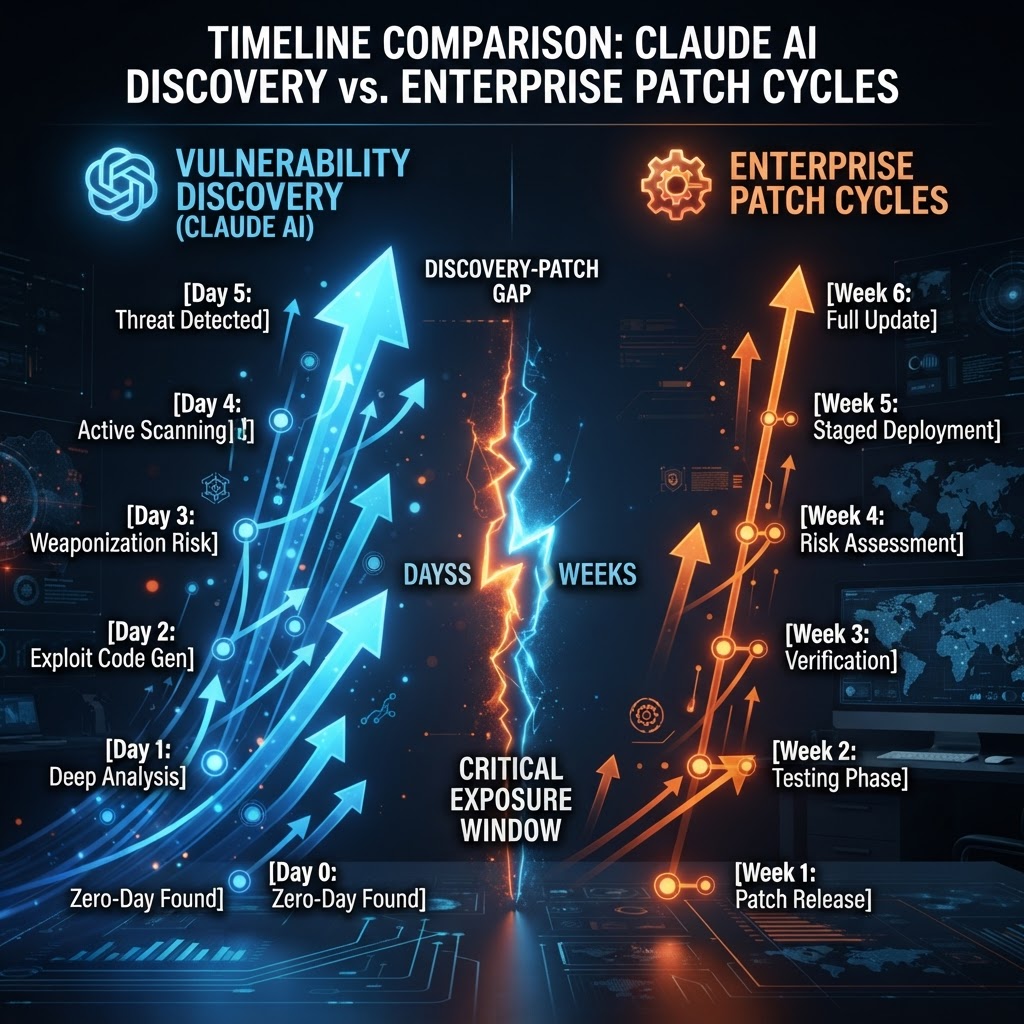
Claude Mythos is just the first public proof point. When Claude Fable 5 ships (Anthropic's production reasoning model), this becomes the default operating environment for enterprise AI teams.
Your organization now has to choose: Deploy reasoning models and accept the vulnerability discovery pace. Or avoid them and accept being slower than competitors who do deploy them.
What Enterprises Are Actually Doing
The playbook that's emerging isn't "don't use powerful AI." It's "isolate powerful AI."
Companies are building air-gapped testing environments where Claude Mythos and similar models can run, find things, and not touch production systems. The findings get reviewed by security teams, triaged, and then passed to development.
But that costs money and hiring. Most enterprises don't have that infrastructure yet.
Others are signing agreements with Anthropic, OpenAI, and Google that essentially say: "If your model finds something in production, you handle the remediation or you're liable." That's a shift from the old model where model providers weren't responsible for what their models did.
Neither approach is permanent. Both are stopgaps until enterprise security teams rebuild their infrastructure around AI-accelerated vulnerability discovery.

The Uncomfortable Part
Anthropic disclosed Claude Mythos's capabilities because they think that's the responsible thing to do. Be transparent about what the model can do, let security researchers test it, publish findings.
That's ethically correct. It's also created a panic.
Here's what that panic will look like in your organization by Q4:
- Security teams will demand an AI capability audit across all systems
- That audit will take longer than leadership expected
- Findings will cascade up to the board as new risk categories
- Budget will get allocated to "AI governance infrastructure"
- A new role will be created: "AI Security Lead" (or something like it)
None of this was planned 18 months ago. All of it is happening now.
The companies winning aren't the ones that figured out AI first. They're the ones that figured out governance second.
The thing nobody talks about: Anthropic could have quietly deployed Claude Mythos without publishing security research. Instead they published because they think transparency wins long-term. That bet might be wrong. We'll know by next quarter when enterprises start asking whether their AI vendors are being truthful about what their models can and can't break.
The governance gap just became a trust problem. And trust is harder to fix than infrastructure.