
On November 2, Adam Fry, the product lead for ChatGPT, told journalist Alex Kantrowitz that ChatGPT search now handles about a fifth of Google's search volume. The line traveled fast. By November 3 it was in Big Technology, The Verge, and Search Engine Journal.
Here is the number nobody quoted next to it. In October 2026, across 118,671 sites tracked in Ahrefs Web Analytics, Google sent 24.74 percent of website traffic. ChatGPT sent 0.36 percent. That is the gap this post is about. One number counts questions. The other counts visits. They are moving in different directions, and your marketing plan has to pick which one it is built for.
ChatGPT search is real, and it is big enough to plan around. It is not a replacement for Google, and the proof is in your own analytics if you know where to look.
What ChatGPT Search Actually Counts
Start with the claim itself, because the wording does most of the work. Fry said ChatGPT's volume of search-like queries is now roughly one-fifth the volume of queries of Google. His definition of a search was plain: every time you ask a question and go search the web, that counts as a search. One conversation can count as several searches, since each trip to the web is its own event.
That definition matters more than the number. OpenAI has not published the data, the time period, or the method behind the comparison, and it has not said which Google figure it used as the baseline. Treat the 20 percent as OpenAI's own estimate, not a measured market share. Independent estimates run lower, and one careful summary of the claim puts them side by side. Search data firm seoClarity put ChatGPT's daily search activity at about 7.5 percent of Google's in October 2026. Ahrefs estimated about 12 percent back in February 2026.
Fry also put ChatGPT at 1.2 billion weekly users. That part deserves a footnote. The Verge had already reported the same 1.2 billion figure on September 29, so the jump from 1 billion in about 60 days that Fry described reads shakier than the headline. The user count is huge either way. The growth story attached to it is not settled.
Two more facts keep the claim honest. First, most ChatGPT use is not search at all. Semrush clickstream data from February 2026 found ChatGPT ran a web search in 34.5 percent of cases, which means roughly two of every three ChatGPT sessions never touch the web. Second, Google is not shrinking. On its October 28 earnings call, Google reported its highest year-over-year search query growth in five years. The pie is getting bigger while ChatGPT takes a slice of it.
So the honest version of the headline is narrower and more useful. ChatGPT search is now a real discovery surface, handling somewhere between a twentieth and a fifth of Google's search-like query volume, depending on whose count you trust. It sends a tiny fraction of the visits Google sends. The tension between them is where the work is.
The Gap Is the Story
A query and a visit used to be the same event with two names. Someone typed a question, clicked a result, and landed on your site. ChatGPT search breaks that chain. The question gets asked, the answer gets written, and the trip often ends right there. No click, no session, no trace in your analytics.
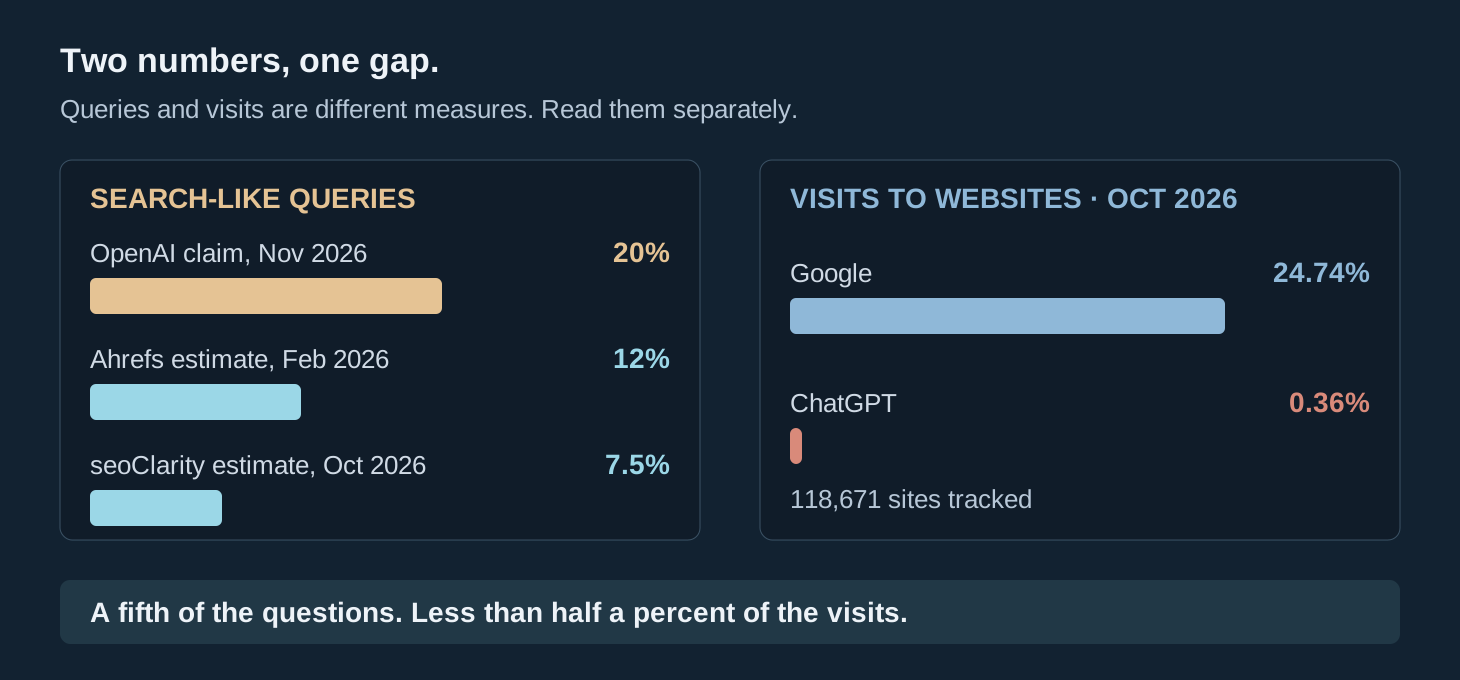
That split shows up in the numbers. OpenAI's 20 percent is a query count. Ahrefs' 0.36 percent is a traffic share. A fifth of the questions, less than half a percent of the visits. The same split showed up in February, when Ahrefs found Google sent about 190 times more visitors than ChatGPT. Eight months later, the query share grew and the traffic gap barely moved.
Google noticed the same split from the other side. On that October 28 earnings call, chief business officer Philipp Schindler said Google is now scaling ads inside AI Overviews and AI Mode to more users and queries. Read that plainly. AI Mode queries earned less than classic search, so Google is putting ads inside the answers themselves. Both companies are monetizing the answer now, not the click after it. The click economy is not dying. It is being fenced off to the searches where a click still has to happen.
Discovery is decoupling from visits, and that split is the shift worth planning around. A growing share of the questions your customers ask will be answered somewhere you cannot see, by a model you cannot track, with a citation you may or may not get. The marketers who adapt first will be the ones who stop asking how much traffic AI search sends and start asking which of their queries still send any.
Sort Your Queries Into Three Buckets
The triage takes an afternoon, and it uses data you already have. Export your top 100 queries from Search Console for the last 90 days. For each one, ask a single question: could a good answer end this search without a visit? Then sort the list into three buckets.
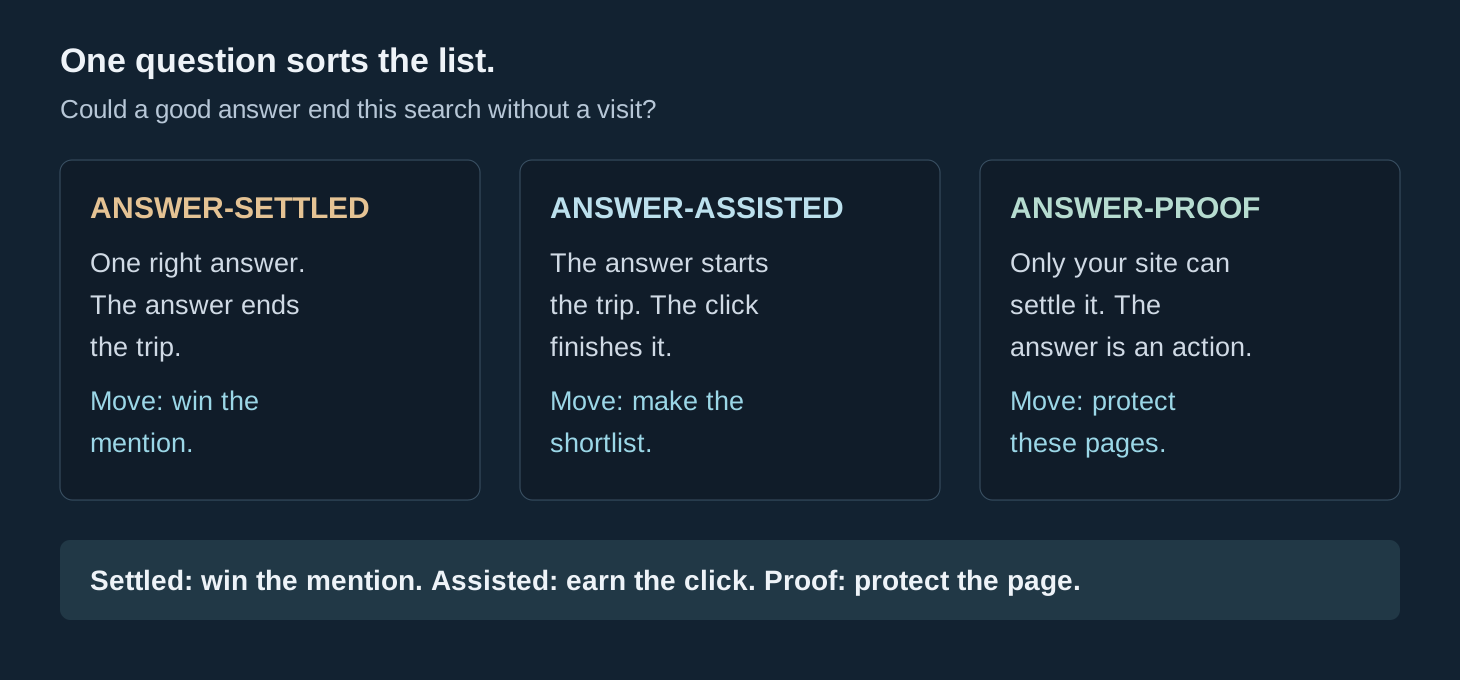
The first bucket is answer-settled. These are questions with one right answer, and the answer is the whole trip. A price, a definition, a how-to step, a comparison with a clear winner. The searcher reads the answer and moves on. Chasing clicks here is chasing a door that already closed. The move is to win the mention instead. Feed the answer with facts it can quote: named products, current prices, real specs, hours that are actually right. A mention in the answer is the win now, and it is measurable in a way a lost click never will be.
The second bucket is answer-assisted. The answer starts the trip and the click finishes it. Someone asks for the best option, reads a shortlist, then clicks to verify, compare, or buy. The shortlist is the new front page. If your name is not in it, the click never had a chance. If your name is in it, your landing page has to answer the same question the answer raised, in the first screen, or the searcher bounces back to the answer and picks the next name. This bucket is where most commercial queries live, and it is where the old SEO work still pays, just one step earlier in the trip.
The third bucket is answer-proof. These are the searches only your site can settle, because the answer is an action, not a fact. Book a demo. Check your price. Log in. Use the tool. See the original data. No model can complete these for the searcher, so the visit survives. Protect these pages like revenue, because they are the visits that stay when the rest of the list goes quiet. This is also where original reporting earns its keep. A model cannot summarize data that does not exist yet, so the pages built on your own numbers are the hardest for an answer to replace.
Run the sort with real numbers, not vibes. Pull the same 90 days in GA4 and look at referrals from ChatGPT alongside your Search Console list. If a query sits in the answer-settled bucket and your ChatGPT referrals are flat while your impressions hold, that is the split doing its work in your own data. If a query sits in the answer-proof bucket and its clicks are falling anyway, something else is wrong, and the answer is not the suspect.
One more warning about the data. Google's generative AI performance report counts impressions only. It has no click count for AI features. The clicks AI answers send land in the normal Performance report, mixed with everything else. I covered why that gap breaks measurement back in September, and the gap has not closed since. Do the subtraction yourself or you will read the AI report, see impressions with no clicks, and conclude the answer sends nothing.

Claim the Scoreboard Before It Opens
Four days after the 20 percent claim, the second piece of the story showed up. On November 6, e-commerce analyst Juozas Kaziukenas posted screenshots on LinkedIn of a ChatGPT feature OpenAI is building, a Business Hub where a company can claim its business and see how often ChatGPT mentions it in answers and how many people click through to its website. Search Engine Roundtable reported it the same day, and an independent write-up lays out what the screenshots show.
The details come from one person's view of an unreleased interface, and OpenAI has not announced it, so treat everything here as a preview. What the screenshots show is a daily chart of two numbers: impressions, meaning how often the business appears in ChatGPT responses, and clicks on links to the business website. Access is limited to businesses that verify ownership, and the example given is connecting a Shopify store. It does not show the prompts behind the mentions, any user data, or competitor benchmarks or rankings. It will tell you mentions rose or fell on a given day, and nothing about why.

That is still a first. Until now, the only first-party scoreboard for AI search came from Google, and it counts impressions without clicks. A ChatGPT scoreboard that counts both would be the first time a business can see its own mention-to-click rate on an AI surface, in the platform's own numbers. The catch is the gate. Only verified businesses get in. The companies that claim early will have months of baseline data by the time everyone else shows up. The ones that wait will start from zero on a scoreboard that rewards history.
Three things to do while the Hub is still unannounced. First, keep your site open to ChatGPT's search crawler. OpenAI's own crawler documentation says a site that blocks OAI-SearchBot is left out of ChatGPT search answers. Second, check whether your business can be claimed when the Hub opens, and what verification looks like for your platform. The only route named so far is a Shopify connection, so WooCommerce, Squarespace, and custom builds are an open question. Third, fix the facts the answers quote. The mention is only as good as the evidence behind it, and a wrong price or dead product page inside an answer is worse than no mention at all.
Local businesses get one extra wrinkle. A BrightLocal study from September 16 found ChatGPT surfaces different local businesses than Google's AI does, partly because ChatGPT leans on Yelp and Bing while Google's AI leans on Google Business Profile. All three AI platforms rely on Yelp, so a current Yelp listing with real hours, phone, photos, and review replies is the practical response, alongside the Google profile you already keep.
The Number to Watch Next
The 20 percent will be argued about for months, and the argument will miss the point. The number to watch is the next one OpenAI puts out, and whether the traffic share moves with it. If ChatGPT's query share holds at a fifth and its traffic share climbs from 0.36 percent toward even 2 percent, the answer is starting to send people again, and the shortlist matters more than ever. If the query share grows and the traffic share stays flat, the answer is settling more searches on its own, and the mention is the metric that counts.
You still own the work either way. Sort the queries, fix the facts, claim the scoreboard when it opens, and stop grading AI search by a click count built for a page that no longer exists. The searchers left your site a while ago. The question is whether your name went with them.