
The $100 Billion Hallucination
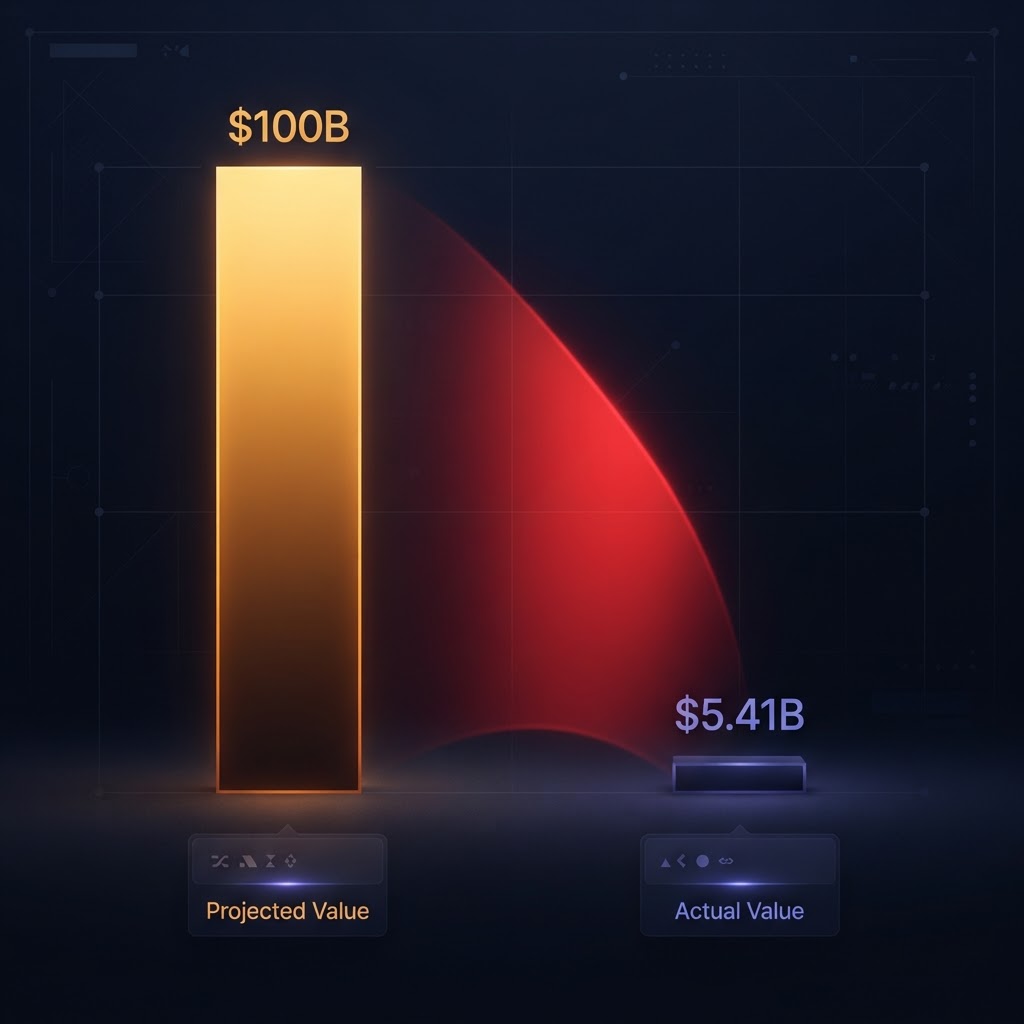
OpenAI projected $100 billion in annual ad revenue from ChatGPT by 2030. Five months into their ad pilot, the entire U.S. chatbot advertising market is on pace to generate less than $1 billion this year.
That gap is not a slow start. It is a 90 percent miss, according to Emarketer's forecast. And it tells you something important about where AI advertising actually works and where it does not.
OpenAI launched its ad trial in February. By April, executives were touting $2.5 billion in projected 2026 ad revenue and that $100 billion 2030 target. The assumption was simple: ChatGPT would capture search ad budgets at scale, dominate a mature chatbot ad market, and outperform every ad format in history. All at once.
The market disagreed.

Where the Money Actually Goes
AI ad spending is not collapsing. It is growing fast. U.S. AI ad spend will hit $32 billion this year and exceed $68 billion by 2030, per Emarketer's May forecast.
But here is the catch: more than 80 percent of that spending runs through traditional paid search listings alongside Google's AI Overviews. Not standalone chatbot placements. Not ChatGPT ads.
The money is following AI into search, not into chatbots. Google is capturing the AI ad revenue wave because it already owns the infrastructure, the intent signals, and the advertiser relationships. OpenAI is trying to build all of that from scratch inside a product people use to write emails and debug code.
That is not the same business.
Google's AI Mode hit 1 billion monthly users at I/O 2026. Search revenue grew 17 percent to $63 billion. Google is not losing the AI ad race. It is winning it by wrapping AI around the ad format that already works.
The Criteo Numbers Sound Big Until You Look
Criteo became OpenAI's first ad tech partner in March. By June, they reported 2,000 brands advertising on ChatGPT. Their "Prompt Smart Ads" product showed a 4x spend lift. Those numbers sound impressive until you do the math.
Two thousand brands across an ad platform is tiny. Google Ads has millions of advertisers. The 4x spend lift sounds great, but lift from what base? If you were spending $500 a month on ChatGPT ads, a 4x lift gets you to $2,000. That is not a budget reallocation. That is an experiment that is still in the lab.
OpenAI has been making moves that read like survival, not growth. They dropped the $50,000 minimum spend requirement. They added self-serve ad management. They introduced CPC bidding. These are concessions you make when adoption is not matching your projections. They are the moves of a platform trying to lower the barrier because the barrier was too high.
Meanwhile, partners told CNBC the rollout was too slow and too conservative. The excitement was there. The execution was not.
The Executive Who Was Supposed to Build This
Fidji Simo was the executive behind OpenAI's advertising push. She joined from Instacart with a clear mandate: build a serious ad business. In April, she went on medical leave. In July, she stepped down to a part-time advisory role.
The person who was supposed to build the $100 billion ad business is no longer building it full time. That does not mean OpenAI's ad ambitions are dead. It means the leadership gap at the top of the ad division is real, and it comes at the worst possible moment: five months into a pilot that is already missing targets by 90 percent.
What This Tells Marketers
If you are a CMO or marketing director looking at your 2026 budget, the ChatGPT ad story has a clear lesson.
AI advertising works when it augments existing search behavior. It does not work when you try to invent a new ad channel inside a product that people use for productivity, not commerce. The intent is different. The format is different. The measurement is different.
The $32 billion going into AI ads this year is mostly flowing through Google's search infrastructure with AI layered on top. That is where your budget should be. If you want to understand why bad data in that infrastructure is quietly destroying budgets, this piece breaks it down.
The brands winning on cost efficiency are not the ones chasing new ad channels. They are the ones switching to cheaper models and reinvesting the savings into channels that actually convert. And the ones still reporting "AI ROI" without real measurement are running what amounts to ROI theater.
ChatGPT ads are not useless. Criteo's 2,000 brands prove there is some signal. But the signal is a rounding error compared to the $32 billion flowing through AI-enhanced search. If OpenAI captures even half of Emarketer's $5.41 billion 2030 forecast, that is a real business. It is just not the $100 billion business they promised.

The Format Does Not Match the Intent
This is the part that matters most. People open Google to find things to buy. People open ChatGPT to think, write, and work. Those are fundamentally different jobs.
When you search "best running shoes 2026" on Google, you are in shopping mode. The ad format matches the intent. When you ask ChatGPT to help you outline a presentation, an ad for running shoes is an interruption, not a service.
OpenAI knows this. That is why their ad format is subtle, embedded in conversation rather than displayed alongside results. But subtle ads in a productivity tool generate subtle revenue. The $100 billion projection assumed ChatGPT would become a search engine. It has not. It has become a tool. Tools are harder to monetize with ads than search engines.
The search attribution collapse is already reshaping where budget flows in 2026. Smart marketers are following the intent, not the hype. The money is going to AI-enhanced search because that is where buyers already are. ChatGPT ads are an experiment worth watching, not a channel worth betting on yet.
The Real Question
The question is not whether ChatGPT will have ads. It will. The question is whether the format can ever match the intent.
OpenAI projected $100 billion. The market is saying $5 billion for the entire chatbot ad category. Somewhere in between is the truth, and the truth is going to look a lot closer to $5 billion than $100 billion.
The brands that figure this out early will save their budgets. The ones that chase the $100 billion hallucination will waste a year and a lot of money learning what Emarketer already told us for free.