The Number That Should Terrify You
Gartner predicts that by 2028, AI agents will handle 90% of all B2B purchasing. That is $15 trillion in procurement flowing through automated systems, not human buyers. Not in some distant future. In less than two years.
If you run B2B marketing, that number should make your stomach drop. Everything you built, the content engine, the thought leadership, the ABM campaigns, the sales enablement decks, was designed to persuade a human being. A person who reads case studies, feels urgency, gets hooked by a strong narrative, picks up the phone, and signs the deal after a conversation with a sales rep they trust.
Your buyer is becoming a bot. And bots don't read your blog posts.

This is not a hypothetical. Forrester predicts that by 2026, at least one in five B2B sellers will be forced to respond to AI-powered buyer agents with dynamically generated counteroffers. Not emails. Not phone calls. Automated counteroffers, because the entity on the other end is not a person. It is a procurement agent running a comparison matrix.
94% of B2B buyers already use AI tools like ChatGPT to research vendors before they ever talk to sales. That means by the time a human enters the conversation, the AI agent has already shortlisted vendors, compared pricing, scored capabilities, and possibly made a recommendation. Your job as a marketer is no longer to persuade the human. It is to be picked by the agent.
What AI Buying Agents Actually Do
An AI buying agent does not care about your brand story. It does not get inspired by your founder's journey. It does not share your LinkedIn post. It does not feel FOMO from your limited-time offer.
Here is what it does instead. It ingests structured data. It compares specifications. It evaluates pricing against budget constraints. It checks certifications, compliance ratings, and vendor reputation scores. It reads API documentation. It tests response times. It cross-references security audits. Then it produces a ranked recommendation.
The agent treats your product as a feature vector: price, ratings, shipping speed, certifications, integration compatibility, uptime guarantees, and return policies. Marketing copy is noise. Brand storytelling is invisible. The emotional hooks that took your team six weeks to craft? The agent skips them entirely.
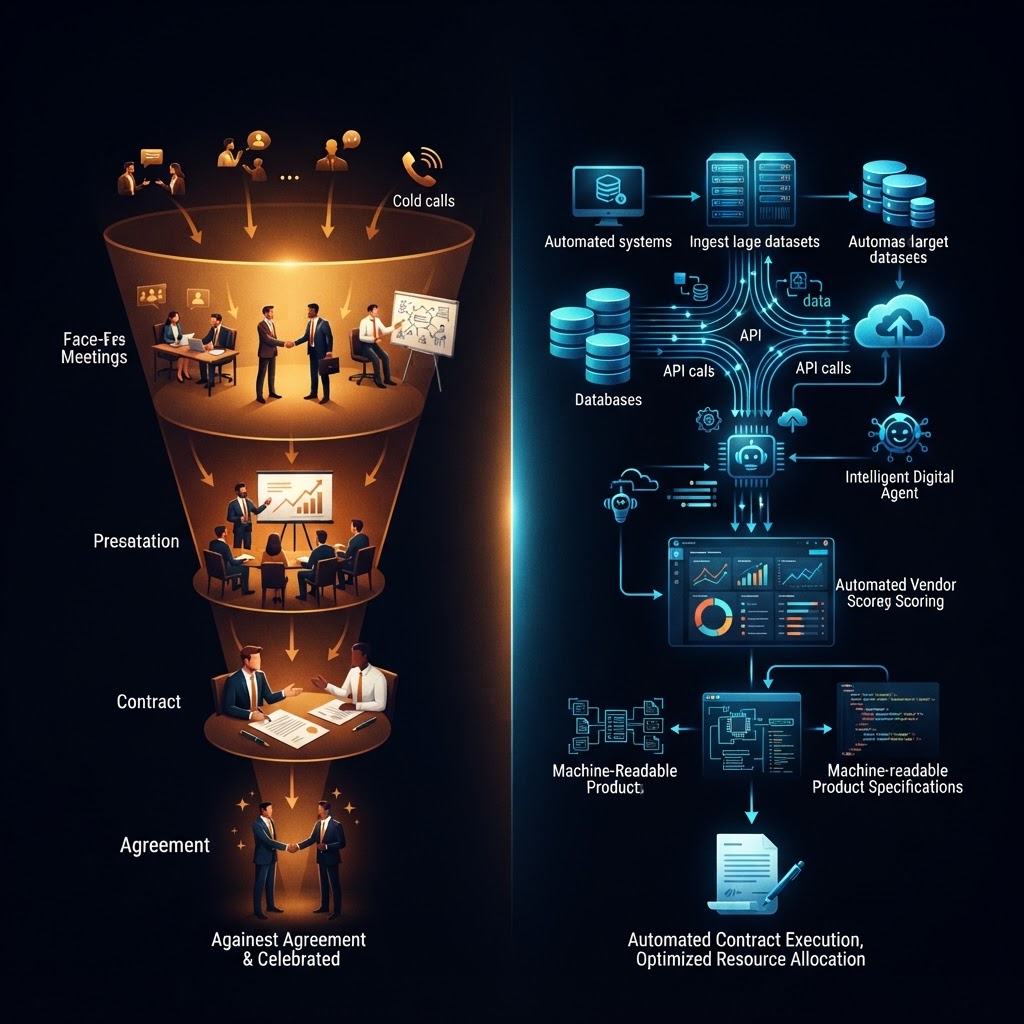
If your product data is messy, your schema is incomplete, or your API documentation is buried in a PDF, the agent moves on. It does not schedule a demo. It does not request a quote. It deprioritizes you and ranks a competitor whose data is cleaner.
This is the new reality. Your website is no longer a brochure for humans. It is a data source for machines.
Where the Playbook Breaks
Let's walk through the major pillars of B2B marketing and see what happens when the buyer is a bot.
Content marketing. Your blog posts, whitepapers, and ebooks are written to persuade humans. AI agents do not read 2,000-word thought leadership pieces. They scrape structured data from product pages, extract specs from comparison tables, and pull metrics from schema markup. If your content strategy is "publish more long-form posts," you are building a library no one is checking out.
This connects to a broader pattern we explored in our post on AI search attribution collapse. As AI systems mediate discovery, the traditional content-to-lead pipeline breaks down because the intermediary is no longer a human clicking a link. It is an agent parsing data.
Brand and awareness. Brand equity matters less when the buyer is an algorithm. An AI agent does not prefer Salesforce because it saw a Super Bowl ad. It picks Salesforce because the API is well-documented, the integration ecosystem is broad, and the uptime SLA is 99.99%. Brand awareness campaigns still matter for the human who approves the agent's recommendation, but they are no longer the primary lever.
Account-based marketing. ABM works because it targets specific humans at specific companies with personalized messaging. When the procurement process is agent-mediated, there is no human to personalize for. The agent evaluates all vendors against the same criteria. Your beautifully crafted ABM landing page with the company logo and the personalized greeting? The agent never loads the page. It pulls the product feed.
Sales enablement. Gartner also predicts that by 2028, AI agents will outnumber human sellers by 10x. Yet fewer than 40% of sellers will report that AI agents improved their productivity. That means the agent explosion is not helping your sales team close deals. It is replacing the human conversation that closes deals. Your sales decks, battle cards, and ROI calculators are built for conversations that may not happen.

Marketing attribution. When an AI agent mediates a purchase, who gets credit? The agent? The vendor whose data feed was cleanest? The platform that hosted the comparison? Attribution was already broken in the human-mediated world, as we discussed in our analysis of attribution drift and measurement failure. Agent-mediated procurement makes it worse because the touchpoints are API calls, not page views. Your analytics platform may not even see the interaction.
This is the same dynamic we covered in how AI shopping agents hijack brand decisions, but in B2B the stakes are higher. A B2B procurement decision can be worth millions. When an agent deprioritizes your product because your schema markup was missing a certification field, you lose a contract you never knew you were competing for.
What Actually Works When Bots Buy
Here is the part where most articles would say "adapt your strategy" and list five vague recommendations. Let's be specific.
Make your data machine-readable. This is not optional. Every product page needs structured data markup. Every spec sheet needs to be available as JSON or XML, not just PDF. Your API documentation needs to be public, current, and comprehensive. If an agent cannot parse your product data in under five seconds, you are invisible.
Google introduced Universal Cart at I/O 2026, a cross-merchant AI shopping cart that spans Search, Gemini, YouTube, and Gmail. It started as a consumer feature, but the architecture is built for B2B. Structured product feeds, conversational attributes, real-time inventory. If your data is not in the right format, the cart does not see you.

Build for agent-to-agent interaction. Your sales page should expose an API endpoint that lets buying agents query pricing, availability, and specifications programmatically. Think of it as a self-serve procurement portal, but for bots. If an agent has to scrape your HTML to find your pricing, you have already lost.
Keep the human in the loop. The agent recommends. The human approves. That means you still need brand trust, social proof, and thought leadership for the approval step. But the scope shrinks. Your marketing needs to win two battles: the agent's data evaluation and the human's final sign-off. Most teams are only fighting the second one.
Rebuild your measurement around agent interactions. Track API calls, data feed requests, schema validation success rates, and agent query patterns. If you do not know how agents are interacting with your product data, you are flying blind. The vendors who win this transition will be the ones who can see what the agents are doing.
The Quiet Exit
There is a version of this future where B2B marketing gets simpler. Fewer brand campaigns, fewer gated ebooks, fewer webinars that nobody attends. More structured data, more API endpoints, more clean specs.
The marketers who survive this shift are not the ones who write the best blog posts. They are the ones who make their product data so clean, so comprehensive, and so accessible that an AI agent has no reason to look anywhere else.
$15 trillion is moving. The question is whether your data is ready for it.