
On July 15, Apple's market cap hit $4.88 trillion. Nvidia dropped to second place at $4.87 trillion. For about 36 hours, the company that sells consumer hardware dethroned the company that powers the entire AI infrastructure buildout.
Most people called it a blip. Market noise. Rotation into mega-cap consumer tech.
They're wrong. It's a signal.
What Just Happened
Over the last 18 months, Nvidia became the defining bet on AI. Every dollar you spent on Claude, ChatGPT, Gemini, or any LLM inference went through Nvidia H100 or H200 chips. The company printed money. Revenue up 126% year-over-year. Gross margins north of 70%.
Then something shifted.
Apple released iOS 18 with on-device AI. OpenAI released a dirt-cheap API tier optimized for mobile inference. Microsoft stopped building on Nvidia's cloud and started building custom silicon (Maia). Every major cloud vendor started doing the same. Custom chips, lower dependency on Nvidia's hardware tax.
And on July 15, the market finally priced it in. Apple's consumer AI play beat out Nvidia's infrastructure play.
The CMOs who should be paying attention: your vendor strategy is about to break.

Why This Matters for Your Budget
Here's the arithmetic that explains the flip.
Nvidia's original pitch: build once, run anywhere on our chips. The chip tax is 60-70% of inference cost. As demand grows, so does Nvidia's revenue. Infinite scaling, premium margins.
That thesis worked as long as AI stayed cloud-only.
Then inference moved to the device.
On-device models eat Nvidia's lunch because they don't require cloud chips. Apple, Samsung, Qualcomm. They all benefit. The cloud vendors (AWS, Azure, Google) stop paying Nvidia's premium. They deploy custom silicon instead. Margins compress.
The financial impact is brutal. Nvidia's gross margin will trend toward 45-50% over the next 18 months as competition intensifies. Their revenue growth will decelerate. The stock price reflects that reality.
But here's the second-order effect that matters to you.
When Nvidia owned the margin, AI vendors (OpenAI, Anthropic, etc.) had pricing power. They could charge premium API rates because chip costs were fixed and high. The bill passed to users.
As margins compress, pricing wars start. API costs drop. Vendor differentiation collapses. The generic LLM becomes a commodity.
For you as a CMO, that sounds great. Cheaper AI tools. But there's a catch.
The Catch: Proprietary Moats Get Stronger
The math for vendors changes under margin compression.
When API pricing is premium, vendors focus on breadth and openness. OpenAI's API is available to everyone. Claude's API is available to everyone. The model is. High margin per call, high volume.
When margins compress, vendors shift strategy. They lock IP into proprietary channels.
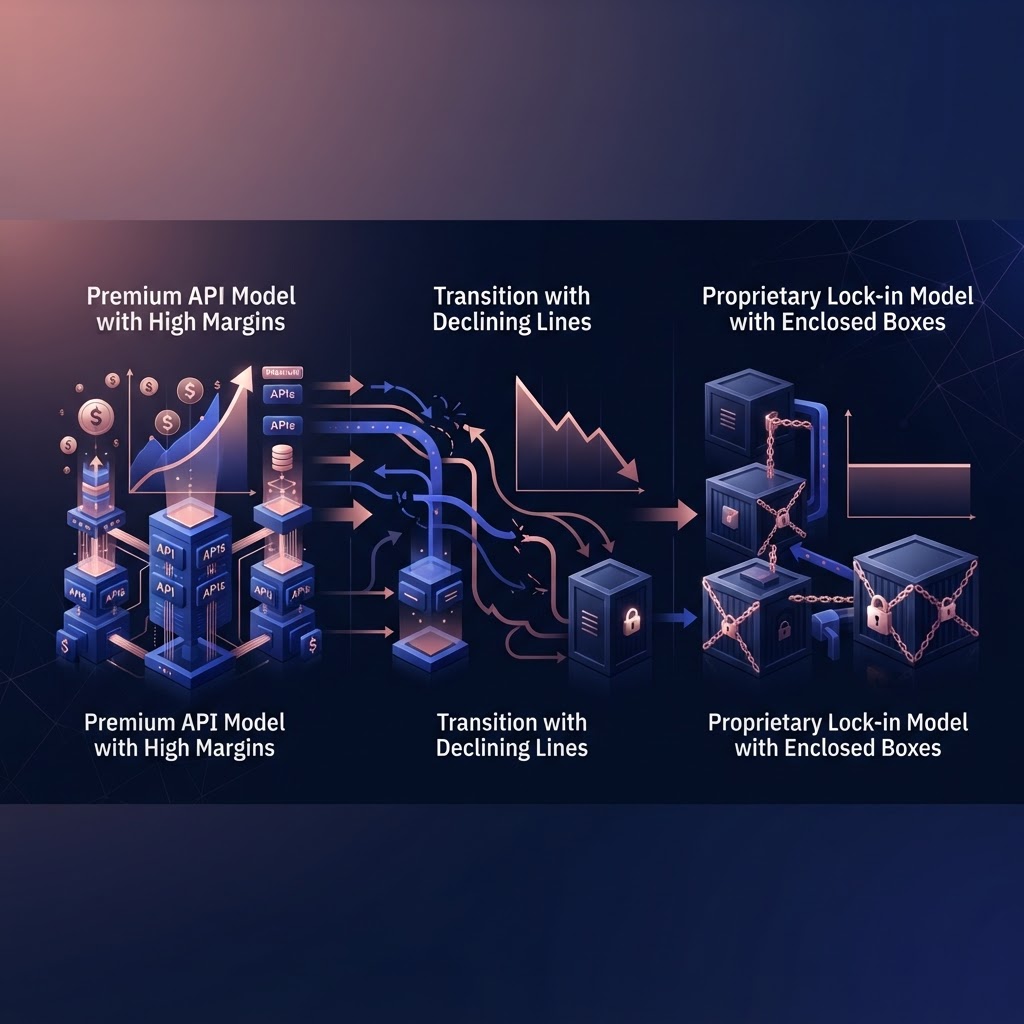
Apple is doing this now. iOS 18's on-device models are Apple-only. You can't get them anywhere else. The moat isn't in the API pricing. It's in the device lock-in.
Microsoft is doing the same. Copilot is embedded in Windows, Office, Azure. You don't call it as an API. It's part of the product. You buy the whole stack or you buy nothing.
In 12-18 months, every major AI vendor will have done this calculation. The generic, pay-per-API model will look like a loser's game. The winners will be the companies that own the device, the OS, or the enterprise stack.
For you, this means your vendor partnerships are about to narrow. The AI startups you're betting on (even the well-funded ones) will be absorbed or will pivot to being tools within larger platforms. The API layer won't be the business. It will be the moat.
And the vendors that own the moat will charge differently. Not per-call. Per-seat, per-device, per-seat-per-month. Friction goes up. Lock-in deepens.
What's Happening to Marketing Measurement
Here's where this hits you directly.
Most AI-powered marketing tools (attribution, audience modeling, bid optimization) were built on the assumption of cheap, unlimited API access to best-in-class LLMs. You could call Claude, ask it to analyze your campaign data, and the cost was negligible. That's the architecture that shaped the entire AI-marketing category.
That era is ending.
As vendors shift to proprietary stacks and margin compression forces repricing, the cost structure of these tools changes. They'll move from "call the API" architecture to "use our locked platform" architecture.
Today, a mid-market CMO can spin up a workflow that calls OpenAI's API, connects to their marketing cloud, and runs analysis on 500K customer records for about $40-60. The economics work because APIs are cheap and stateless. You pay for compute, nothing more.
In 18 months, that same workflow won't exist. The vendor (Salesforce, HubSpot, Adobe) will embed their own AI model into their platform. You'll get charged per seat or per monthly active user. You won't pay for the data analysis. You'll pay for access to the platform.

Here's what changes:
-
Your data stays on their servers. Multi-tenancy, no flexibility to use your own models. No ability to export and analyze with a cheaper provider.
-
Switching costs skyrocket. You're not just switching a vendor. You're migrating years of data, custom configurations, model training history. The cost of leaving is $200K+. You don't leave.
-
Margins come from lock-in, not from efficiency. Vendors have zero incentive to optimize for your cost. Your optimization is their problem. They optimize for stickiness.
The CMOs who built ad-hoc AI workflows (calling APIs, integrating with Zapier, building custom logic with contractors) will find those workflows become untenable in 18 months. The APIs will either shut down or become prohibitively expensive.
The ones who bet on closed platforms (Salesforce Einstein, HubSpot AI, Adobe Analytics with GenAI) will find themselves overpaying. But at least stable. At least survivable.
The smart move happens now. Build what you can on open-source models today, before the proprietary lock-in becomes the only option. Llama 2, Mistral, Mixtral. These models are free. They run on your infrastructure or on cheap GPU providers. Lock-in risk: zero.

That window closes in about six months. After that, the open-source path gets harder because the data landscape fragments. Vendors will push data into their proprietary systems. Portability becomes a feature you can't afford to lose. And they won't let you have it cheap.
The Uncomfortable Question
If Apple can outperform Nvidia with slower, less powerful on-device models, what does that say about how good these models actually need to be?
Turns out, really good isn't the binding constraint. Good enough plus access plus lock-in is.
That reframes the entire AI race. It's not about who builds the smartest model. It's about who owns the relationship with the user. Who controls the device, the OS, the platform.
For you, it means the LLM arms race (bigger models, higher benchmarks, more FLOPS) isn't actually what you should be watching. Watch instead. Who owns your customer's attention. Who's got device-level integration. Who's making switching costs irreversible.
The answers to those questions will determine your vendor landscape in 2027.
The flip of Apple over Nvidia wasn't a market hiccup. It was a repricing of a fundamental shift in how AI gets built, distributed, and monetized. From infrastructure-as-a-commodity to platform-as-a-moat.
The CMOs who see it as an opportunity to lock in better vendors now (and to build on open-source models while they're still accessible) will have an advantage. The ones who wait for clarity will find the door's already closed.