
On July 17, 2026, Apple's market cap briefly crossed $4.88 trillion. For the first time in over a year, it surpassed Nvidia's $4.86 trillion. The media called it a "flip." Investors called it a rebalancing. What it actually was: a referendum on which AI strategy wins long-term.
For 13 months straight, Nvidia owned the narrative. Every AI company needed their chips. Every enterprise building models needed their infrastructure. Every investor betting on AI was betting on Nvidia. Then something shifted. And it didn't have anything to do with how many H100s Nvidia could ship.
The Belief Changed, Not the Outcome
Nvidia didn't lose because their chips got worse. They lost because investors started believing that custom silicon, geopolitical constraints, and margin compression were real problems. Apple didn't win because they suddenly had a better product roadmap. They won because their bet on on-device AI, private cloud compute, and privacy-first architecture started looking like the smarter long-term play.
In other words: the market repriced which future it believes in.
Nvidia's story was simple for 18 months. Every foundation model needs to run somewhere. Every enterprise needs infrastructure. Nvidia makes the only chips that matter at scale. Customers had no choice. Customers would always need more. Revenue goes up forever.
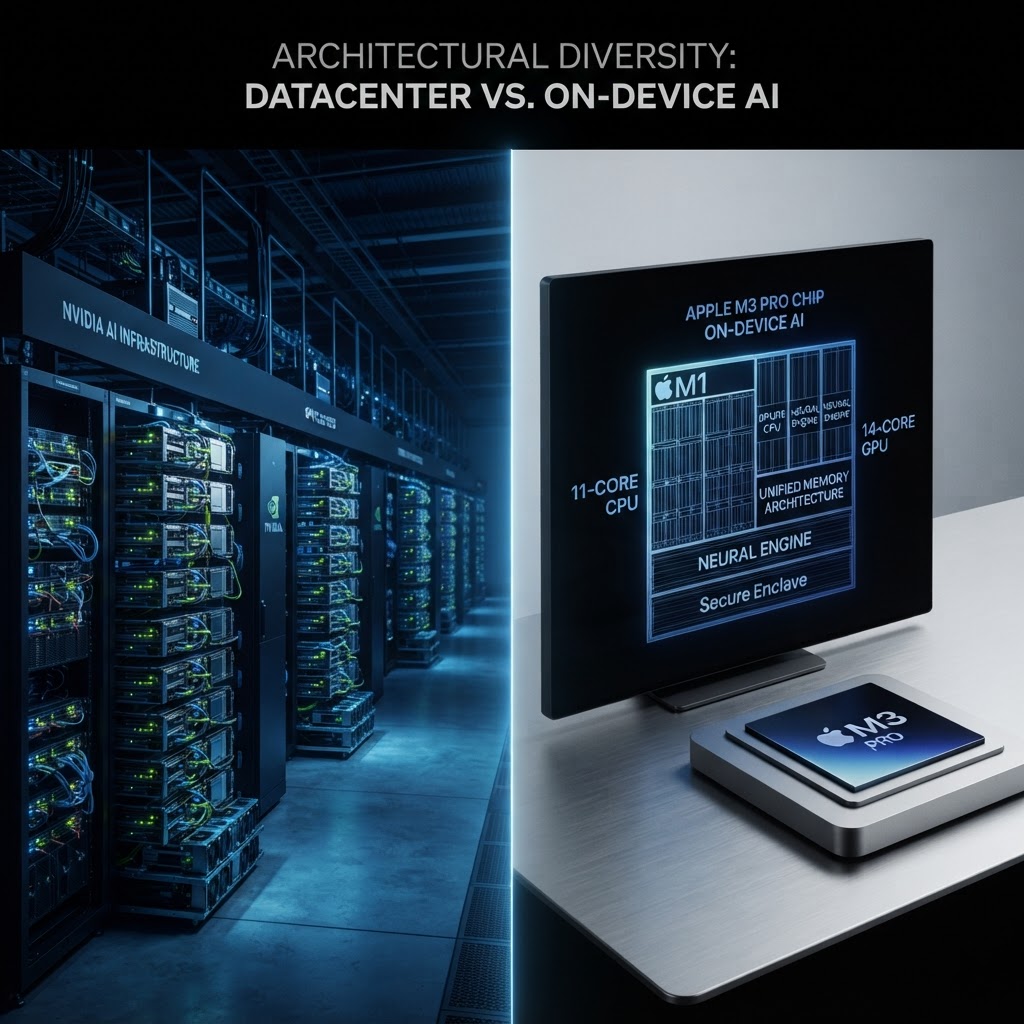
Apple's story was always complicated. We're putting AI on your phone. You own your data. We're not scraping your behavior for training. We're not selling your patterns to advertisers. The compute happens locally, not in a cloud center, not in a data center, not on someone else's servers. This is AI that respects you.
In June 2025, that story sounded nice. In July 2026, it sounds inevitable. If you've been tracking how enterprise AI spending is collapsing despite the hype, you understand why this shift matters so much.
What Actually Happened to Nvidia
Three things happened at once.
Custom silicon is real. Meta built custom chips for their Llama training. Google has TPUs. Microsoft, Amazon, and OpenAI are all building proprietary silicon specifically optimized for their own workloads. This isn't theoretical anymore. It's in production. Nvidia's margin story-the "we're the only game in town" narrative-has a clock on it now.
Export restrictions are tightening. Nvidia's most powerful chips require export licenses to certain countries. The U.S. Department of Commerce has been scrutinizing loopholes. Every quarter brings new restrictions. That's not a short-term headwind. That's structural. China can't buy Nvidia's best stuff. The Middle East has caps. Nvidia's addressable market isn't infinite anymore.
The AI boom cooling narrative has teeth. OpenAI reported disappointing user and revenue numbers. The "AI will disrupt everything immediately" crowd is quieter. Companies that spent $20 million on GPU clusters are asking harder questions about ROI. The gold rush mood is fading. That matters for Nvidia because their whole thesis depends on insatiable demand. If demand plateaus, Nvidia's valuation needs to reset. This is part of a broader pattern: CMOs are discovering that AI agents are actually costing them money, not saving it.
None of this means Nvidia goes to zero. It means Nvidia stops being a monopoly play. It means Nvidia becomes a commodity supplier with geopolitical headwinds and margin pressure. That's a different company at a $4.8 trillion valuation.
Why Apple's Bet Actually Won
Apple's strategy in 2024 looked conservative. On-device processing. Limited cloud fallback. No aggressive training partnerships. No race to the foundation model frontier. It felt like Apple was sitting out the AI revolution.
But what Apple was actually doing was building for the world after the fever breaks.
By July 2026, that world exists. Here's what's true now.
Privacy regulations are getting real. The EU's AI Act has teeth. The California Privacy Rights Act is enforced. Regulators are actively asking companies: where is your model being trained? Who has access to user data? Can you prove the system doesn't learn from behavior? Apple's architecture answers every one of those questions immediately. Competitors have to retrofit privacy. Apple shipped privacy.
Consumers don't want cloud AI. They want AI on their devices. Apple Intelligence works when you're offline. No data sent to a server. No waiting for a cloud API. Users can feel the difference, and they prefer it. It's faster. It's not creepy. It just works. That's not a feature advantage. That's a philosophical advantage.
Margins matter more than scale at trillion-dollar valuations. Apple's AI strategy is built on their ecosystem leverage. They sell premium hardware with AI baked in. They don't need to sell compute to Google or Meta or anyone else. Their economic model doesn't depend on cloud infrastructure spending. Nvidia's does. At $4+ trillion, that difference matters. Investors are repricing for it. The entire measurement crisis around AI's ROI in marketing is making investors more skeptical of pure-infrastructure plays.

The Flip Might Reverse, But the Narrative Changed
It's worth noting: Apple and Nvidia will probably keep trading places on a weekly basis now. The valuations are so close and the trading so intense that small news moves the crown around. That's not the important thing.
The important thing is that investor conviction shifted. For the first time since late 2022, the consensus is: "Maybe on-device, privacy-first AI actually wins." That's a thesis change. That's not a stock-picking decision. That's a structural bet on which AI future gets built.
Nvidia is still an essential company making essential chips. But they're not the inevitable monopoly they looked like 13 months ago. And Apple isn't the cautious late-mover anymore. They're the architect of the AI future the market actually wants to fund.
The flip itself will fade. The belief shift probably won't.