
Customer-Ready AI Can Destroy Brand Loyalty
AI feels less bad. The brand still owns the failure.
Customers accept AI when it clears ordinary work. When it makes a consequential mistake, they blame the brand, not an invisible vendor. Trust needs visible evidence, a human exit, and a recovery path that works.
What actually changed
AI crossed a quality threshold in 2026. That does not mean customers surrendered their judgment. It means brands have less time to hide a weak experience behind novelty.
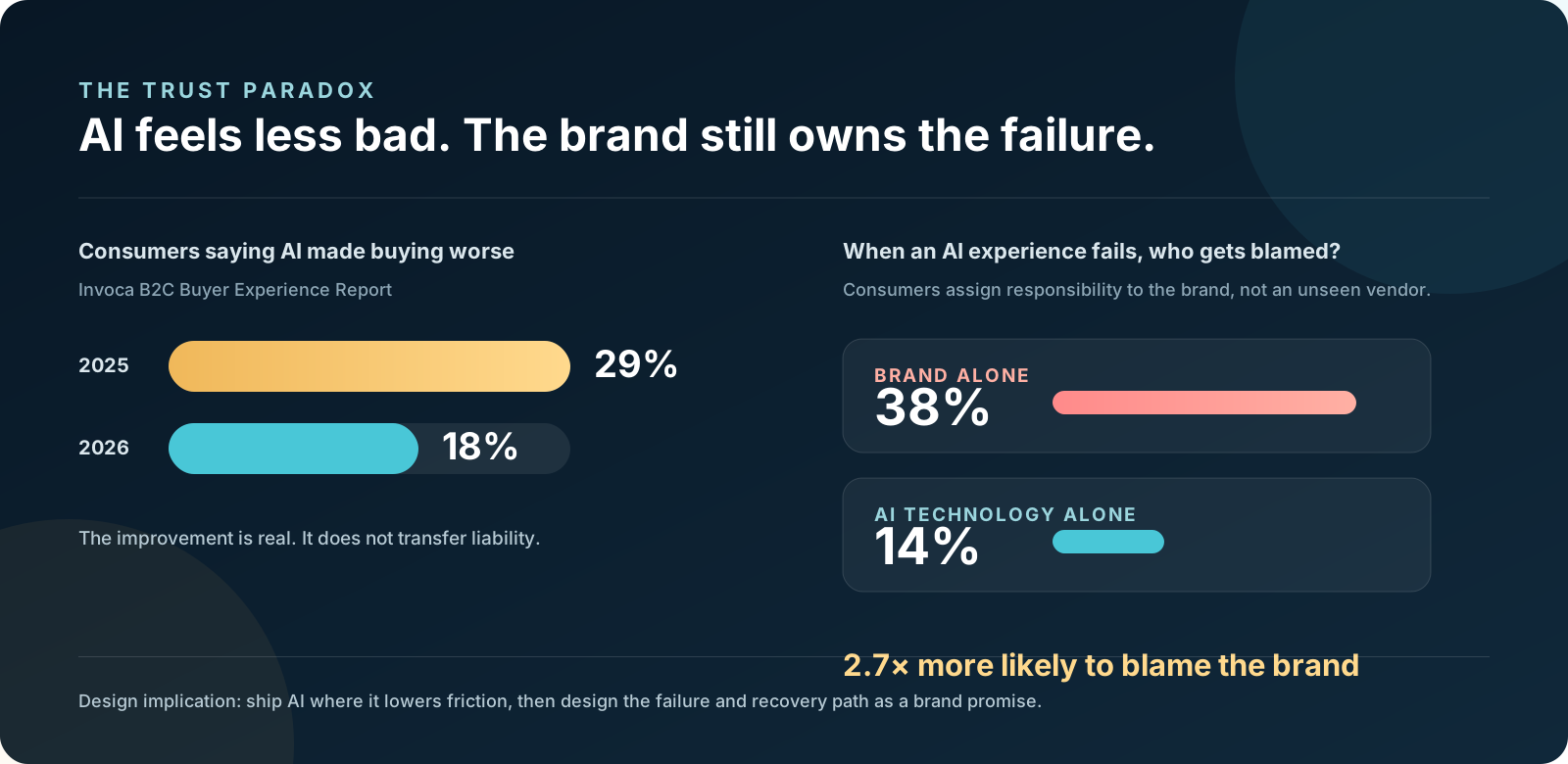
Invoca's 2026 B2C Buyer Experience Report found the share of consumers saying AI made a buying experience worse fell from 29% to 18%. Forty-six percent now say AI made it better. Much of the change is not excitement. It is invisibility: AI got good enough that people mostly stopped noticing it when it handled ordinary work.
Consumers also arrive more prepared. In the same Invoca survey, nearly 60% of US consumers used a generative-AI tool to research a high-stakes purchase, up from 41% a year earlier. Boomers drove much of the jump, moving from 11% to 34%. A customer who has already compared options and decoded a financing term with AI arrives closer to a decision and less tolerant of a front line, human or automated, that cannot keep up.
The report also shows a useful split. Consumers have become more forgiving of a single poor experience, but less patient with delay. The share saying they would stop doing business after one bad experience fell from 66% to 40%, while the share who hung up after waiting too long rose from 50% to 75%. Speed is not a cosmetic metric. Nearly 60% expect a response within an hour, while only 36% of brands meet that expectation.
The real trust trap
Invoca found that when a brand AI fails, consumers blame the brand alone 38% of the time and the technology alone 14% of the time. Add the 30% who blame both, and roughly two-thirds hold the company that deployed the system responsible. The vendor takes almost none of the relationship damage.
That is not a customer misunderstanding. A customer never chose the model provider. They chose the company that decided which system would speak, what it could access, what it could promise, and when it should hand off. “The vendor hallucinated” is not a recovery plan because it is not an answer to the person whose trust was spent.
The practical risk is not simply an incorrect answer. It is a confident answer that creates a false sense of verification. A warranty term, product ingredient, billing detail, or eligibility rule can sound settled because the interface sounds authoritative. If the claim later fails, the customer does not experience a technical defect. They experience a brand that was careless with a decision they were asked to trust.

Where humans still win
The original version of this thesis oversold a simple claim: that customers are ready for AI everywhere. The real data is more useful. Consumers compartmentalize. They prefer AI for simple tasks, fast answers, and skipping the hold queue. They reserve people for context and nuance, complex problems, and empathy, which happen to be the qualities a high-stakes decision runs on.
The generational pattern makes the boundary concrete. In Invoca's findings, 34% of Boomers now use generative AI to research a purchase, yet 85% still want a human representative when it is time to decide. The phone remains the top help channel across generations. The lesson is not that AI is failing. It is that convenience and judgment are different jobs.
A brand should therefore design an honest path: fast automation for the routine majority, source-backed answers where a claim matters, and a person who can take responsibility for the consequential tail. The worst experience is neither AI nor human. It is an AI gatekeeper that delays the human judgment a customer already knows they need.
The fact-checking problem is real, just more specific
MIT Media Lab researchers tracked 67 people for four weeks as they evaluated news headline-image pairs. While actively using an AI chatbot, participants were 21% more accurate at catching fake news. The trouble appeared after the AI was removed: unassisted accuracy on new items declined 15 points by the fourth week, even as many participants felt they were improving.
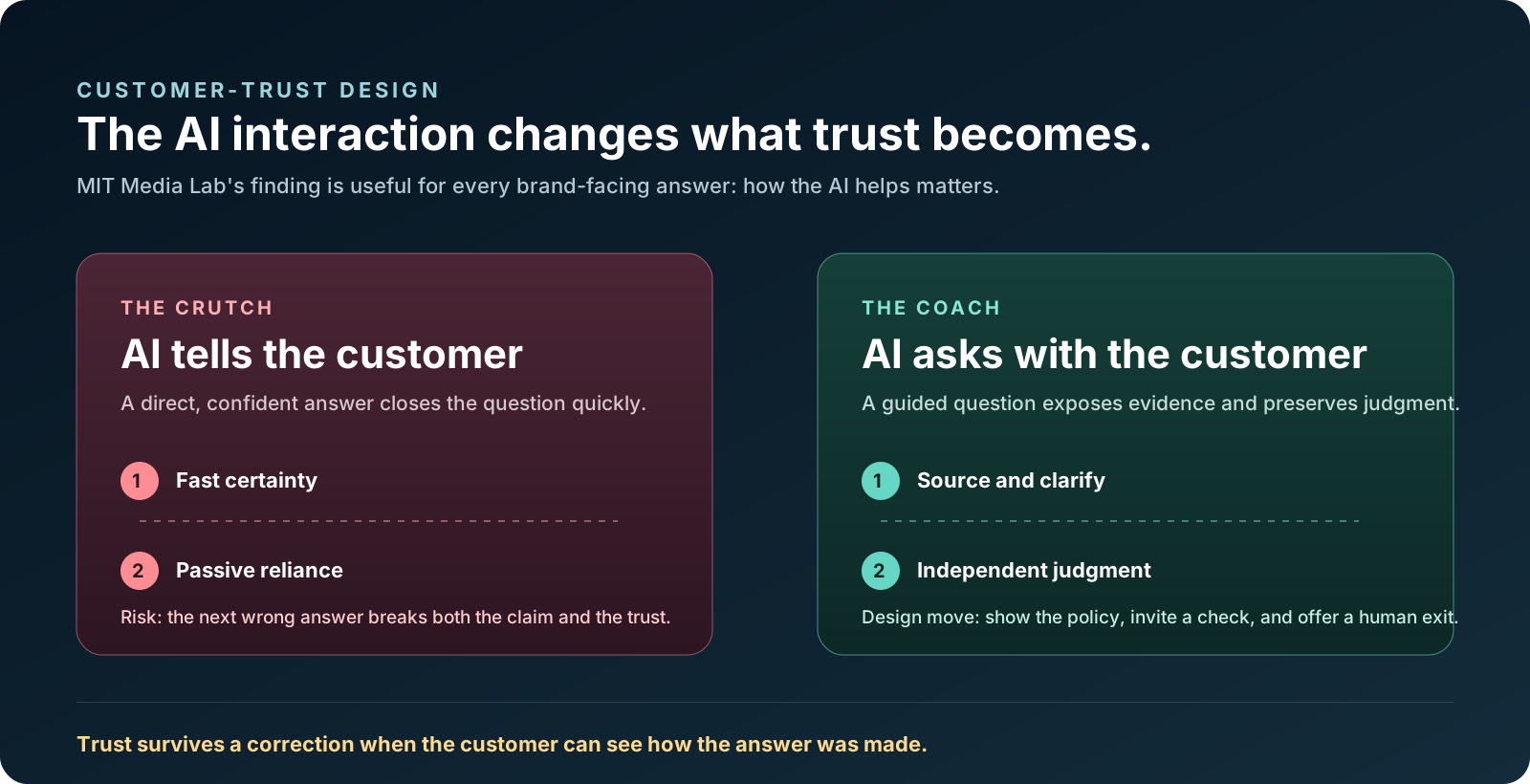
That is not proof that every AI answer makes people gullible. The mechanism mattered. Direct-answer systems encouraged passive reliance. The study's “Dependency Developers” shifted from active evaluation to accepting what the system told them. Researchers compared the effect to GPS weakening a sense of direction and calculators weakening mental math: assistance can be helpful now while quietly outsourcing a skill needed later.
The useful finding is the alternative. AI that asked Socratic questions and probed a user's reasoning built more independent skill, even though it felt slower. For a brand, that turns “tell versus ask” into a design decision. A consequential answer should show its source, invite a clarifying detail, and make it easy to check the claim. A few extra seconds can be the difference between earned trust and borrowed confidence.

How to build brand-facing AI without borrowing trust
Start by narrowing the promise. An agent that routes a return, surfaces an order status, or finds a policy paragraph can lower friction without impersonating judgment. An agent that determines whether a complicated claim is true, explains an exception, or blocks access to human help is doing more than answering. It is making a brand commitment.
For that second category, make the evidence visible. Cite the exact policy or source behind an answer. Ask a clarifying question before asserting a conclusion. Preserve the decision and the source used. Offer a human exit before the customer has to prove the system wrong. These are not concessions to weak technology. They are controls that let a customer see why an answer deserves trust.
Then design the recovery path before launch. A customer should be able to correct an answer, understand who will review it, and receive a response at the pace the interaction requires. Every AI failure is a brand failure first. Treating that fact as a product requirement makes the vendor relationship, the escalation path, and the human owner legible before an incident forces the question.

What actually wins
Deploy AI where consumers already trust it: simple tasks, fast answers, and queue-skipping work. Keep complex, emotional, or high-stakes choices human-led, with AI preparing evidence rather than impersonating empathy. This is not a smaller ambition. It is a more durable one because it connects automation to the moment where it can actually earn trust.
Build interaction styles that help a person reason rather than simply accept. The system should show its work, distinguish a known answer from an uncertain one, and leave the customer with enough context to challenge a mistake. That makes correction less humiliating for the customer and less destructive for the brand.
Finally, build for honest recovery. The data says customers will forgive one bad experience more often than they did a year ago, but they will not wait indefinitely to be heard. The companies that win will not ask how to deploy AI everywhere. They will ask where AI makes this specific customer faster, clearer, and more capable, and where it would merely make the brand look evasive.
The operating model behind trustworthy AI
A customer-facing AI system needs a service design, not only a prompt. The moment it speaks for a brand, the product is the complete loop: what the system can answer, what it can prove, how a person takes over, and how the organization learns when the answer was wrong.
Set an authority boundary in customer language. Do not begin with a list of model features. Begin with the jobs a customer can recognize. The assistant can find an order, explain a published return window, gather the facts for a claim, and route a simple request. It cannot decide a disputed eligibility question, reinterpret a regulated commitment, or become the only path to a person. The boundary should be visible in the interaction and enforced in the workflow, so the customer never learns it only after a consequential failure.
Connect every consequential answer to a source of truth. Product claims, terms, inventory, pricing, and policy are not generic knowledge. They are changing records with owners. A reliable system retrieves the current record, preserves the version it used, and tells the customer when the answer depends on a missing fact. This is why a pleasant, generalized chatbot can still be a trust liability: it may sound certain while being disconnected from the information a human representative would check before making the same statement.
Measure the recovery, not just the answer rate. Track how often customers correct an answer, how often an escalation changes the original outcome, how long the handoff takes, and whether the same issue recurs. A high containment rate is not proof that the system is good if customers give up, leave, or discover the mistake later. The useful measure is whether the customer received a correct, explainable result at the right speed, with a clear remedy when the system could not provide one.
Treat the answer as a record, not a chat bubble. For every consequential response, retain the policy version, the retrieved evidence, the customer's question, and the handoff outcome. If a team cannot reconstruct why one customer heard “yes” while another heard “no,” the incident has not been contained. It has only been moved into a support queue where the customer has to prove the system wrong.
Give a human owner the power to change the system. A support agent can apologize for a bad answer, but someone must own the policy, source, or tool rule that produced it. Keep the original customer question, the response, the evidence, and the corrective decision together. That lets a team distinguish a one-off misunderstanding from a repeatable defect. It also turns each correction into product learning rather than a private service recovery that disappears into a ticket queue.
Test the moments that create a trust debt. Run the system against an expired offer, a missing profile field, a contradictory policy, a request that needs context from two systems, and a customer who asks the same question twice in a different way. The happy path only proves that the assistant can repeat known information. The difficult cases reveal whether it knows its limits, retrieves the right record, and hands a person enough context to finish the job without asking the customer to start over.
Make the handoff feel like service, not failure. The customer should not have to discover the human option by becoming angry or by finding a hidden support link. State why the matter needs a person, pass along the conversation and evidence, and give a realistic response window. This turns a limitation into an honest signal of care. It also protects the human team from receiving a bare transcript with no indication of what the system already checked or why it stopped.
Review the boundary on a cadence. New products, new policies, and new model behavior can all make a once-safe task unsafe. Sample resolved conversations, look for repeated corrections, replay representative edge cases, and adjust the authority envelope before a small pattern becomes a public complaint. Assign each failure category to a named decision owner and give exceptions an expiry date. Otherwise a temporary workaround quietly becomes an undocumented customer promise. Customer trust is not a score the interface earns once. It is an operating condition a team either keeps proving or slowly spends.
FAQs
Are consumers more comfortable with AI now?+
Yes. Invoca found the share saying AI made buying worse fell from 29% in 2025 to 18% in 2026, while 46% said it made the experience better. The meaningful shift is from negative to neutral or useful, not unconditional enthusiasm.
Who gets blamed when a brand AI makes a mistake?+
Consumers blame the brand alone 38% of the time and the AI technology alone 14% of the time. Another 30% blame both. The model vendor is not the relationship a customer believes they are in.
Do consumers prefer AI to human help?+
Not for consequential moments. Ninety-eight percent say human connection matters in a high-stakes purchase, and 59% choose a human when AI and human help are equally available.
Can AI fact-checking create dependency?+
It can, depending on interaction design. MIT Media Lab found AI assistance helped participants while it was present, but direct-answer interactions were associated with worse unaided performance later. Guided, Socratic interactions built more independent skill.
What should a brand do?+
Use AI for simple, fast, low-stakes work; show the policy or source behind consequential answers; ask clarifying questions; provide a fast human exit; and design recovery as a visible brand responsibility.