
The meeting always goes the same way.
CFO looks at the AI spend. Asks for the ROI. CMO pulls up a spreadsheet that shows activity: campaigns deployed, personalization events tracked, segmentation improvements. But nothing that ties directly to revenue. CFO nods. Budget gets cut by 15 percent next quarter.
This isn't a story about bad CMOs. It's a story about an impossible job. Marketers are being asked to prove the value of AI tools that weren't designed to be measured in the first place. And they're losing budget because they can't.
You Can't Measure What Doesn't Have a Finish Line
Here's the core problem. AI in marketing doesn't work like a paid search campaign. You don't launch it and get results back in 72 hours. You deploy it, it touches thousands of interactions, influences a fraction of decisions, and then mixes with every other signal in your funnel.
A machine learning model that improves email open rates by 3 percent is actually good work. But how much revenue did that 3 percent generate? That depends on what segment saw the improvement, what they bought, when they bought it, and whether they would have bought anyway without the email.
You're asking for precision in a system built on approximation. That's not a calculation anymore. That's a guess dressed up as analysis.
The real pain point isn't the lack of tracking. It's the lack of a counterfactual. In paid search, you can turn ads off and see what happens. In organic, you can wait for algorithm changes and watch traffic shifts. In AI, you can't really turn off a recommendation engine and measure the delta because your entire product behavior changes. The baseline disappears. The experiment becomes impossible.
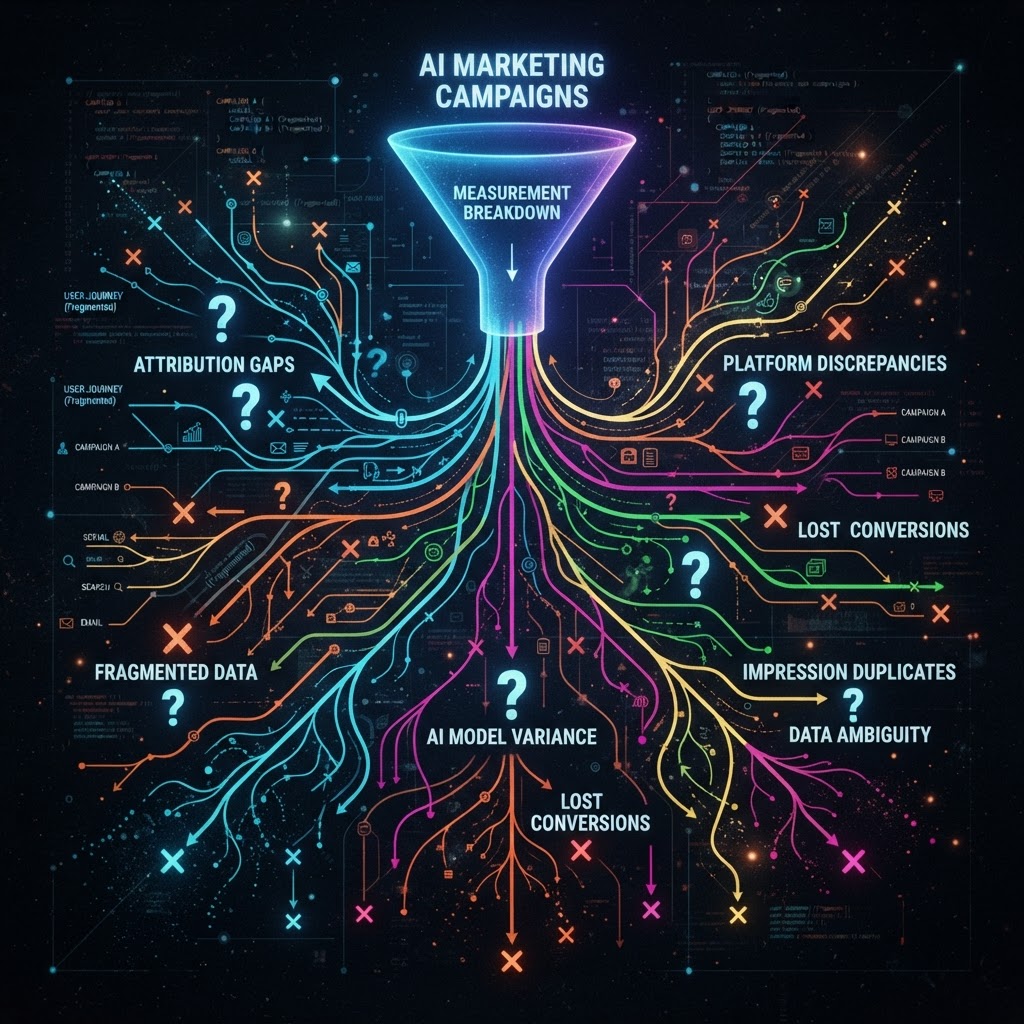
Gartner research shows CMOs are shifting spend toward measurable channels as budgets tighten. They're not being paranoid. They're being rational. When you can't prove impact, you move money to the channel where the causality is clear.
The Tools You're Using Weren't Built for Proof
Most marketing platforms added "AI" to their feature list by wrapping a machine learning model around existing workflows. That's not a measurement layer. That's automation with a learning curve and a premium tier.
You get a dashboard that shows "AI engaged 50,000 users" or "recommendations drove 12% higher CTR." Cool. But what happened next? Did they convert? Did they stick around? Is the engagement actually driving revenue, or is the model just very good at keeping people in the funnel longer without moving them toward a purchase?
The honest answer most platforms give is: we don't know, and we don't measure it. They'll keep not knowing until someone actually builds measurement infrastructure that was designed for AI from the first line of code, not bolted on six months after launch because sales was asking for it.

This is why budget cuts are accelerating. Boards are not being unreasonable. They're asking CMOs to do something the industry has fundamentally failed to solve: prove that a black-box system designed to optimize for engagement is actually moving money to the bottom line. This problem echoes what we saw with AI agent production failures earlier this year. Companies deployed agents without measurement infrastructure, couldn't prove they worked, then had to spend $200K+ recovering from the damage. The ROI illusion is the same trap, just slower.
The Deeper Issue: AI Costs Are Real, AI Value Is Speculative
Here's what nobody wants to say out loud in a board meeting: AI tools cost money right now. They cost money in licensing fees, in headcount to manage them, in integration overhead, in the endless time your team spends configuring, debugging, and explaining why the results don't match the vendor's demo.
The value is always six months away. Always. "This will improve retention." "This will increase customer lifetime value." "Once we have a year of data, we'll see the impact." None of that is wrong, but all of it is speculative. It's promise, not proof.
Companies like JPMorgan have reported that AI hasn't made their operating costs go down yet, even as it's cut jobs in some areas. The cost of maintaining, licensing, and operating AI systems is a floor. The benefit is a ceiling you can't measure yet. JPMorgan is one of the most sophisticated operators on earth and they still can't crack this equation.
So a CMO sits in a budget meeting and has to choose between:
- Keeping an AI tool they can't prove works but that their CEO is asking about because it's shiny
- Maintaining a fully staffed demand gen team that runs campaigns with measurable results every single quarter
The decision becomes obvious when you can't measure option one. And it's happening across the industry. As AI adoption increases, CMOs are shifting budget away from unproven AI investments and back toward channels where causality is clear.

What Actually Matters Right Now
If you're a CMO in this position, you're not being irrational for cutting AI spend. You're being responsible. You're protecting your team's credibility and your company's budget from tools that haven't earned their place.
But here's what actually changes the game: forcing your vendors to define what success looks like before you deploy anything. Not engagement metrics. Revenue metrics. Not "more interactions." "More revenue per user." Not "improved segmentation." "Reduced unsubscribe rates by 2 percent, which equals X additional annual retention."
Most vendors can't make those promises because they don't know what their tools actually do in your specific context. They know what it did in their case study. They don't know what it will do for you with your data, your audience, your product. That's the real admission that needs to happen in the sales conversation.
The second shift is building measurement infrastructure your team actually owns. Not dashboards from the platform. Actual analytics work that isolates the impact of AI from every other variable in your funnel. Yes, that's expensive. Yes, it requires analytics talent. But it's the only way to actually know whether you're getting value.
Third, stop thinking about AI as a cost center that proves itself. Think about it as a tool for one specific job. You don't need an AI system that improves marketing across the board. You need an AI system that solves one measurable problem: better email send times, more accurate audience segmentation, faster creative iteration. Pick one thing. Measure the hell out of it. Once you prove that one thing works and delivers ROI, expand from there.
The Measurement Crisis Hits Everyone
This isn't just a CMO problem. Finance teams can't reconcile AI spending with ROI. Sales leaders can't tell whether AI tools are helping or hurting forecast accuracy. Product teams can't tell if personalization is driving engagement or just noise. The entire organization is flying blind.
What makes this different from previous marketing tech cycles is the scale of investment. Five years ago, if a martech tool didn't work, you turned it off and lost $50K. Now if an AI platform doesn't work, you've potentially built your entire workflow around it. You've trained your team. You've integrated it into your data pipeline. Turning it off is a $500K+ decision with fallout across the org.
So you keep paying for it. You hope that in six more months the data will clear. You're stuck in what I call the measurement hostage situation: too invested to quit, not profitable enough to justify.
The Thesis Nobody Wants to Hear
AI is being oversold in marketing right now. Not because the technology is bad. The technology is actually quite good. It's because the industry hasn't built the measurement infrastructure to know whether any of it works in your business.
CMOs cutting budgets isn't a failure of vision. It's a rational response to a fundamentally broken sales motion. The vendors need to shift from "AI will transform your marketing and here's our testimonial from another company" to "AI will do this specific job and here's exactly how we'll prove it to your CFO."
Until that happens, every AI budget conversation is going to end with a cut. The winners in 2026 won't be the vendors with the most features or the flashiest demo. They'll be the ones who say "here's exactly what this costs, here's exactly what it should deliver, and here's how we measure it." Those are the vendors who get budget.
The losers will keep talking about potential.