Six days in November, the outages kept coming. Microsoft. The FAA. The big banks. United. Apple. Then the NSA's own classified network. Every official statement said the same thing in different words: not an attack, nothing connected, move along.
I do not buy six separate accidents landing in the same week. I do not buy the coordinated attack theory either. The explanation the reporting supports is duller and worse. AI tools found a pile of security holes at once, everyone rushed to fix them, and the fixes broke things.
The week, in order
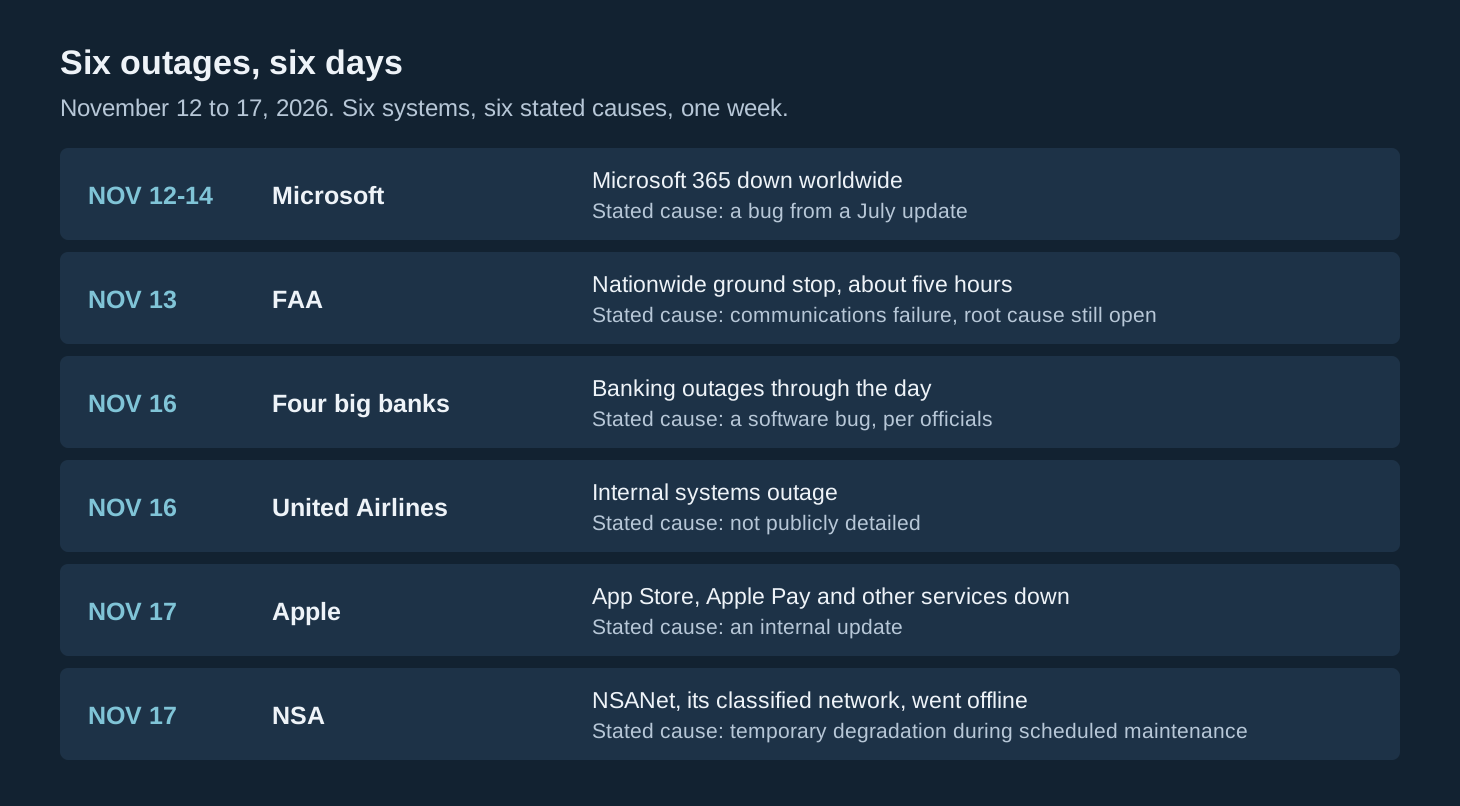
Six causes, six systems, one week. Possible. But a second version of this week was said in private, to Congress.
What they told Congress
The Washington Sun reported on November 17 that Wall Street executives and the NSA told members of Congress the outages stemmed from attempts to fix vulnerabilities identified by AI models. The Sun cited three sources familiar with the private conversations. The fixes, the sources said, temporarily overwhelmed the systems. One congressional official put it plainly: "These models are identifying massive vulnerabilities, and that increases the urgency to patch right away."
Reuters could not verify the Sun's report. Nobody has proven the whole week shares one cause. But one piece is on the record. Jay Clayton, the Director of National Intelligence, said on Fox Business that the NSA network failed after a patch for PHP vulnerabilities discovered last month. The NSA's own statement stuck to the maintenance line and said mission-critical capabilities stayed operational. Both can be true. Maintenance is when you patch. The question is why the patching got so urgent, everywhere, at once.
The part I find genuinely unsettling
In October, the Associated Press reported that researchers had discovered critical vulnerabilities in PHP, the programming language behind roughly 70 percent of the web. The two flaws, nicknamed PHP2Shell, were disclosed on October 21. Researchers at OpenAI, Wiz and Calif found them with AI help. The flaws could expose sensitive information, including passwords, and the NSA urged organizations to patch.
So millions of systems got the same urgent homework at once, and every IT team faced the same two bad options. Leave a known hole open, knowing attackers run the same kind of AI and can find it too. Or patch right now, on production systems, and accept that the fix might take you down. Multiply that by every bank, airline and agency running PHP, and the week stops looking like a coincidence. It looks like a traffic jam. Everyone got the same red alert and hit the same narrow door at once.
The week's other face
The same week had a real attack in it, worth separating from the outage story. On November 16, attackers got into Optimizely, a tool companies use to test changes on their websites, and pushed malicious code onto 178 major sites, including the BBC, CNN, Zoom and Equifax. They never had to break into 178 companies. They broke into one trusted vendor and rode its connection into all of them.
That is a different problem from the patching crunch. I wrote the Optimizely side separately for the business audience. If you run a site, read what businesses should do about the scripts running on their own sites. The connection is simple. The web runs on shared parts, so a flaw or a breach in one shared part lands everywhere at once.
The honest counterpoints
Plenty of officials disagree with the patching theory. Secretary of State Marco Rubio said there is "zero evidence" the outages are connected and called them completely unrelated. The FAA administrator said there was "zero evidence of anything AI-related" in the ground stop. Each company gave its own cause, and some are probably exactly what they say. A July update bug is a July update bug. Homeland Security Secretary Mullin said he was 98 percent confident the disruptions were not cyberattacks, which honestly matches the patching theory more than it fights it. Nobody serious claims hackers took these systems down. The argument is whether the defense did.
Here is where I land. The patching theory does not need to explain all six outages. It only needs to be true of some of them, and for the NSA one, the head of national intelligence basically said it out loud. The bigger point survives every denial. AI changed the speed of finding holes, and patching has not changed at the same speed. That gap is the story.
Why neither choice is safe anymore
Google's Threat Intelligence Group said on November 16 that "the era of autonomous attacks has arrived." Their sharper point was about patches themselves. Criminals now use AI to study newly released security fixes, work out the flaw each one closes, and build an attack from the fix. The patch is now a map. The moment a fix ships, it tells attackers where the hole was. Anyone who has not applied it yet is standing in a marked spot.
So patch slowly and attackers reverse-engineer your open hole from the fix you did not install. Patch quickly and a rushed change can take you down in front of your customers. There is no safe speed anymore, only a choice of which risk you would rather explain afterward. Patching used to be housekeeping. It is becoming the main event. One engineer in the week's discussions summed it up in a line I cannot improve on: urgency plus lack of testing equals a bunch of outages.
My assessment
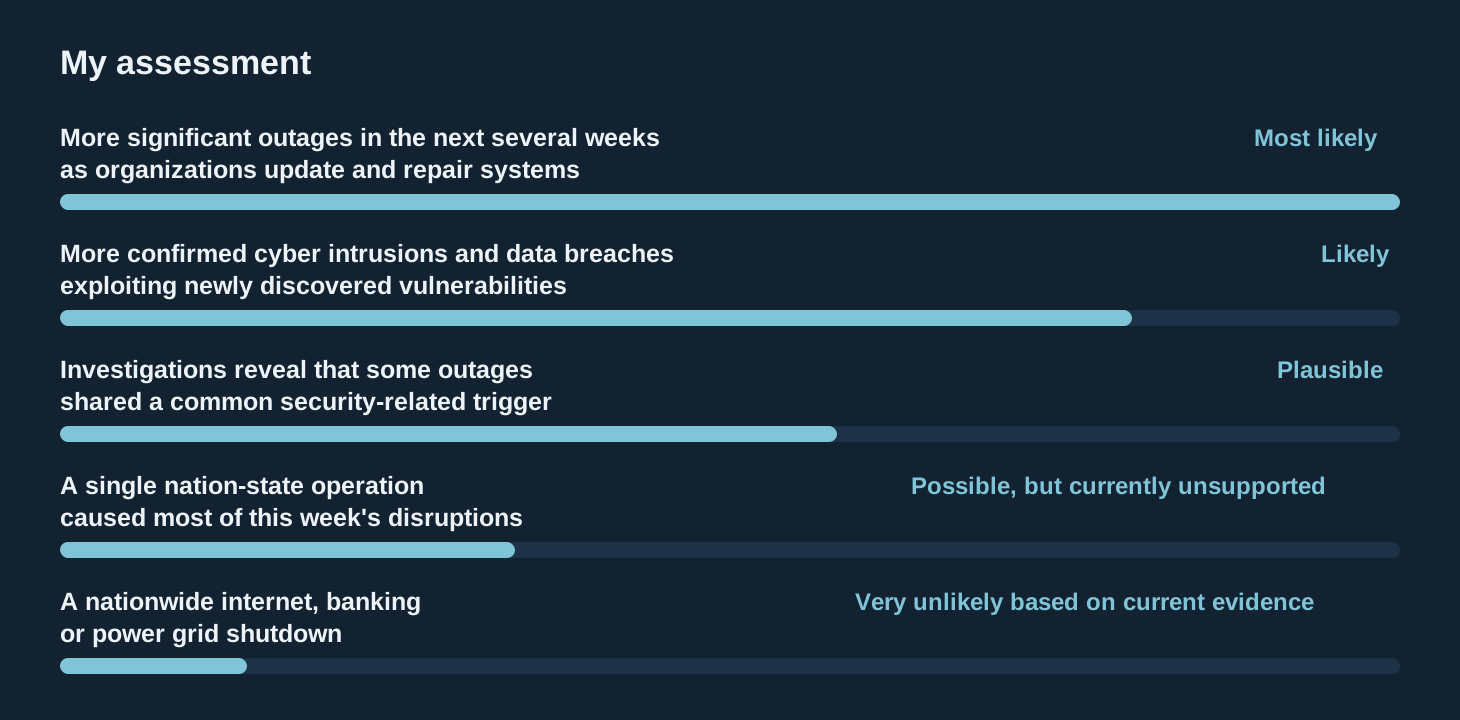
The first row is the one I would bet on. The PHP flaws alone guarantee weeks of patching, and patching at this scale and speed will take more systems down before it makes them safer. When those outages come, the statements will say maintenance, or a software bug, or an internal update. Some of those statements will even be the whole truth.
What I am watching for is the second-order effect. Attackers read the same disclosures everyone else does, with AI reading them faster. Every rushed patch wave is also a starting gun. The organizations that come out of this best will not be the ones that patched fastest or slowest. They will be the ones that treated patching like the high-risk operation it has become, and knew what was running on their systems before the red alert arrived.
AI found the holes first. Everything since has been the sound of everyone trying to close them at once.