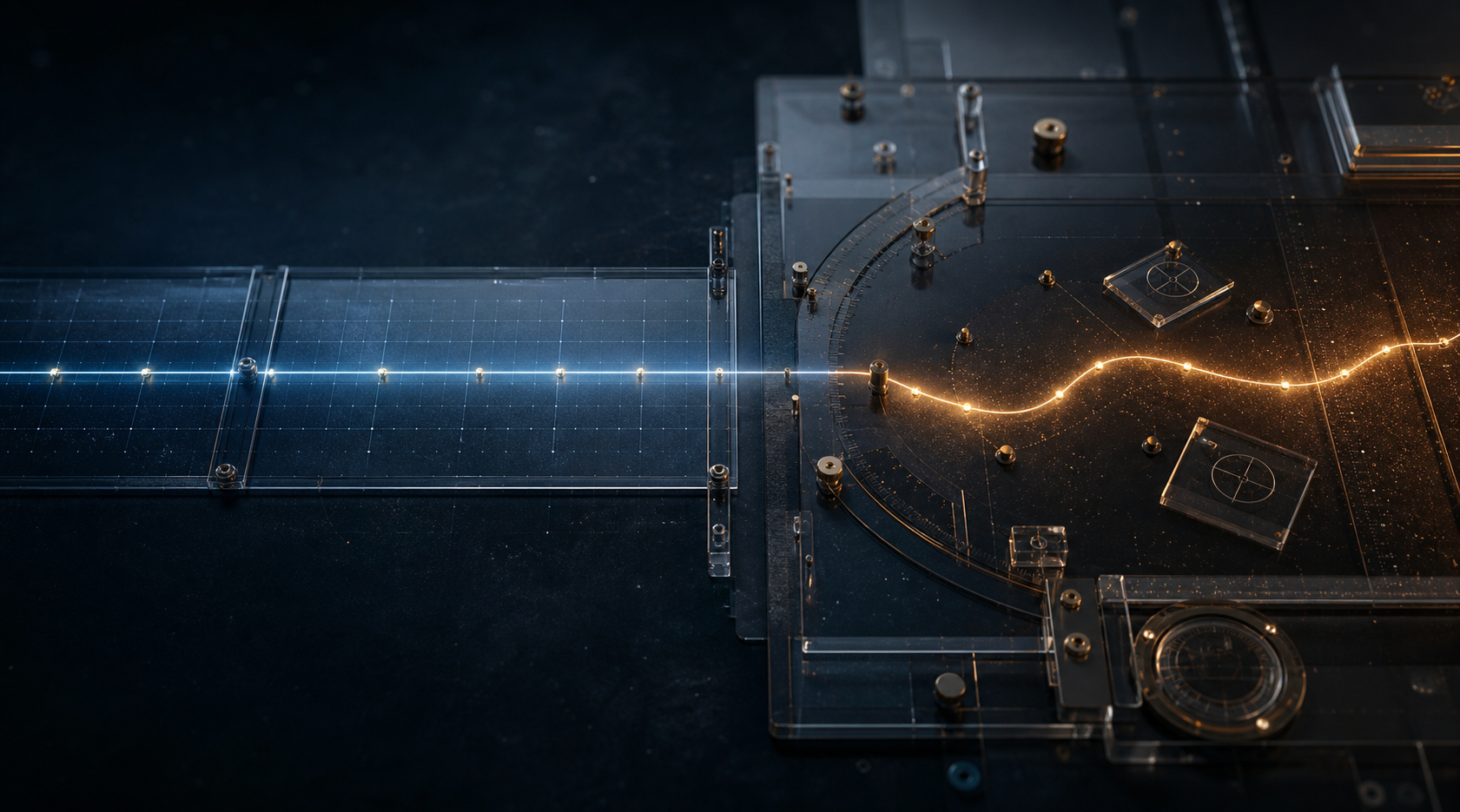
Why Your AI Model Is Quietly Failing Mid-Campaign
Your campaign dashboard can stay calm while the system making decisions inside it slowly stops describing the world you are buying into.
Model drift is not a dramatic crash. It is the slow loss of predictive quality after launch, while clicks, conversions, and ROAS remain too noisy to tell you what changed. Marketing teams need a separate model-health loop before they trust another campaign to an AI system.
91%
models degraded in one peer-reviewed study
1,400
marketers in Jasper's 2026 survey
49 → 41%
ROI confidence as adoption rose
31%
planning an AI Architect or Operations hire
The model can be wrong while ROAS looks fine
The dangerous version of model failure is not a red error. It is a believable answer generated from an outdated picture of the customer.
A model trained on June data learns patterns specific to June. July traffic is not June traffic. User behavior shifts. Competitors change their offers. A new channel changes the mix of visitors. The distribution the model learned from no longer matches the distribution it receives in production.
That mismatch is drift. The model can keep returning scores, rankings, or recommendations without knowing that its internal logic is no longer reliable. The campaign dashboard sees the outcomes of many other variables and averages the evidence away.
The practical distinction is simple: campaign analytics tells you what happened to the business. Model monitoring asks whether the system making the decision is still behaving like the system you validated at launch.
The top line can keep a campaign looking familiar while the decision-making system underneath drifts away from its launch behavior.
Three types of drift, one marketing blind spot
Data scientists usually separate drift into three families. Marketing teams do not need a statistics lecture, but they do need to know which layer moved before choosing a fix.
The inputs changed
Covariate drift
The people, signals, or traffic sources entering the model look different from the training data. Seasonal shifts, new channels, and agent-mediated browsing can all change the input mix.
The outcome changed
Label drift
The thing being predicted no longer means what it used to. Purchase intent, lead quality, or conversion may move as markets, offers, and customer expectations change.
The relationship broke
Concept drift
The relationship between input and outcome changes. Longer sessions may stop predicting conversion because ad fatigue, urgency, or competitor pricing rewrites the decision path.
Clicks, conversions, and ROAS can stay within a familiar range while the model's internal logic becomes wrong. Those are business outcomes, not proof that the model is healthy.
The evidence this is not hypothetical
A peer-reviewed 2022 study in Nature Scientific Reports analyzed 32 datasets across four industries and four standard model architectures. It found temporal degradation in 91% of the models tested. The researchers describe this as AI aging: performance changes over time even after a model reaches strong launch accuracy.
The number is not a forecast that every marketing model will lose 91% of its quality. It is evidence that degradation is common across production conditions, architectures, and datasets. Launch performance is a snapshot, not a warranty.
The marketing-specific symptom appears in Jasper's 2026 State of AI in Marketing survey of 1,400 marketers. AI adoption climbed to 91% of teams, up from 63%, while confidence in proving AI ROI fell from 49% to 41%. More systems are running, but teams feel less able to explain the result.
That does not prove every ROI problem is drift. It does show why model health deserves its own evidence loop instead of being inferred from a noisy business metric.

The evidence is not a single red number. It is the change in behavior that appears when weekly samples are placed next to the launch baseline.
Why marketing stops measuring model health
Traditional machine-learning pipelines hold out validation data, compare predictions with ground truth, and alert when performance moves outside an expected range. Marketing rarely has the same feedback loop. Outcomes arrive late, volume feels too valuable to reserve, and every campaign is mixed with seasonality, creative changes, and budget shifts.
So teams measure clicks, conversions, and ROAS because those numbers already have owners. The problem is that business performance and model quality are different layers. Good business metrics can sit on top of a degraded model, especially while other parts of the campaign are compensating.
Jasper's 2026 survey also reported a 3.4x year-over-year increase in blockers from legal, compliance, and brand review as AI use scaled. The organization is adding more AI surface area while the review system is still catching up.
That is an incentive problem before it is a tooling problem. Measurement can slow a demo and create evidence that a flagship initiative is misbehaving. But delaying the evidence does not keep the model healthy. It only makes the eventual diagnosis more expensive.
Prediction
What the model expected
Outcome
What actually happened
Comparison
Where behavior moved
Correction
Who pauses, retrains, or rolls back
Drift is not the same as model decay
The terms are often used interchangeably, but the operational answer changes depending on what moved. Confusing the two can make a bad system harder to recover.
The world or base model changed
The model's learned knowledge is stale. A vendor changes a foundation model, the market shifts, or new examples make the old training window less representative. The useful response is to refresh the model, update the data, or compare a newer version with the old one.
Diagnostic question: do new inputs look different from the conditions the model learned?
The operating behavior changed
The world may still be recognizable, but the live system is taking different paths, accumulating context, or reinforcing its own previous decisions. The useful response is behavioral: replay a fixed suite, reset to a known-good configuration, tighten the policy, and inspect the feedback loop.
Diagnostic question: do the same representative cases now produce materially different decisions?
If you retrain a drifting system on its own recent behavior, you can teach the problem to look normal.
Diagnose first. Refresh knowledge when the world changed. Reset behavior when the system changed. That distinction keeps a monitoring failure from becoming a permanent training decision.

What the failure costs
Undetected drift is a compounding decision problem, not a single bad prediction.
First, optimization moves further away from reality. Bids, budgets, audiences, and creative are adjusted based on predictions that reflect an older market. Then the model starts exploiting spurious patterns, correlations that felt real in the training window but were actually noise.
The most dangerous step is feedback. A bad prediction gets acted on. The resulting outcome is fed back as evidence. The model sees its own decision and becomes more confident in the pattern that caused the mistake. You are not only using a degraded model. You are giving it more opportunities to make its degradation look justified.
This is also where live marketing is changing faster than the old drift playbook assumes. A growing share of browsing may be mediated by AI agents that research, compare, and summarize on behalf of a person. That is not drift by itself, but it changes the training distribution and makes it more important to know whether the model is learning from people, agents, or a mixture it was never designed to distinguish.
Wrong signal
The model reads an old pattern as current reality.
Action
Budget, bid, audience, or creative changes follow it.
Feedback
The outcome returns as evidence shaped by that action.
Confidence
The bad pattern looks more justified than before.
The monitoring infrastructure that exists now
The original version of this argument stopped at "monitoring is engineering work." That is true, but it is no longer actionable enough. A market has formed around the exact gap between a model's launch behavior and its live behavior.
PeerSpot's July 2026 model-monitoring rankings list Arize AI, Fiddler AI, Evidently, WhyLabs, and H2O.ai among the leading solutions by category mindshare. These platforms can watch the statistical shape of incoming data, compare it with training data, diagnose a change, and route a review before another week of decisions is made.
That does not mean every marketing team needs an enterprise platform. It means "we cannot fix this because it is too technical" is a weaker excuse than it was. Start with the simplest loop that gives a human a chance to see the change: fixed samples, logged predictions, eventual outcomes, and a review owner.
Analytics tools tell you what happened to the campaign. Monitoring tools tell you whether the decision-making system is still the system you validated.
Fixed evaluation set
Same representative cases, replayed on a schedule.
Prediction and outcome log
Keep the decision next to what happened later.
Drift comparison
Separate input, label, and concept changes.
Human owner
Give a person authority to pause or roll back.
Tools can accelerate the loop. They cannot decide what a business is willing to tolerate or who owns the rollback.
What to do before the next campaign
You do not need a full ML platform team to close the first part of the gap. You need decisions made before the model controls real budget.
The organizational answer is emerging. Jasper found that 65% of marketing organizations now have a designated role managing AI workflows, and 31% planned to hire an AI Architect or Operations role for reliability, integrations, governance, and scale. Until that becomes a standard seat, assign the responsibility explicitly.
A useful alert is not simply “the score moved.” It says which population moved, how far it moved from baseline, how long the change lasted, and what decision is paused while someone investigates. That context keeps a monitoring program from becoming another noisy dashboard that everyone learns to ignore.
Read the adjacent model-decay post as a different problem: vendor or base-model behavior changing under you. This article is about live campaign models whose inputs, labels, or decision relationships have changed. The fixes overlap, but the diagnosis comes first.
Keep a baseline
Save a representative evaluation set before the model controls live budget.
Log decisions
Store predictions and eventual outcomes together, not in separate dashboards.
Review monthly
Compare current behavior with launch behavior before the campaign explains itself.
Separate the diagnosis
Ask whether inputs, outcomes, or the decision relationship changed.
Name the owner
Give someone authority to pause, retrain, or roll back without an incident debate.
FAQs
What is AI model drift in marketing?
Model drift is the gradual loss of predictive quality after deployment because real-world inputs, outcomes, or the relationship between them no longer match the training conditions. In marketing, a drifting model can keep producing confident audience, bid, or conversion predictions while those predictions become less useful.
How common is model drift?
A 2022 peer-reviewed study published in Nature Scientific Reports tested 32 datasets across four industries and four standard model architectures. It found temporal degradation in 91% of the models tested. That makes degradation an expected production condition, not a rare defect.
How can a marketing team detect drift?
Keep a fixed evaluation set, log predictions alongside eventual outcomes, compare current behavior with a launch baseline, and separate model-health metrics from campaign metrics. If scale justifies it, use a monitoring platform that can flag distribution changes and route a review before the model controls another week of budget.
What tools exist for model monitoring?
PeerSpot currently lists Arize AI, Fiddler AI, Evidently, WhyLabs, and H2O.ai among the leading model-monitoring solutions by category mindshare. The right choice depends on the model stack and the feedback loop, but the practical point is that teams no longer need to build every monitoring primitive from scratch.
Who should own drift monitoring?
Assign it explicitly to a person or team that can see both the model and the campaign. Jasper reported that 31% of marketing organizations planned to hire an AI Architect or Operations role in the next 12 months. Until that role exists, name an owner, define the review cadence, and give that person authority to pause or roll back the model.

A model can keep answering,
but doesn't mean it is still right.