The End of
“Wait, What Was I Thinking?”
A guide to AI Memory and the architectural blueprint for your new digital second brain.
March 28, 2026 · 10 min read
There is a peculiarly human tragedy in the lifecycle of a good idea. We all possess a cognitive junk drawer — a chaotic repository of brilliant ephemera from 2018, half-remembered passages from dog-eared paperbacks, and an endless purgatory of PDFs saved “for later.” Our minds are exquisite at generating insights but notoriously terrible at preserving them.
Imagine if your brain possessed an external hard drive that did not merely store your data, but actually understood it. We are currently witnessing the maturation of exactly this paradigm — requiring two distinct components: the “Personal Knowledge Vault” (the digital library containing the sum of your captured thoughts) and “AI Memory” (the genius, tireless librarian who navigates it).
The Historical Impulse
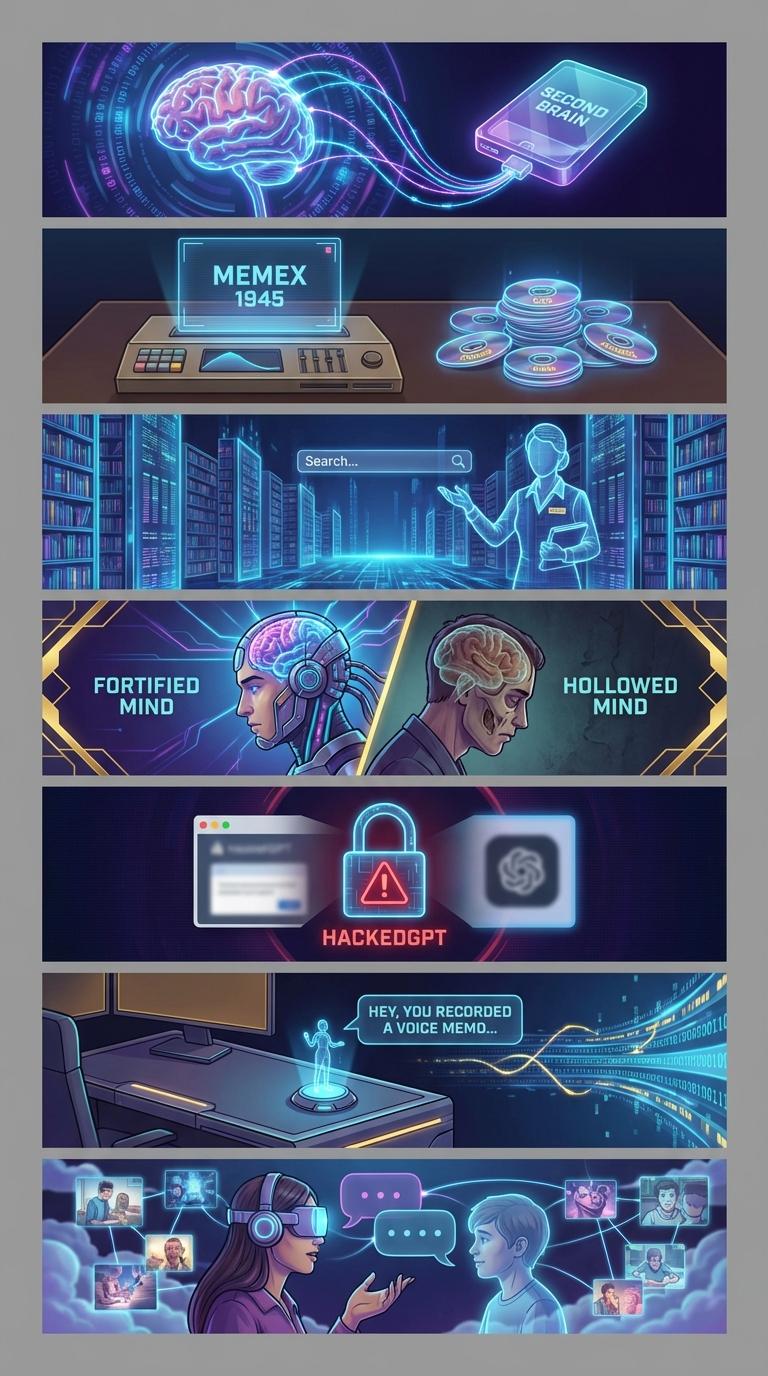
In 1945, Vannevar Bush penned his seminal essay As We May Think, conceptualizing the “Memex” — a theoretical, mechanized desk that would store a person's books, records, and communications.
Our attempts to build the Memex frequently stumbled. Consider the “lifelogging” movement of the 2000s, epitomized by Gordon Bell's MyLifeBits project. We attempted to record everything, but without intelligence to process this deluge, it became a digital graveyard where data went to rot.
This failure ushered in the Manual Era. Tools like Notion and Obsidian offered frameworks, but they required us to perform the heavy lifting of the archivist. Today, the AI explosion has finally filled that vacancy. The librarian has arrived for their shift.
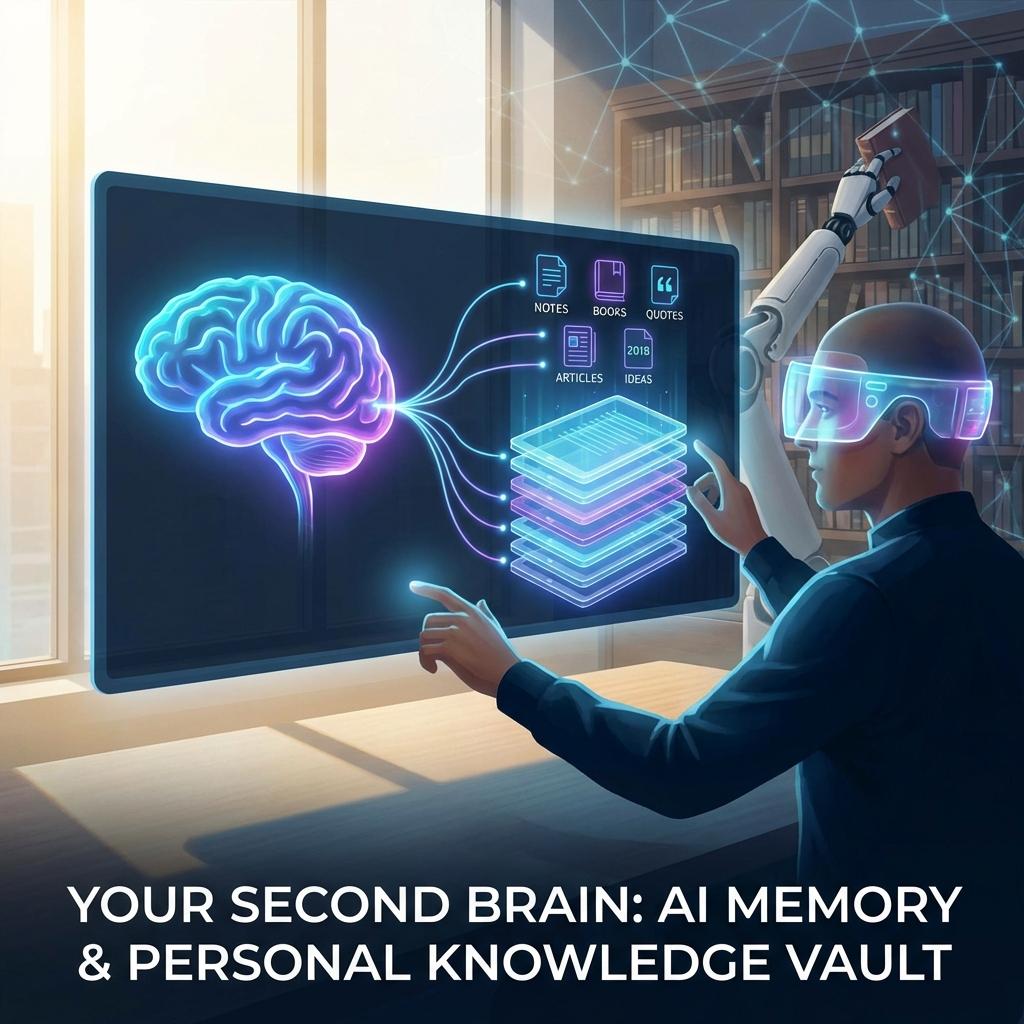
This synergy between the Library and the Librarian is fundamentally reshaping our relationship with information. The Vault serves as the static foundation. The AI Memory activates it through RAG (Retrieval-Augmented Generation) — allowing the AI to “read” your specific life architecture, fetching relevant notes and synthesizing answers based entirely on your context.
Team “Fortified Mind”
Offloading memory frees biological bandwidth for high-level synthesis. We are outsourcing mundane retrieval to focus on connection.
Team “Hollowed Mind”
Eliminating the friction of recall may lead to cognitive atrophy. Does the struggle of remembering create the neuroplasticity we need?
The “Privacy Rebels” are transforming the “Local-First” software approach into a philosophical movement. They desire a second brain, but refuse to let Big Tech hold the deed to their consciousness — their paranoia justified when examining the “Recall” drama and the blurry line between assistant and pre-installed spyware.
Listen to the Breakdown
Deep dive into the ethics of AI memory architecture
We must also contend with the terrifying reality of “HackedGPT” and Memory Injection. If your AI reads all data to build its memory, a malicious email could “poison” your second brain. Then there is the deeply uncomfortable phenomenon of “Context Bleed” — the moment when an AI surfaces your private anxieties during a professional screen-share.
The future belongs to the librarian that never sleeps.
We are moving toward a reality of “self-healing” notes, where an ambient AI tidies your chaotic jottings and fixes broken conceptual links while you dream. We will see the rise of the “Mini-Me” model — Small Language Models running locally, trained exclusively on your voice.
Instead of merely answering questions, the AI will interrupt your current workflow to offer, “You recorded a voice memo about this exact philosophical problem three years ago. Would you like to review your past thoughts?”
We are transitioning from the sterile act of “searching for files” to a dynamic, ongoing conversation with our past selves. The imperative now is to begin building your vault. Just remember: before you hand over the archive of your soul, make sure you are the only one holding the key.