
The Brussels ruling hit on a Thursday. New watermark requirements. A 3% turnover penalty. Deadline: August 2.
What nobody talked about in the press coverage: the studies buried in the announcement. Data errors, not thin attribution models. Measurement errors, not bad creative. The poison isn't the strategy. It's the data itself.
And it's already costing you.
The Numbers Are Uglier Than You Think
Last month, a study across 500+ enterprise accounts showed a pattern. The data looked clean on the dashboard. Charts trending up. ROI looking reasonable. But when auditors dug into the actual values flowing through the system, 30-40% of the rows had quality issues.
Not missing data. Not NULL values that the system could flag. Corrupted values. Duplicates. Timestamp mismatches. Values that should have been rejected at ingestion but weren't.
A mid-market SaaS company found out by accident. Their CFO was comparing a Shopify revenue report to their marketing platform's conversion data. The numbers didn't reconcile. Not off by a little. Off by 18% in a way that made their "successful" campaigns look profitable when they were actually losers.
They'd been optimizing toward false signals for eight months.
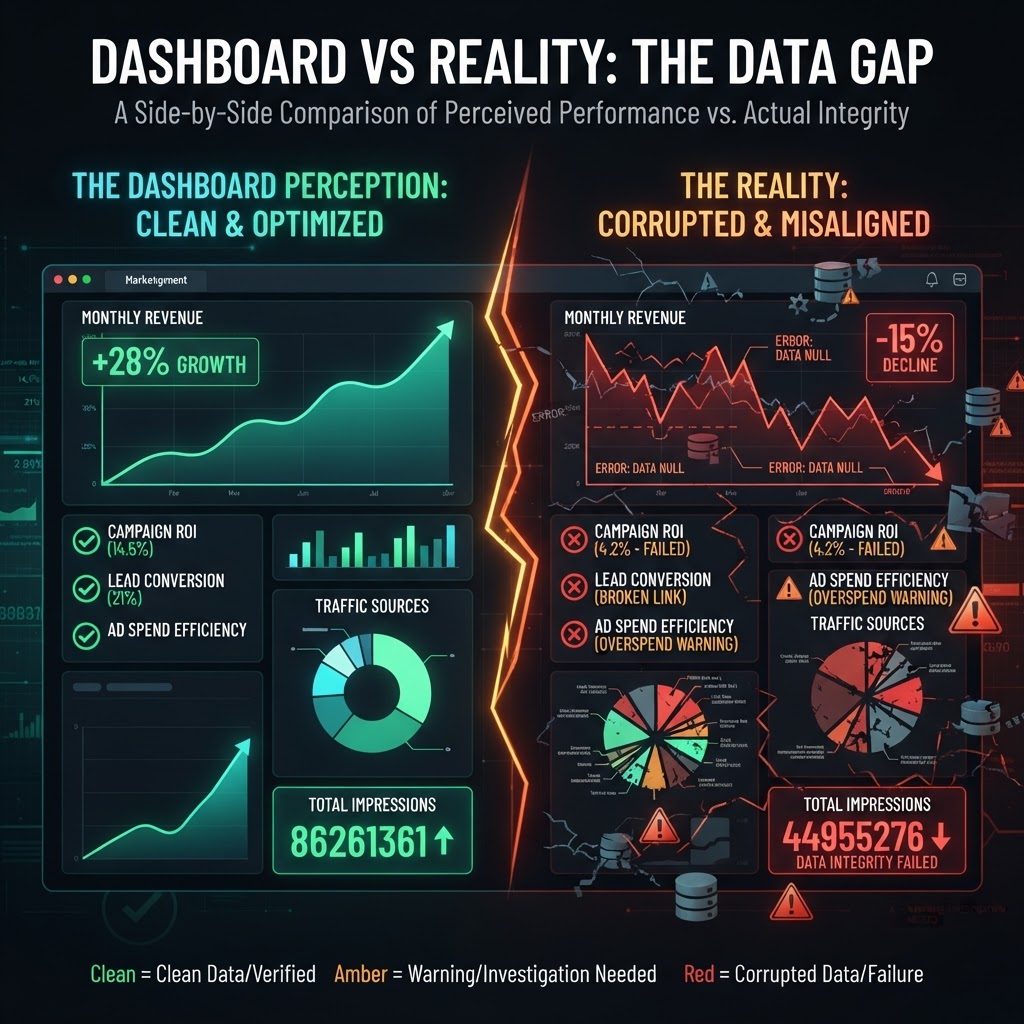
Why Data Quality Failures Look Like Success
AI systems are really good at masking data problems. That's the trap.
When your marketing platform runs data through an AI model, the model smooths over inconsistencies. It fills gaps. It makes educated guesses about what the data should be. None of that is necessarily wrong, but none of it is real.
The output looks perfectly normal. Charts render. Dashboards update. The system reports confidence intervals and margins of error. Everything looks scientific. Everything looks trustworthy.
What actually happened: the garbage went through a model that made it sound sophisticated. Your optimization algorithm then spent your budget based on hallucinations.
The worst part isn't that this happens. It's that you can't see it happening. A human analyst can smell something wrong if they spend time in the data. An AI system just keeps operating on whatever it was given.
How You Know This Is Happening to You
Three signals to watch for:
Signal 1: Reconciliation gaps that your team blames on "attribution complexity." You run the revenue report. Compare it to your platform's attributed revenue. They don't match. Your team says it's because some conversions are unattributed, or the models use different lookback windows. Maybe. But if the gap is growing, or if it's consistently 10%+ off, that's usually data quality, not attribution philosophy.
Signal 2: Campaign performance that doesn't match your actual business results. Your dashboard shows a 4:1 ROAS on paid search. Your actual CAC (the real one, from your finance team) doesn't match. The discrepancy should be 5-10% at most. If it's more than that, your platform is running on corrupted inputs.
Signal 3: Models that keep recommending similar actions across different data segments. When an AI system gets garbage data, it often makes generic recommendations because it can't find real patterns. If your platform keeps saying "increase bids on high-intent keywords" regardless of which campaign, account, or industry you're looking at, it's not generalizing wisdom. It's failing to find signal in the noise.

The Compliance Trap (And Why It Might Save You)
Brussels just forced the issue. Every AI system processing marketing data needs watermarks on data lineage. You need to be able to prove where the data came from, how many steps it went through, and whether it's been corrupted in transit.
The 3% turnover penalty is brutal. But here's why you should care: the watermark requirement forces your vendors to actually care about data quality. If they can't prove data provenance, they're liable. That changes behavior fast.
The August 2 deadline is in 8 days. Most AI marketing platforms haven't fully implemented this yet. Some are scrambling. A few are probably going to fail compliance and lose access to the EU market.
But the ones that make the deadline? They'll have actual data quality. For the first time, you'll be able to trace a conversion back to its source and know if it's real.
That's huge. But it also means you're about to discover how much of your current data is garbage.

What You Should Do Before August 2
First, stop trusting your dashboard numbers until you've audited them. Take your top 10 campaigns. Pull the raw data exports from your platform. Compare them to your CRM, your billing system, and your actual revenue. Do they reconcile?
If they don't, you found your data quality problem.
Second, ask your vendors what their data quality SLA is. Not their uptime SLA. Their actual data accuracy guarantee. If they hedging or giving you something vague like "99% data integrity," dig deeper. What does 99% mean? Is that row-level or column-level? What's the retry logic when corruption is detected?
Third, if you're running AI systems on marketing data, request a data lineage audit. Where is the data coming from? How many transformations has it been through? Are there deduplication steps? Are there quality checks at ingestion?
You might not get all of these answers. Most vendors haven't thought this deeply about it. That's a red flag.
The Bigger Picture
Data quality failures in AI systems are the new normal. They're not dramatic. They don't cause crashes. They just slowly burn your budget while you keep optimizing toward noise.
The Brussels ruling didn't solve this. But it forced vendors to start caring. And that matters.
For now, assume your marketing data is corrupted until you prove otherwise. Because statistically, it probably is.
Bookmark this: Why AI Systems Fail Silently explains the broader pattern of invisible failures in autonomous systems.
Related: How AI Controls Fail at Scale covers governance gaps that let bad data slip through undetected. And Measurement Paradox explores why ROI proofs are increasingly impossible when data quality collapses.