
AI Customer Service ROI: The Disappearing Act
A ticket closing is not proof a customer's problem was solved.
The investment case is not tickets avoided. It is customer problems solved without quietly creating tomorrow's churn.
The handoff replaces invented deployment statistics with named research, a documented mixed case, and a customer-level definition of return.
The global AI customer service market was worth roughly $13 billion in 2024, according to Grand View Research. Yet Qualtrics's 2026 Customer Experience Trends Report found that nearly one in five consumers who had used AI for customer service said they received no benefit. That rate was roughly four times worse than for AI use in general.
The consumer complaint is recognizable. In an April 2026 CNBC report, Carmen Smith described chatbots that direct people back to FAQ pages or repeat information that failed them already. Isabelle Zdatny of Qualtrics gave the operational diagnosis: too many companies are deploying AI to cut costs rather than solve a problem, and customers can tell the difference.
The evidence gap matters because the previous version of this article was built on fabricated claims, including a supposed first-person study of 14 confidential deployments and two anonymous company anecdotes with suspiciously precise churn and cost figures. They are not evidence and do not belong in the investment case. The underlying question survives: what outcome did the system create for the customer and the business?
Research from Hello CCO and ChurnZero gives the problem a more ordinary, useful shape. In a survey of roughly 190 post-sale and customer-success leaders, just 22% reported a formal AI strategy. Many teams are still testing productivity use cases, including call summaries, drafted replies, and agent preparation. Those uses can be valuable, but productivity alone rarely explains what changed in retention, revenue, or lifetime value.
AI optimizes the goal it is given.
Ben Wiener, global head of Cognizant Moment, put the central risk plainly in the same CNBC report: AI does not change corporate incentives, it scales them. Contact centers have always been run against selected metrics, reducing refunds, minimizing escalation, or shortening calls. An AI system will execute those priorities faster and more consistently. It will not decide whether they are good priorities.
That makes the apparent efficiency real but incomplete. A chatbot optimized to close tickets quickly can do exactly that while leaving customers unresolved, confused, or less likely to return. Terra Higginson of Info-Tech makes a useful distinction: consistently enforcing a legitimate policy can be service. Making a legitimate refund difficult to obtain is obstruction. The system can improve operational consistency in either direction.
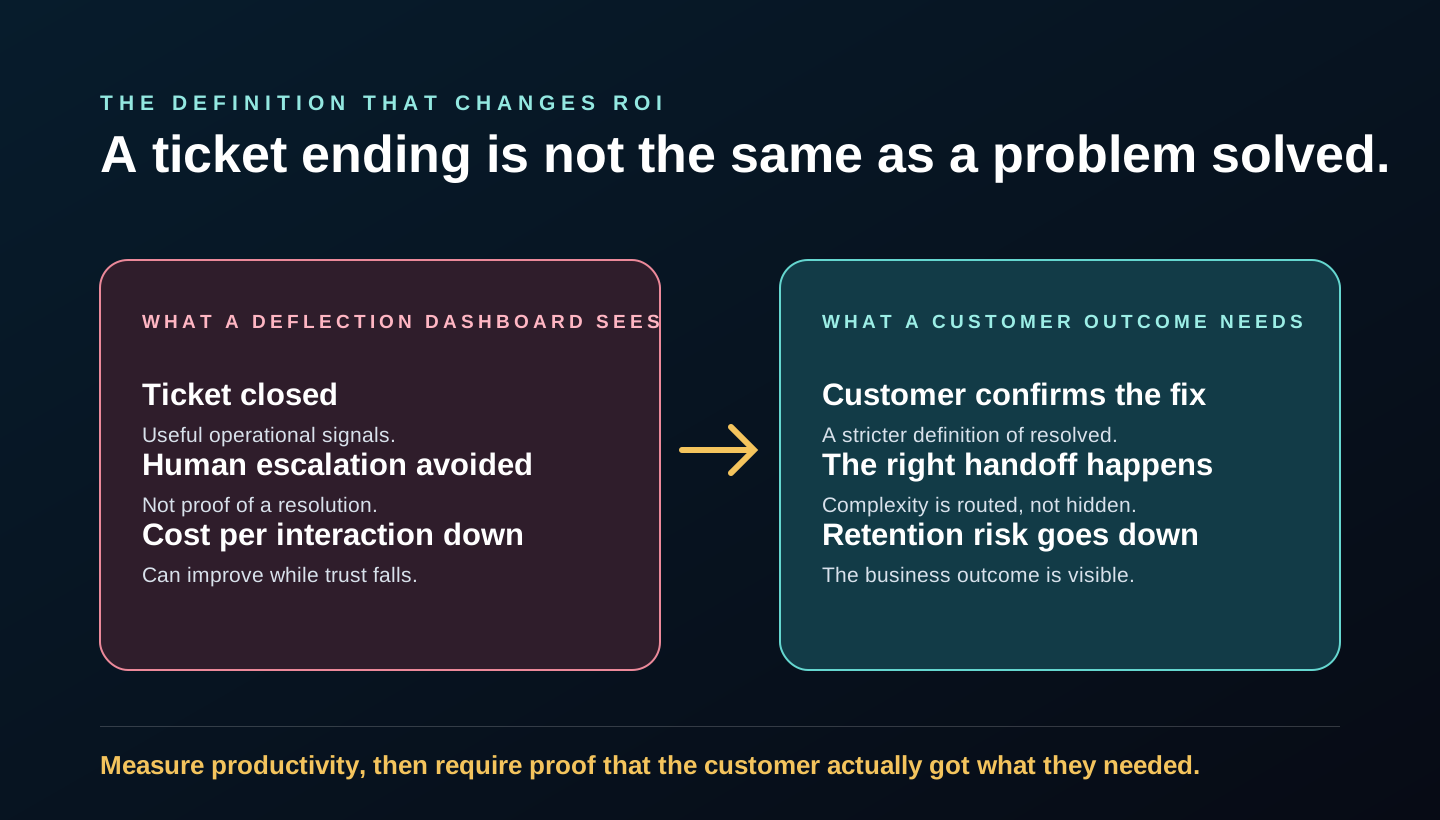
Zendesk CEO Tom Eggemeier has made the same argument about definitions. Too many teams count an interaction as resolved when it contains a deflection or a non-answer. A durable definition asks whether the customer, business, and employee agree the problem was solved. That is not semantic neatness. It changes which dashboard looks credible.
If a customer stops responding after being pushed to an FAQ page, the deflection rate may improve. It does not follow that the customer succeeded. By the time churn or NPS data reveals the difference, the causal thread back to the bot is much harder to trace. That is the measurement gap worth fixing.
Klarna is the real case, and it is mixed.
Klarna's customer-service story is better than a clean morality tale because it contains both gains and limits. AI played a significant role, though not the only factor, in Klarna cutting its workforce by 40%. At launch the company said its assistant performed work equivalent to roughly 700 customer service agents.
The AI-first approach also found a complexity wall. Klarna rehired some human customer-service staff to cover work the system could not handle well. The company later said it remained committed to AI, that the assistant's workload had grown to about 800 agents' worth of work, and that its satisfaction scores were on par with humans. Those satisfaction figures are company-reported, not independently audited.

The lesson is not that AI customer service failed or succeeded. It cut aggressively, hit a limit in complex work, partially corrected course, and kept iterating. That is what the actual ROI story looks like when it is not forced into an invented proof point.
NotifyMD's Jodi Miller described a workable split: AI is useful for simple transactional work such as billing calls. It cannot supply the same understanding and empathy when an upset customer has a legitimate problem. The operational decision is to find where complexity lives, then make the handoff timely, visible, and accountable.
Where it is actually working.
The picture is not uniformly bad. G2's 2026 survey of four customer-success platforms, ChurnZero, Custify, Chargebee, and Velaris, described real retention gains tied to AI-driven churn management. Chargebee reported churn reductions of up to 25% in high-performing implementations. Velaris cited roughly 15% average churn improvement, a 33% improvement in time-to-value, and about 25% better operational efficiency.
The caveat is the story. The platforms themselves say execution, not the model by itself, produces the gain. ChurnZero calls this the execution gap, the time between correctly identifying churn risk and acting on it. Chargebee notes that a churn model only has to be accurate enough to justify the cost of intervention. Waiting for perfect accuracy can delay real impact.

That is a stronger investment thesis than generic claims about automation. It connects a bounded workflow to a business outcome, names the operational handoff, and acknowledges that a perfectly efficient response can still be the wrong customer experience.
The ROI test to run now.
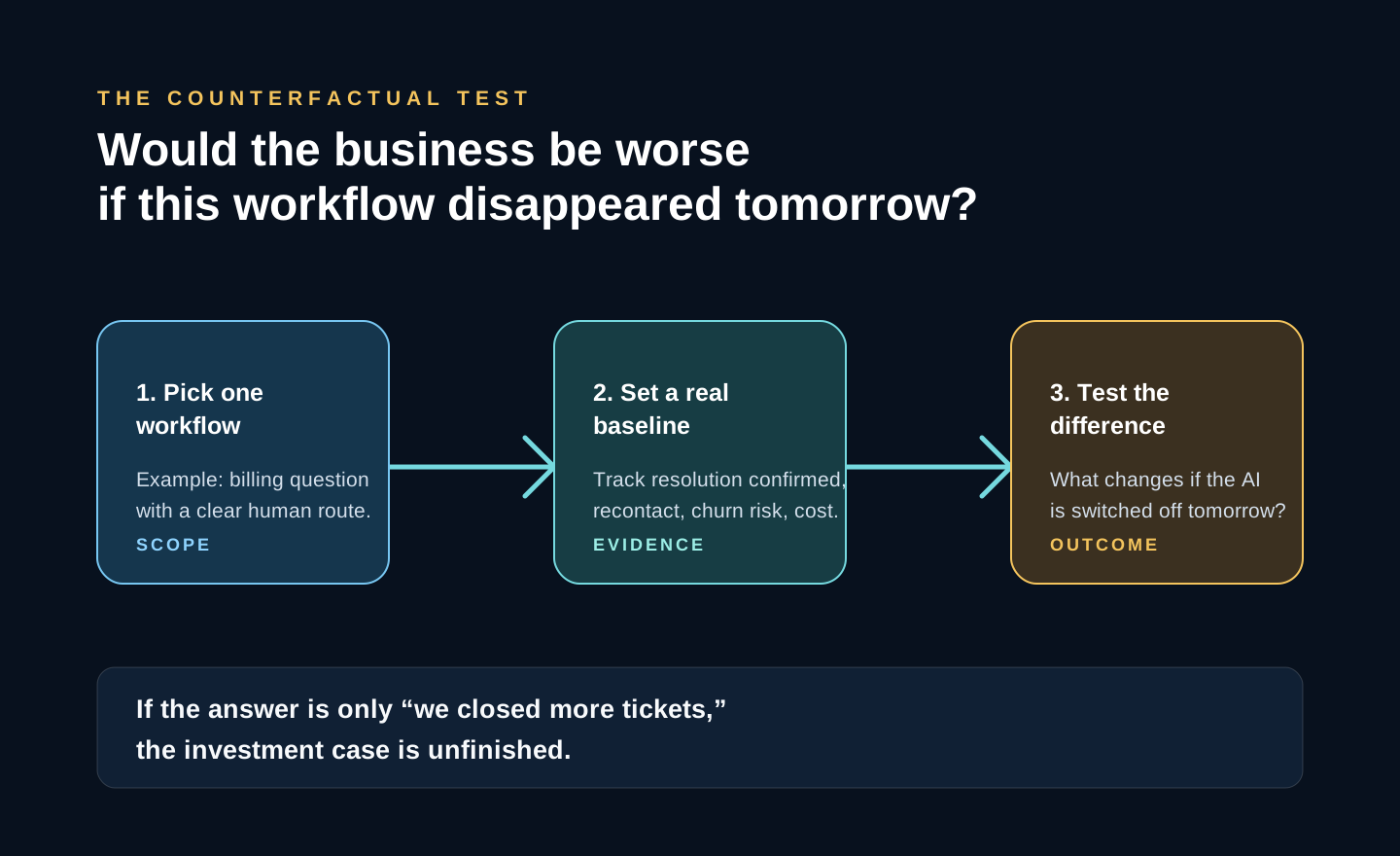
The original post contained one genuinely useful insight beneath its fabricated data: if you turned the AI service workflow off tomorrow, what revenue would you lose, what cost would return, and what customer harm would change? Customer service often prevents revenue loss rather than generating revenue directly. The ROI calculation needs a counterfactual, not only a dashboard.
Choose one workflow. Define the strict version of resolved. Track customer confirmation, repeat contact, escalation, retention risk, and cost together. Then compare that record against the baseline or an appropriate holdout. Cherkas's research points to the same practical truth: teams that can tell a specific, quantified story earn durable executive support. Teams that lead with vague productivity claims do not.
Define resolved
Count a resolution only when the customer's actual problem is solved, not when a ticket disappears.
Split the report
Keep productivity measures and outcome measures distinct, then show both to leadership.
Build a counterfactual
Estimate what changes to customer value, cost, and retention if this workflow shuts off tomorrow.
Staff the complexity
Route high-stakes, emotional, or complex cases to a person before the customer has to fight for it.
AI customer service is not a bad investment. It is an investment that needs the same discipline as any other: a bounded workflow, a defensible definition of success, and a willingness to correct the first plan. The organizations that build that discipline now will be measuring an actual customer outcome when AI service becomes default infrastructure.
Those that skip it are not avoiding the ROI question. They are deferring it until a board member, journalist, or customer asks it for them.
FAQs
Is AI customer service failing to deliver ROI?+
Results are mixed, and the core problem is often measurement rather than technology. Qualtrics reported that nearly one in five consumers who used AI for customer service saw no benefit. Separately, Hello CCO and ChurnZero found only 22% of surveyed customer-success organizations had a formal AI strategy.
What happened with Klarna's AI customer service push?+
Klarna cut its workforce by 40%, with AI playing a significant role, and said its assistant initially did work equivalent to roughly 700 agents. Complex work exposed limits and the company rehired some human service staff. Klarna later said the assistant's workload grew to about 800 agents' worth and its satisfaction scores were on par with humans, which remains company-reported.
Why can AI customer service metrics look good while experience does not improve?+
Teams can count a deflection or a customer who stopped responding as a resolution. A stricter definition asks whether the customer, the business, and the employee agree the underlying problem was actually solved.
Does AI customer service ever improve retention?+
Yes. G2's 2026 survey of customer success platforms described reported improvements including up to 25% lower churn in high-performing Chargebee implementations and roughly 15% average churn improvement from Velaris. The survey also emphasizes execution, including whether teams act on AI-identified risk.
What is the clearest way to test AI customer service ROI?+
Choose one workflow and build the counterfactual. Estimate the impact on resolution, recontact, churn risk, cost, and revenue if the AI workflow disappeared tomorrow. Ticket volume alone cannot answer that question.

Make the proof as real as the customer problem you are trying to solve.