
The trillion-dollar question isn't whether AI works anymore , it's whether anyone can afford it.
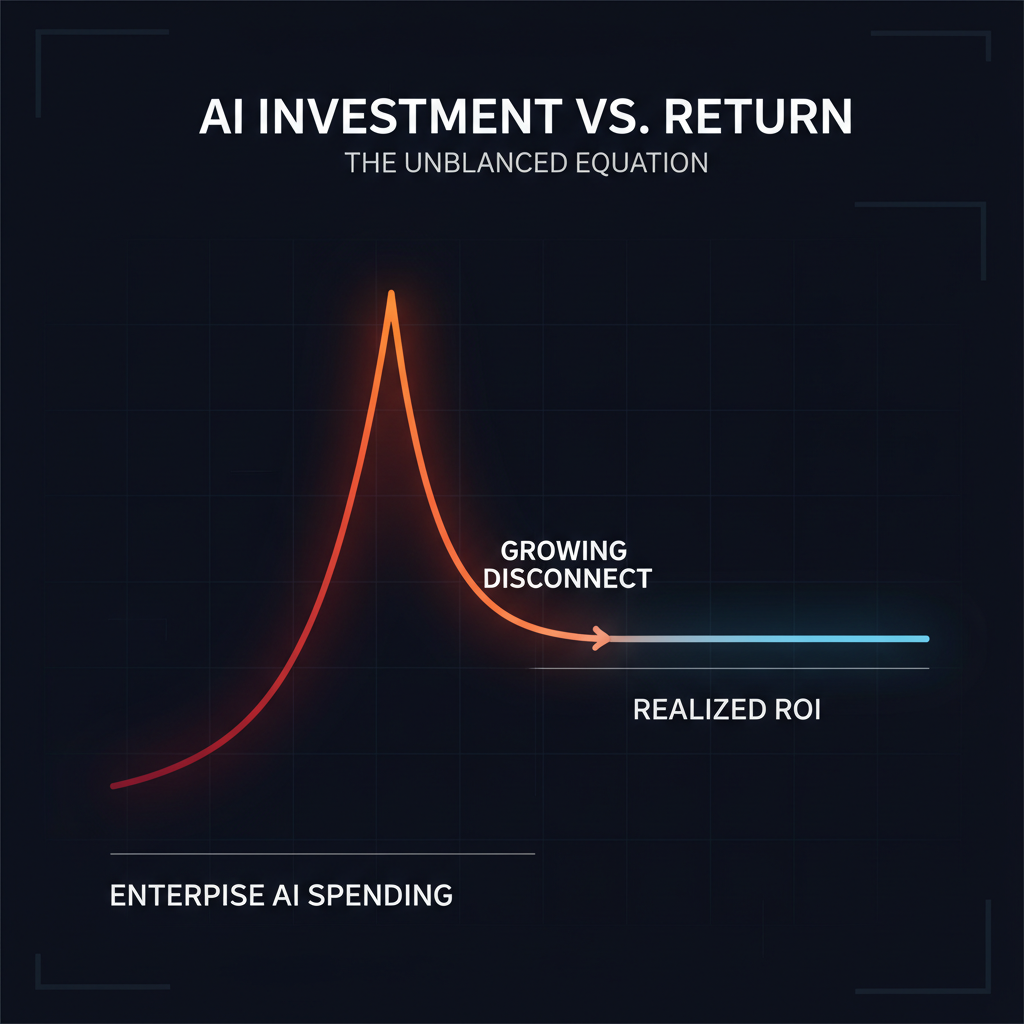
Enterprises dumped $1.3 trillion into AI infrastructure and implementation in 2025. In the first five months of 2026, they're already panicking. Uber burned through its entire 2026 AI budget in four months. One Fortune 500 company spent $500 million on a custom AI system that missed its ROI targets by 63%. McKinsey data shows that while 80% of enterprises feel pressure to adopt AI, only 6% have actually integrated it operationally. The gap isn't talent or vision , it's cash hemorrhaging faster than value materializes.
This is the AI cost paradox: the more you spend, the less you understand what you're spending on. And the market is finally waking up.
The Price Escalation Trap
Token prices are rising. Infrastructure costs are climbing. Model training budgets are exploding. OpenAI, Anthropic, and others are facing a cost meltdown that's cascading down to enterprises trying to use their APIs.
Here's what's happening: as enterprises scaled AI deployments through 2025, they optimized for capability, not efficiency. They built systems with massive context windows, redundancy layers, and continuous fine-tuning. It worked , until the bill came due.
Now, Big Tech is cutting back. OpenAI is raising API prices. Anthropic is throttling usage. AWS is bundling compute costs into new tiers. The economics that made sense at pilot stage don't scale.
But enterprises are locked in. They've already sunk millions into infrastructure. They can't turn it off. They're trapped in a cost escalation loop where savings require architectural overhaul , which requires capital they don't have because they've overspent on AI already.
This is what vendor lock-in looks like in 2026.

The Hidden Cost Multiplier
Most enterprises only count direct API costs. But the real cost multiplier is operational.
AI systems require dedicated ML ops teams ($150K-250K base), continuous data pipeline maintenance, model monitoring and drift detection, governance and compliance audit trails (especially in regulated industries), retraining cycles every 2-4 weeks, and human-in-the-loop review for safety-critical decisions.
A company spending $100K/month on API calls is actually spending $400K/month when you factor in headcount, infrastructure, and ops overhead.
The 2026 Marketing Data Report shows that 73% of enterprises underestimated AI operational costs by 40% or more. That gap is now showing up as cost overruns, missed budgets, and C-suite pressure to "make AI profitable."
Finance teams are only now discovering the true cost structure. The hidden multiplier is killing expected ROI across the board.
The ROI Mirage
Here's the uncomfortable truth: most enterprises can't prove AI is making money.
Deloitte's 2026 AI adoption study found that while 89% of companies deployed at least one AI system in 2025, only 22% achieved measurable ROI. The rest are in "pilot purgatory" , ongoing experiments that show promise but don't move the needle on revenue or margin.
Why? Because ROI measurement for AI is broken. Unlike traditional software, AI systems don't have clear, discrete outputs. They influence decisions. They improve efficiency by 3-5%. They reduce errors by a percentage point. Attribution is murky. Organizations end up funding AI as a "strategic investment" with no clear payback timeline.
Meanwhile, the cost clock keeps running.
This is especially brutal in marketing and customer service, where AI adoption is highest but attribution is weakest. A company investing $2 million in conversational AI can't tell if it's saving $2 million in support costs or just shifting work around. The system might be improving customer satisfaction, but that doesn't hit the P&L for 18 months.
The Consolidation Play
As cost pressure mounts, enterprises are consolidating AI vendors. Instead of best-of-breed tooling (best model from Anthropic, best inference from another provider, best embedding from a third), companies are bundling. Salesforce AI. Microsoft AI. Google AI. Amazon AI.
This is happening not because these platforms are superior, but because enterprises need to reduce the number of bills they're paying. Consolidation trades optionality for cost control.
This moves capital toward the incumbents and starves the specialized AI companies that built genuinely better models. By 2027, the AI market will look like the cloud market: dominated by three vendors, with a long tail of niche players serving specialized use cases.

What Leaders Are Doing (and Not Doing)
The smart ones are rightsizing. They're reducing context windows and moving to smaller models (10-20% cost savings immediately), building internal efficiency layers with custom routing and smarter prompt engineering, moving from fine-tuning to few-shot prompting (lower training cost, faster iteration), and consolidating use cases by picking 3-5 high-ROI applications and defunding the rest.
The ones burning money are chasing every new model release, maintaining multiple vendor relationships "just in case," over-engineering for safety with excessive audit trails, and running pilots indefinitely without forcing productionization decisions.
The difference between the two is ruthlessness. Winners cut deeper. Losers keep spending.
The Bottom Line
The trillion-dollar bet on AI assumed that capabilities would unlock immediate value. They did, in some cases. But they also unlocked a new cost structure that enterprises didn't anticipate.
2026 is the year the bill comes due. By Q4, we'll see broader AI budget cuts as IT reallocates to proven use cases, consolidation announcements as major enterprises move to single-vendor stacks, custom AI shutdowns when ROI doesn't materialize, and a shift toward smaller models as the pendulum swings from "bigger is better" to "efficient is profitable."
The companies that win won't be the ones throwing the most capital at AI. They'll be the ones ruthlessly measuring ROI, consolidating vendors, and engineering for efficiency instead of capability.
That's a much smaller market. And that matters for everyone betting on the AI boom continuing.