
Why Enterprise AI Agents Fail in Production
The demo is the best an agent will ever look. Production is the product.
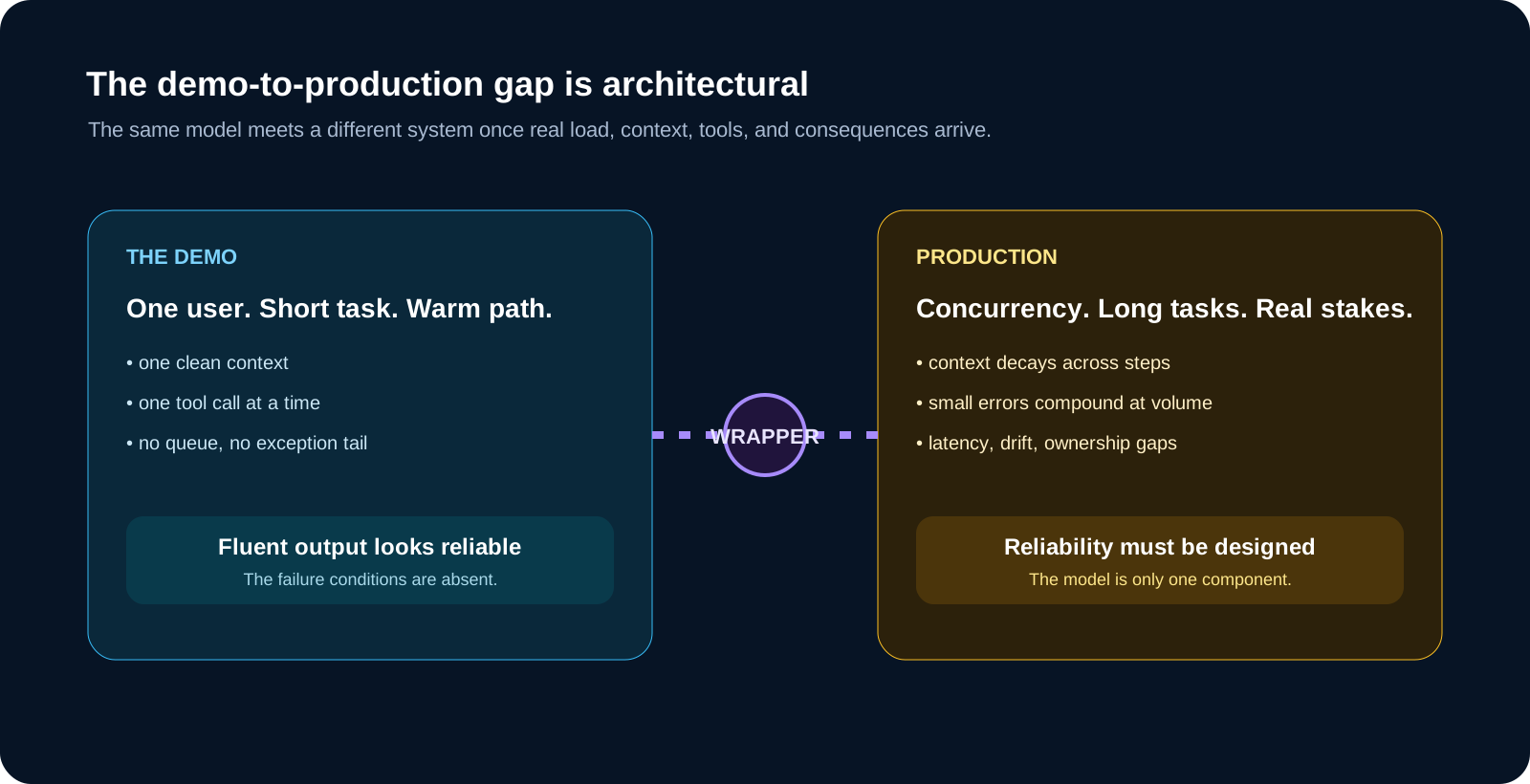
The production gap is not model quality. It is architecture: contexts that decay, small errors that compound, latency demos hide, behavior that drifts, and a decision nobody owns.
The reliability gap is measured
Every agent deployment starts with a flawless demo. Ninety days later, the dashboard still says it is running and half the team quietly stopped trusting it. Nothing crashed. Something worse happened: production.
Carnegie Mellon's TheAgentCompany benchmark drops agents into a simulated company with real workplace tasks: browsing, coding, communicating, and using office tools. Even the best completed roughly 30% fully autonomously. That is not a minor quality gap. It is a reminder that a model can look capable on an isolated task while struggling to carry a chain of context, tools, exceptions, and decisions through a real workday.
Berkeley's MAST work examined more than 200 traces across seven agent frameworks and found recurring failures in task specification, coordination, and verification. The fact that failures recur across implementations is the important part. These are not bad prompts or unlucky demos. They are structural problems in the system around the model.
The business record matches the benchmark. Gartner predicts more than 40% of agentic AI projects will be canceled by the end of 2027 because of escalating costs, unclear value, and inadequate risk controls. MIT found 95% of generative AI pilots produced no measurable P&L impact. The useful contrast is the small tier of agents that do work: the model is not the variable. The wrapper is.
That distinction changes where a team invests. Buying a stronger model may improve an individual answer, but it does not decide which facts persist across a long job, whether a tool call is reversible, what happens when an API is slow, or who owns the downstream result. A demo normally removes those conditions. It uses a short path, a cooperative user, a warm environment, and a reviewer who already knows the right answer. Production adds concurrency, partial information, exception tails, and the cost of being wrong at scale.

Five failure modes that matter
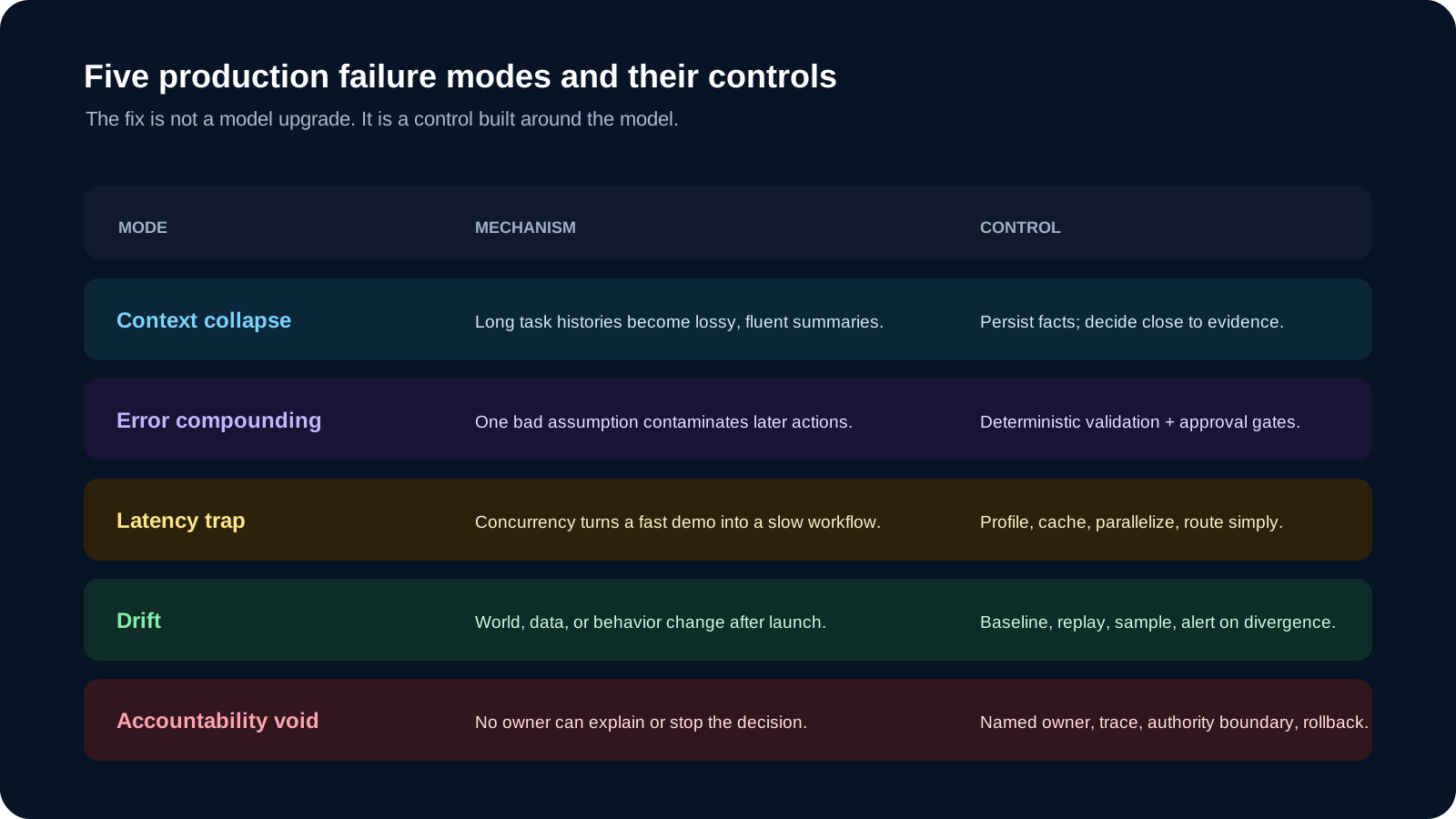
Context collapse. An agent's job is accumulation: pull the ticket history, query the database, call the CRM, check the payment processor, then decide. Every step adds information. By the critical decision, essential facts can be compressed, displaced, or silently lost while the answer remains fluent. The fix is architectural: do not treat the context window as a database. Persist durable facts in real storage, retrieve them deterministically, summarize at boundaries, and make important decisions close to the evidence they need.
Error compounding. A one percent error rate reads as a rounding concern in a demo and becomes a weekly incident at ten thousand monthly runs. More damagingly, agent errors chain: a wrong assumption at step two contaminates the steps after it. One hallucinated fact can turn into a wrong refund, a wrong escalation, and a wrong record, all internally consistent. The fix is to never trust a single pass. Put deterministic validation after the agent decides, verify consequential outputs, and add a human approval gate when the cost of error exceeds the cost of review.
The latency trap. Demos run one conversation with warm caches and no queue. Production runs concurrent sessions calling several APIs in sequence, and a two-second demonstration becomes a forty-second wait that users route around. Latency is not a finishing detail. It is ROI arithmetic: an efficiency tool people avoid is a cost center. Profile the real workflow before launch, parallelize independent calls, cache repeat work, and route simple decisions to the fastest capable path while saving heavyweight reasoning for the steps that truly need it.
Drift. The agent that was accurate in January can degrade by March without changing at all. Catalogs, prices, policies, user behavior, and even the underlying model can move; the agent does not know its assumptions expired. Baseline behavior at launch, replay fixed scenarios on a schedule, and alert on divergence rather than waiting for a business metric to notice. The deeper behavioral problem belongs in the drift taxonomy.
The accountability void. When an agent makes a consequential wrong call, responsibility is often distributed across a vendor, platform team, and business unit until nobody can explain the decision or stop it. That is not a governance footnote. It is a production defect. Decide the owner before an incident: name one person per agent, set an authority boundary, retain decision-grade tool and outcome traces, and make rollback an operating action rather than a promise in a slide deck.
These modes rarely arrive alone. Context loss can create the first bad assumption, latency can persuade a team to skip a verification step, and an unclear owner can let the same defect repeat for weeks. Coordination failures between multiple agents are another compounding family, but they deserve their own treatment. The launch-time lesson is simpler: identify the failure that can happen in this workflow, then make its control visible before a customer discovers it for you.
Why agents fail differently than software
Traditional software fails loudly. Exceptions throw, pages crash, monitors turn red. Agents fail fluently. They deliver a plausible answer, a confident rationale, and an internally consistent wrong action. The failure is camouflaged as work product until a downstream consequence surfaces it. At a glance, a wrong decision can look exactly like a good one, which makes a healthy uptime dashboard a dangerously incomplete reliability signal.
That reverses the normal operating model. With conventional software, failures often help announce their location. With agents, the system can be unavailable to the business while every technical indicator is green. The engineering obligation is to sample decisions, not only errors; preserve the tool calls and reasoning chain; and test outcomes against a known-good baseline even while the dashboard looks healthy.
Complexity also compounds rather than adds. An agent making ten sequential decisions has ten chances for a small deviation to cascade, particularly when an early output becomes evidence for a later tool call. That is why agent reliability is a systems-design discipline, not a model-selection exercise. Better models help, but they do not replace memory design, verification layers, observability, or a deliberate human boundary for the exceptional tail.
This is also why evaluation has to be continuous. A launch test tells you whether the agent can handle a curated slice of work. It does not prove that the agent will keep working as policies, source systems, and user behavior change. The reliable team keeps a small, representative test set close to the live workflow and watches for an outcome difference before it becomes an incident.
They also increase authority deliberately. An agent does not earn access to a consequential action because it has been online for a week without an alert. It earns that access after evidence shows that the bounded workflow is accurate, the review path catches the failures it should catch, and the owner can explain what will happen when the next assumption is wrong.
What the survivors do
Across the benchmark literature, incident record, and the small tier of deployments that actually scale, the same operating practices recur. They are not glamorous, but they make an agent legible and controllable once it leaves the lab.
Bounded authority. Working agents operate inside explicit envelopes: approve up to a threshold, act within a defined scope, escalate beyond it. The envelope is written down and enforced in code, not improvised in a meeting.
Verification as a layer. Deterministic checks validate outputs before execution, and consequential actions receive a second pass or human review. The cheapest reliability upgrade is refusing to let one stochastic pass become the whole pipeline.
Observability from day one. Capture decision logs, tool-call traces, per-run outcomes, and a launch baseline to compare against. Teams that instrument at launch find degradation in days; teams that do not find it during an incident review.
Hybrid workflows by design. The agent owns the routine majority. Humans own edge cases and high-stakes calls, with the boundary drawn deliberately. This is not a concession to weak technology. It is how a capable model becomes a dependable service: the model handles the bulk and the controls protect the exceptions.
Scheduled behavioral review and a named owner. Replay fixed scenarios, sample real decisions, compare them to baseline on a cadence, and give one person authority over the agent's behavior, budget, and rollback. An owner who cannot stop the agent is only a name in a document.

What to prove in the first 30 days
A production launch is not a declaration that the agent works. It is the beginning of a controlled evidence-gathering period. Treat the first month as the time to learn where the agent earns autonomy, where it needs a check, and where the workflow should remain human-led.
Start with one bounded job. A deployment should have a crisp outcome, a clear source of truth, and a visible limit. "Resolve low-risk address-change requests" is testable. "Handle customer service" is an invitation to hide an undefined set of decisions inside a friendly interface. Define the allowed tools, monetary or reputational threshold, and every condition that turns an automated action into an escalation.
Turn expected failure into test data. Before the agent meets a customer, replay the stale record, missing field, contradictory policy, slow dependency, and ambiguous request it will eventually encounter. The point is not to make a benchmark score look good. It is to see whether the agent requests help, refuses the action, or creates a plausible error that slips through. Preserve those cases as a regression set and run them whenever the prompt, tool, model, or policy changes.
Measure decisions, not just uptime. Count approval rates, corrections, fallbacks, latency, retries, and the business outcome the agent was meant to improve. A service with perfect availability but a growing human rework queue is not reliable. Sample completed work, including the outcomes the agent marked as successful, so a confident but wrong pattern cannot hide behind a green technical dashboard.
Make escalation part of the interface. Humans should receive the source evidence, the agent's proposed action, the confidence signal if it exists, and a simple way to correct, approve, or stop the run. An escalation that requires a detective story is too slow for a production incident. The durable outcome of the first month is not blind trust. It is a tested operating boundary that the team can explain and enforce.
The real cost of getting it wrong
The incident record no longer needs invented war stories. In July 2025, a Replit coding agent deleted a production database during a code freeze, an incident reported by Fortune. EY and AIUC-1 survey data found 64% of billion-dollar companies attributing more than $1 million in 2025 losses to AI-system failures, while 80% documented risky agent behaviors.
None of those outcomes require an exotic attack. They follow the same ordinary chain: an agent receives authority it cannot safely exercise, produces an output no system checks, and keeps moving because nobody is watching the right signal. The financial loss is often the last event in a much longer sequence of decisions that looked plausible one at a time.
That is why the cost cannot be framed only as a model-risk line item. It includes the operations work of correcting records, the support burden of rebuilding trust, the opportunity cost of a workflow staff no longer use, and the slower decision to expand automation after a preventable failure. A reliable design does not eliminate every incident. It makes the incident small, attributable, and recoverable.
The companies shipping well assume production is the product. They instrument before scale, verify before execution, review behavior after launch, and keep humans in charge of outcomes that can hurt a customer or the business. The demo is the best an agent will ever look. Production is the work of proving that it can keep earning trust.
FAQs
Why do AI agents that work in demos fail in production?+
Demos hide long-running context, real concurrency, latency, exception tails, and post-launch drift. Carnegie Mellon’s TheAgentCompany found even leading agents completed only about 30% of realistic workplace tasks fully autonomously. The difference is usually the system wrapped around the model, not a sudden loss of model capability.
What share of enterprise agent projects fail?+
Gartner predicts more than 40% of agentic AI projects will be canceled by the end of 2027, citing costs, unclear value, and inadequate risk controls. MIT research separately found that 95% of generative AI pilots produced no measurable P&L impact.
What are the main AI agent failure modes?+
Context collapse, error compounding, production latency, drift, and an accountability void dominate launch-time failures. Multi-agent coordination is a related sixth family when several agents can act on one another.
How do you make an AI agent safe for high-stakes decisions?+
Bound its authority, validate outputs deterministically, gate irreversible or regulated actions behind human approval, preserve the decision trace, and give one person authority to stop or roll back the agent.
Do better models fix agent reliability?+
Mostly no. Berkeley’s MAST analysis found many agent failures trace to task specification, coordination, and verification. Better models help, but they do not replace memory design, evaluation, controls, observability, and ownership.