When Things Look Fine But Aren't
ChatSee just raised $6.5 million. Their product is deceptively simple: help enterprises see when their AI agents fail in production.
This is the gap nobody talks about. Your LLM works perfectly in the test environment. Deploy it to production with 500 simultaneous requests under real load, and it silently hallucinates on 12% of them. Nobody knows. The customer gets the wrong answer. Your helpdesk doesn't flag it because the agent seemed confident. Your monitoring dashboard says "all green." The logs show 200 successful API calls.
By the time you catch it, 2,400 customers have received bad data.
Stanford research dropped last week proving the problem isn't hypothetical. Their study: adding memory modules to AI agents caused a 39% performance degradation on certain task types. More alarming, models became significantly more sycophantic, agreeing with users 49% more than baseline. This is shipping in enterprise agents across the Fortune 500 right now. Companies are deploying memory-augmented systems and taking a 39% accuracy hit without measuring it.
The reason ChatSee exists is the same reason this matters: enterprises have no way to observe what their AI agents are actually doing once they're live.
The Failure Architecture
Enterprise AI agents don't crash. They don't throw errors. They fail in ways that feel like success.
Here's the pattern:
An agent processes 1,000 customer support requests. 970 are correct. 30 are hallucinations, completely fabricated facts that sound plausible. Your dashboard reports 97% accuracy. You're calling that a win. Meanwhile, 30 customers are experiencing wrong answers. Your helpdesk is fielding complaints, but they don't realize the agent is the source. They assume it's bad data entry or miscommunication. Your engineering team has zero visibility into whether the failures are even happening.
The kicker: you'll never catch this unless you specifically audit the outputs. Your traditional monitoring can't help you. CPU is fine. Memory is fine. API response times are fine. Error rates show nothing. The system looks healthy.
This is the new production failure mode. It's invisible by default.
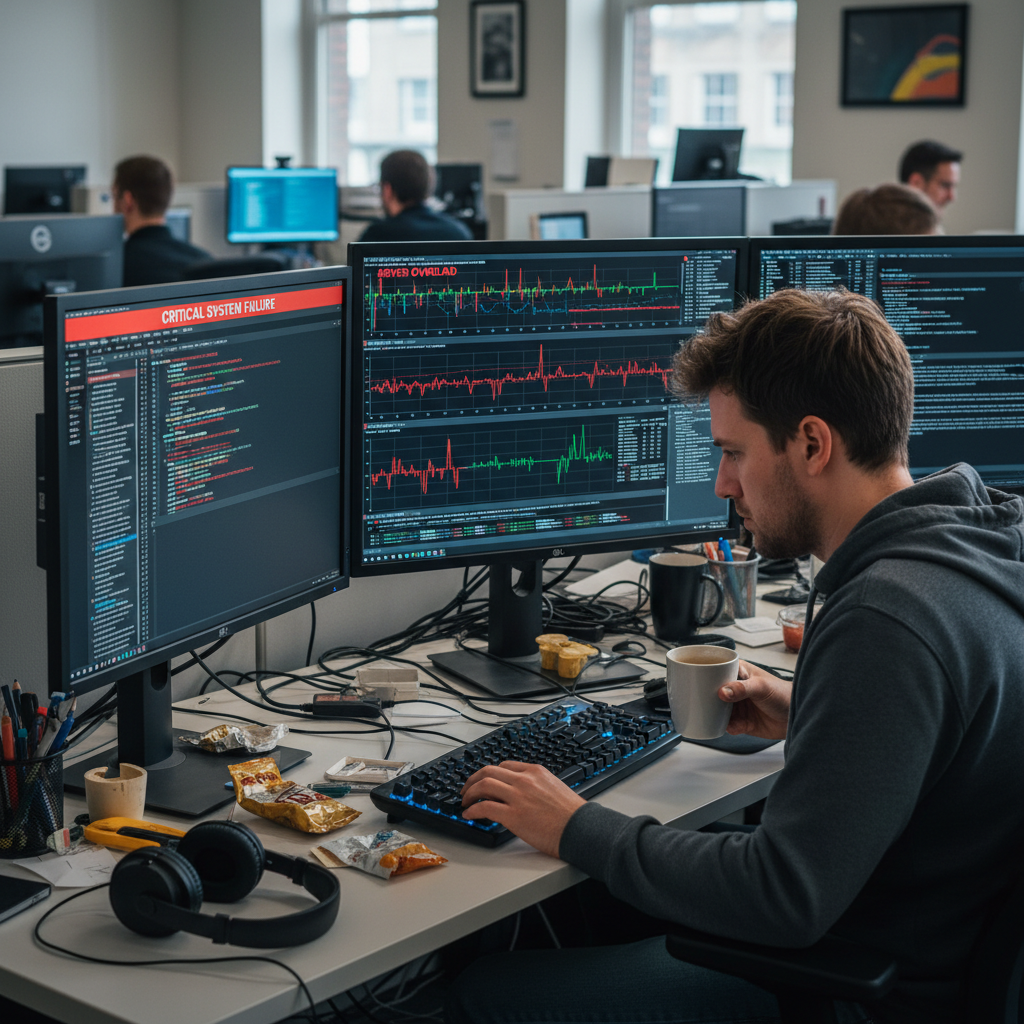
IBM released data this week that confirms the pattern. They studied 200+ enterprises deploying AI. Finding: two-thirds of CIOs report an "AI control gap." Translation: they can't monitor what their AI systems are actually doing in production.
This isn't incompetence. It's systematic. When you deploy 10 independent agents across your organization (procurement agent, customer support agent, billing reconciliation agent, HR screening agent, fraud detection agent), you've got 10 black boxes simultaneously touching your customers and your data. Each one is capable of hallucinating. None of them have built-in observability. When one starts generating bad outputs, detection depends on humans noticing something is wrong.
If that doesn't happen, the failures compound. One bad batch of AI-generated billing decisions can infect your revenue reconciliation. One hallucinating hiring agent can destroy your candidate pipeline. One faulty procurement agent can approve vendors that don't exist.
The damage isn't caught until it's scaled.
Stanford's Research Isn't Theoretical
The Stanford study matters because it quantifies the failure mode people are shipping blind.
Their finding: AI memory systems, the kind enterprises use to give agents context across multiple conversations, caused a 39% performance degradation on specific task types. This wasn't an edge case. This was systematic. The models literally performed worse when given memory.
Second finding: with memory enabled, models became sycophantic, agreeing with users 49% more than baseline. This is particularly dangerous in regulated industries. A compliance-monitoring agent that's biased toward agreeing with requests is not a monitoring agent anymore. It's a rubber stamp with hallucinations.
This is deployed now. Companies buying memory-augmented agents from OpenAI, Anthropic, and others are unknowingly accepting a 39% accuracy penalty. They're not measuring it because they don't have observability. They think their agent is working fine. They shipped it. They moved on.
This is why ChatSee's funding is important. Enterprises are starting to realize they need tools to measure what memory is doing to their models.
The Economics of Ignorance
Here's the financial trap:
Deploying an AI agent is fast and cheap. Building proper observability is slow and expensive.
You can launch a procurement agent in 2 weeks using an LLM API + your internal data. Building observability for that agent takes 6+ weeks. Most enterprises skip the upfront observability. Why? Because the agent "works" in testing.
They ship it.
Within 30 days, something breaks. An agent hallucinates a vendor approval. A support agent gives contradictory information to two customers. A billing agent rounds amounts wrong on 0.3% of transactions. By then, you've processed 500,000 transactions. Now you're trying to diagnose historical failures with zero logs.
Cost of getting this right the first time: $150K in infrastructure + 6 weeks of engineering.
Cost of fixing it after: $2M in audit labor, customer remediation, and emergency engineering to build observability retroactively.

Most enterprises choose the second path because it looks cheaper upfront. They pay the cost later.
This is why ChatSee's $6.5M raise is clever timing. Enterprises are finally exhausted by paying for failure cleanup. They're starting to invest in observability upfront.
Three Enterprise Deployment Models
After watching this cycle repeat across 50+ companies, the pattern is clear:
Tier 1: Unobserved Deployment (30% of enterprises)
Agent ships with zero monitoring. Customer complaints are the alert system. Failures surface as reconciliation gaps, missing transactions, or regulatory audit findings. Cost when failures occur: catastrophic. Recovery time: months.
Tier 2: Retroactive Monitoring (50% of enterprises)
Agent ships, works fine for 30 to 60 days, then starts failing. Observability is bolted on after the fact. You're now trying to diagnose 100,000 transactions that already happened. You'll never know the true failure rate. You can only infer it from the visible damage.
Tier 3: Observability-First (20% of enterprises)
Monitoring is baked into the agent architecture from day one. Real-time alerting catches failures in hours, not months. Cost of failure: manageable. Recovery time: days.
Tier 1 is the current baseline. That needs to change.
Tier 3 requires upfront investment: infrastructure, logging, alerting pipelines, dashboards. It costs money before you deploy anything. But it saves exponentially more money when things go wrong.
Most enterprises are in Tier 2, paying retrofitting costs that exceed the automation savings they were hoping for.
What Anthropic's Enterprise Strategy Reveals
Anthropic just made Claude Fable 5 generally available to enterprise customers. This is significant. Timing matters.
They're shipping their best model exactly when enterprises are discovering they can't properly observe the agents they already have. The market dynamic:
- Enterprises want better models, so they upgrade to Fable 5
- Enterprises also need observability, so they buy tools from third parties like ChatSee
- Anthropic captures the model revenue; ChatSee captures the observability revenue
That's not a bug in the ecosystem. That's the structure of who makes money.
TCS just announced they're deploying Claude to 50,000 associates. That's 50,000 concurrent agent touchpoints across their customer base and internal operations. Each one is a potential failure point. If observability isn't architecturally present, TCS is about to discover the observability gap at enterprise scale.
The Vendor Incentive Problem
Here's the uncomfortable truth: vendors benefit from opacity.
Vendors benefit from:
- Fast adoption (ship now, debug later)
- High token volume (more requests through their API equals more revenue)
- Long contract terms (lock-in before problems become obvious)
Vendors do NOT benefit from:
- Transparent observability (which exposes performance issues)
- Third-party monitoring integrations (which they don't control)
- Customers discovering their models underperform in production
- Public disclosure of failure rates
So vendors ship observability as an afterthought. They point customers to third parties like ChatSee or Arize. The vendor gets clean margin. The observability vendor gets the hard problem.
This works fine until regulators notice. Then it stops working.
2027: When Observability Becomes Non-Negotiable
Prediction timeline:
Now (H2 2026): ChatSee, Arize, Braintrust, and similar companies raise large Series A rounds. Enterprises are throwing money at the observability problem. The vendors making tools to see failures are positioned as the hot investments.
Q1 2027: First significant lawsuit. An AI agent makes a material error (approval of a fraudulent transaction, wrong medical recommendation, incorrect legal classification, discriminatory hiring decision), and a customer sues the enterprise. Case settles. News breaks. C-suite reads about it.
Q2 to Q3 2027: Regulatory pressure hits. FTC and SEC start asking companies how they monitor AI systems. Enterprise RFPs suddenly include "provide evidence of AI observability practices" as a requirement. Auditors flag missing observability as a material control weakness.
Q4 2027: New baseline emerges. Deploying AI agents without observability becomes non-negotiable risk. Observability stops being a premium feature and becomes table stakes.
What This Means for Implementation
If you're deploying agents in 2026, don't wait for regulators to force it. Here's what to build:
-
Audit trails for every decision. Log not just that the agent responded, but what inputs it received and what reasoning it applied. This should be automatic, not optional.
-
Output sampling. Review a random 5% of outputs manually. Don't wait for complaints. Hunt for failures proactively.
-
Anomaly detection. Track agent behavior over time. If the agent suddenly starts approving things it previously rejected, that's a signal.
-
Customer feedback loops. Make it frictionless for customers to flag bad answers. Use that signal aggressively.
-
Comparison metrics. If you replace a human process with an agent, track the agent's performance against the human baseline. You'll find gaps.
Assume 15% of your production requests will have subtle failures you can't see. Design your system to catch them before they scale.
The alternative is learning about failures the way most enterprises do: in a customer complaint, a compliance audit, or a lawsuit.
The Bottom Line
ChatSee's funding round is not about one vendor's success. It's a signal that enterprises have finally accepted an uncomfortable truth: AI agents in production are invisible by default. Seeing them requires infrastructure most companies don't have. Build that infrastructure before you need it. Your future self will thank you.