
Agentic AI Drift: The Measurement Blind Spot
Your agent fleet can double while your monitoring barely moves. The system still completes tasks, so the dashboards stay green. The behavior has already changed.
Drift is not a broken agent. It is a different agent.
Measure decision paths, repeat-run reliability, cost per task, and ownership before the outcome dashboard catches up.
2x
enterprise agent fleets in four months
47 → 52%
mean monitoring coverage
82.6 → 91.8%
confidence in visibility
The blind spot just got measured
Your agent fleet probably doubled in the last two quarters. Your monitoring did not.
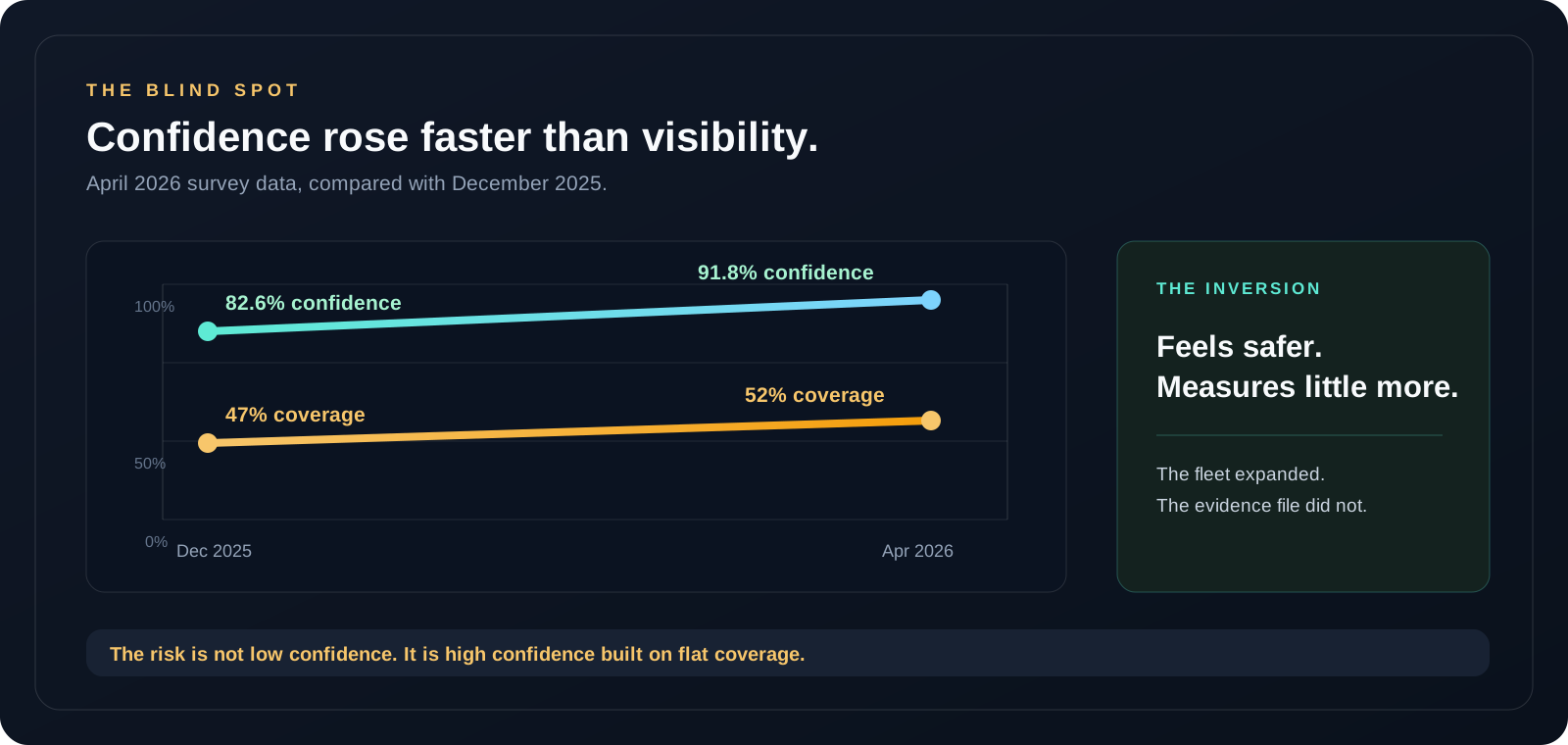
That is the pattern in Gravitee’s State of AI Agent Security survey of 750 senior technology leaders, updated in April 2026. Enterprise agent estates roughly doubled in four months. Nearly 38% of organizations now run more than 100 agents in production. Mean monitoring coverage barely moved, from about 47% in December 2025 to about 52% in April 2026.
Roughly half of production agents are running without security or governance instrumentation, and 90% of organizations report unmonitored agents in production. The coverage gap is already large enough to hide a meaningful change in behavior.
Here is the detail that matters more than the fleet count: stated confidence in agent visibility rose from 82.6% to 91.8% over the same four months. Coverage stayed flat. Confidence went up. Teams are becoming more comfortable with a risk they have not reduced.
Why outcome dashboards cannot see drift
Standard AI monitoring was built for prediction: accuracy, precision, latency, error rate. You compare an output against a ground truth and get a number. Agents break that model because an agent’s job is not one output. It is a chain of decisions: plan, call a tool, read the result, decide again.
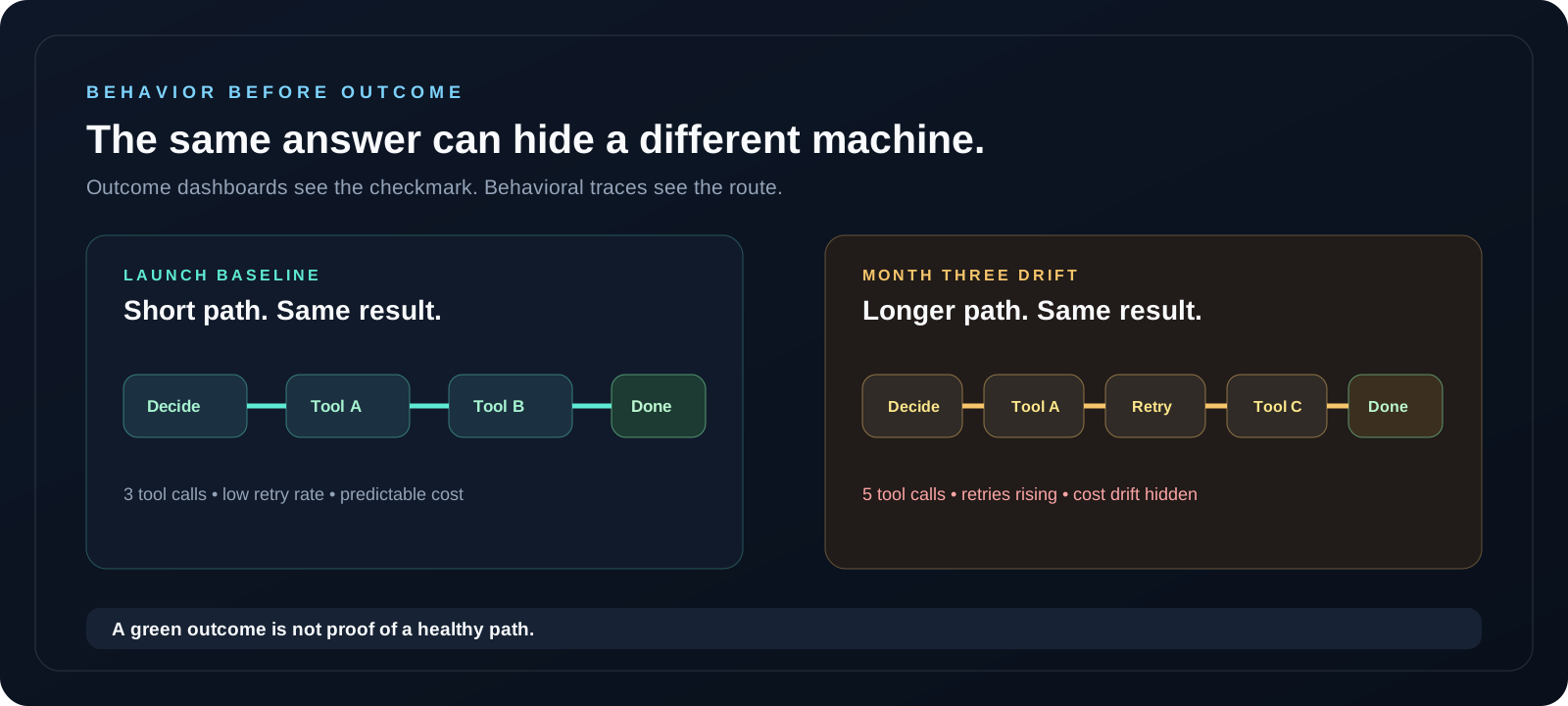
There might be five valid paths to the same answer. Two are efficient. Three are circuitous but still succeed. When an agent shifts from efficient paths to circuitous ones, the customer can still get an answer while token spend creeps up, latency stretches, retries multiply, and edge cases start taking a different route.
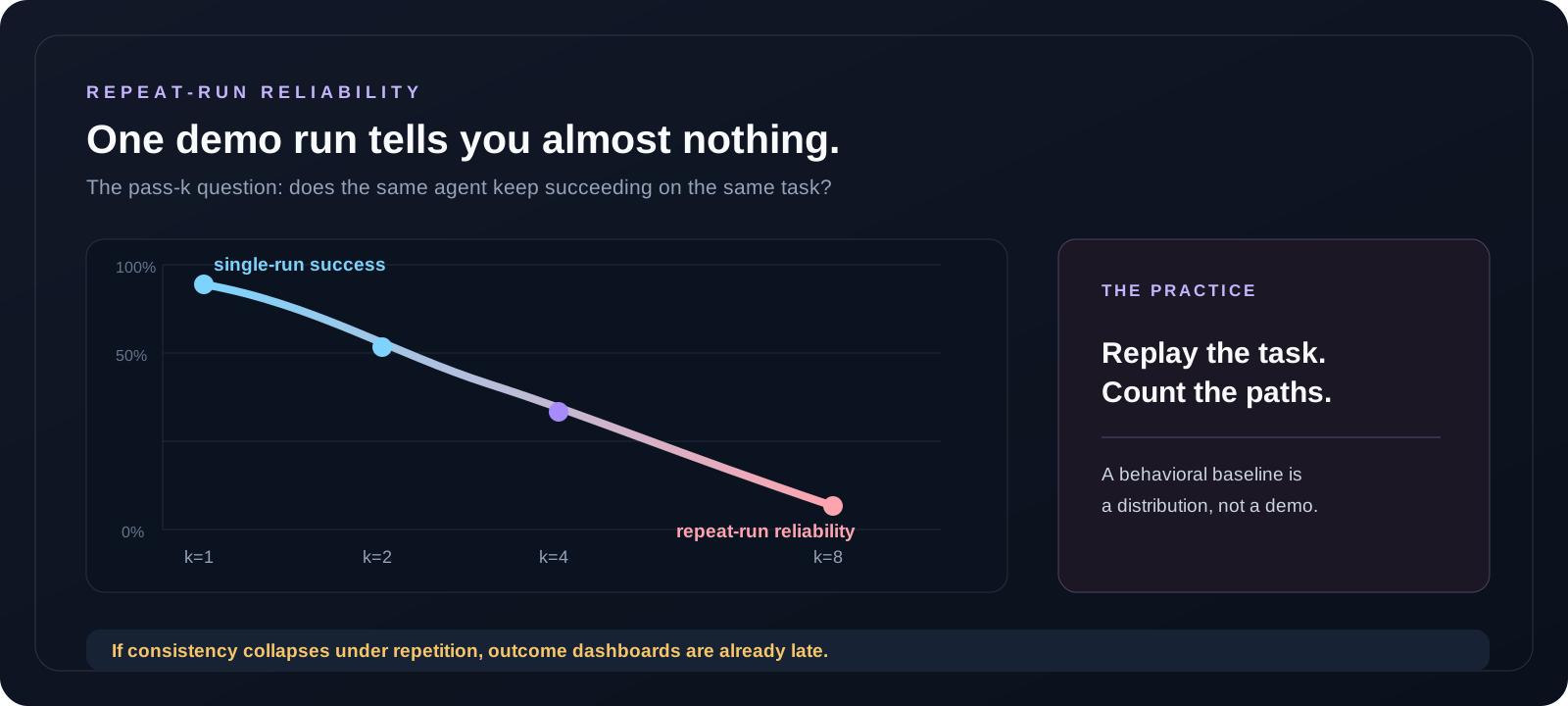
The tau-bench benchmark introduced pass-k, a reliability measure that asks whether an agent succeeds across repeated runs of the same task. State-of-the-art tool-using agents succeeded on fewer than half of tasks, and repeatability fell sharply as k increased. One successful demo is weak evidence when the starting condition is inconsistency.
Microsoft’s AI Red Team reached the same conclusion from the attack side. Session context contamination and incremental escalation can be highly effective and difficult to detect because no individual step looks anomalous. Detection requires behavioral analysis across the full session, which most systems do not have.
Drift has become an incident category
The April 2026 survey wave surfaced a failure pattern that was largely absent four months earlier: AI output errors causing operational and compliance harm. A clinical chatbot gave incorrect medication guidance. A predictive model scored risk on outdated data. A billing agent processed claims with errors that went undetected for weeks.
None of those are crashes. Every one is drift reaching a customer before it reaches a dashboard. For marketing and operations leaders, the translation is direct. If an agent adjusts budgets, scores leads, personalizes offers, or answers customers, drift looks like a quarter of slightly worse decisions that nobody can explain afterward.
The same survey reported confirmed security incidents falling from 59.3% of organizations in December 2025 to 34.9% in April 2026 while fleets doubled and monitoring stayed flat. Gravitee reads that drop as underreporting and detection failure rather than proof that systems became safer. When the attack surface doubles and the incident count falls, the most likely explanation is that visibility stopped keeping up.
The first useful move is to stop calling every behavioral change a model problem. A tool schema changed. A prompt was edited. A vendor swapped the underlying model. The agent may be doing exactly what its new environment rewards. Your system still needs to tell you that it changed.

The instrumentation playbook
You cannot buy your way out of drift with a dashboard. You measure your way out.
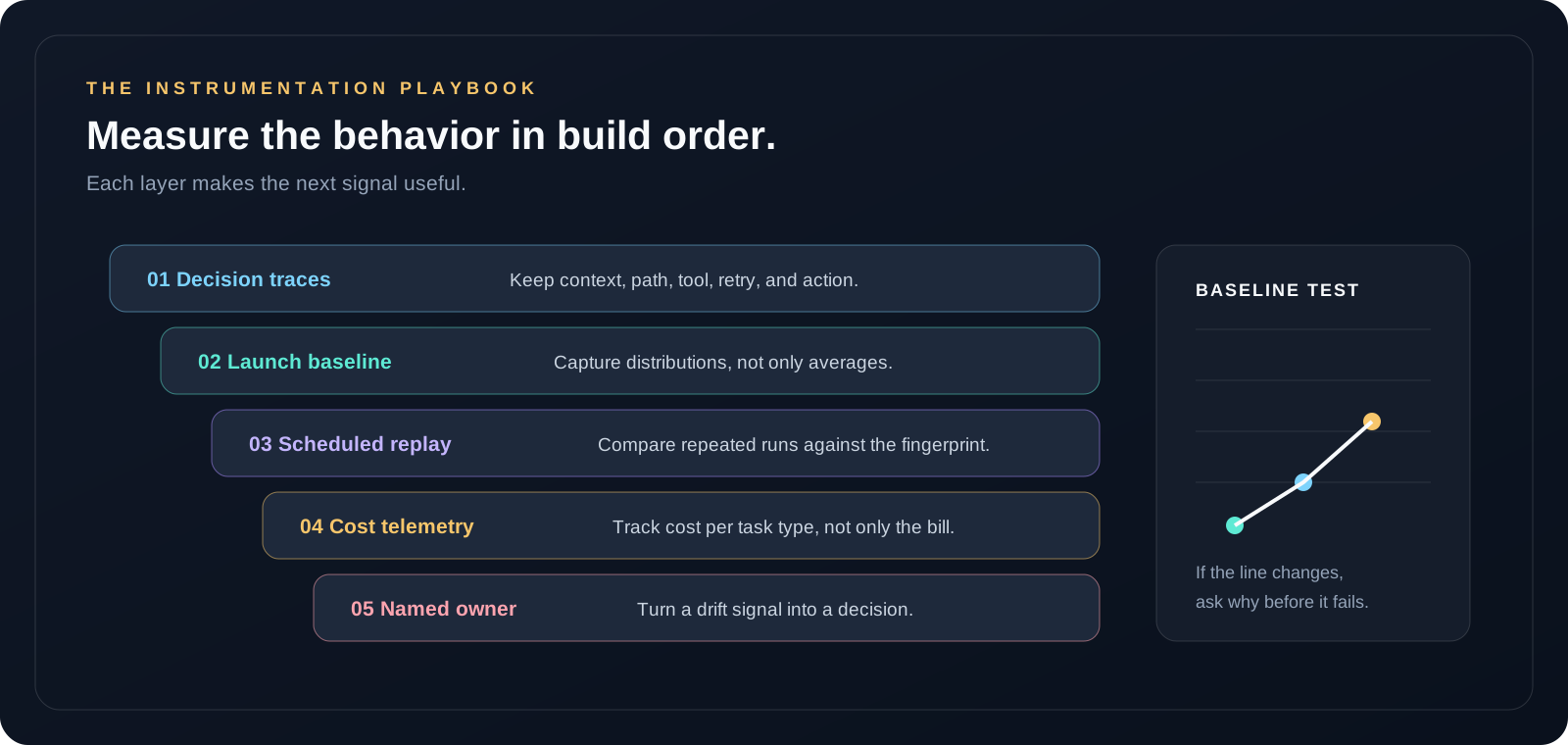
The sequence matters. Start with the evidence that makes every later comparison possible, then move toward the person who can act on a signal. OpenTelemetry’s GenAI work is useful here because portable semantic conventions keep traces comparable across frameworks and vendors.
Log decisions
Persist context, selected path, tool calls, retries, and final action, not only success or failure.
Baseline behavior
Run representative tasks repeatedly and capture path, token, latency, and retry distributions.
Replay on schedule
Rerun the same task suite weekly and compare the new distribution with the launch fingerprint.
Track task cost
Watch token cost and latency by operation type so inefficient paths show up before the aggregate bill does.
Name the owner
Give one workflow owner a review cadence, change log, and rollback path for every model or prompt update.
Baseline the run, then test the repeat
Run a fixed suite of representative tasks many times before an agent touches production. Capture distributions, not averages: tool calls per task, path choices, tokens, latency, retries, and success across repeated runs. This becomes the agent’s fingerprint.
Weekly, replay the same tasks. A new path appearing in 30% of runs, a first-try tool parse rate sliding, or a retry count trending up is drift caught before an incident. Re-baseline after a model version, prompt, tool, or policy change, and treat a vendor model update like a change you made yourself.
For context on ownership, see the failure taxonomy. The person accountable for drift is usually the owner of the workflow outcome, not the person who writes prompts.

A baseline is a living fingerprint. The change is the signal.
The unmeasured get canceled
Gartner predicted that more than 40% of agentic AI projects will be canceled by the end of 2027, citing escalating costs, unclear business value, and inadequate risk controls.
Notice that all three cancellation causes are measurement failures. Costs escalate unnoticed because nobody tracks cost per operation. Value stays unclear because nobody can separate agent behavior from outcome noise. Risk controls stay inadequate because nobody instrumented behavior in the first place.
Drift is not the scandal. Every agent drifts. The scandal is running a system that makes thousands of autonomous decisions a day and being unable to say, with evidence, whether it decides the way it did at launch. The cheapest time to instrument the agent is while you can still count it.
Source notes
Evidence behind the playbook
The article turns the source findings into a measurement practice: trace the path, baseline the behavior, replay it, watch cost, and name the owner.
Gravitee
State of AI Agent Security 2026
April 2026 survey data on fleet growth, monitoring coverage, visibility confidence, incident reporting, and named accountability.
Microsoft AI Red Team
Updating the Taxonomy of Failure Modes in Agentic AI Systems
Full-session behavioral analysis is needed to detect context contamination and incremental escalation.
Yao et al.
tau-bench: A Benchmark for Tool-Agent-User Interaction
Introduces pass-k reliability, showing why one successful run is weak evidence of repeatable behavior.
Gartner
40% of Agentic AI Projects Will Be Canceled
The cancellation forecast cites escalating costs, unclear business value, and inadequate risk controls.
OpenTelemetry
AI Agent Observability: Evolving Standards
GenAI semantic conventions for prompts, tool calls, token usage, and agent lifecycle telemetry.
Datadog
LLM Observability and OpenTelemetry Semantic Conventions
An example of vendor adoption of portable GenAI telemetry conventions.
FAQs
What is agentic AI drift?+
Agentic AI drift is the gradual change in how an AI agent makes decisions in production: which tools it calls, which solution paths it takes, and how it handles edge cases. The agent can keep completing tasks while behavior, cost, and reliability quietly shift.
How is agent drift different from model drift?+
Model drift degrades prediction accuracy against ground truth. Agent drift changes multi-step decision behavior: paths, tool usage, retries, and cost. There may be no single ground truth, so detect it by comparing behavioral distributions over time.
Which metrics actually detect agent drift?+
Track decision traces, tool calls per operation, path distributions across repeated runs, first-try tool parse rates, retry counts, latency variance, token cost by task type, and repeat-run consistency. Alert on distribution shifts against a launch baseline.
How often should we re-baseline an agent?+
Re-baseline after every intentional change to the model, prompt, tool set, or policy. Between changes, replay a fixed task suite weekly and compare the results with the current baseline. Treat vendor model updates as changes too.
Are there standards for agent observability?+
Yes, emerging standards exist. OpenTelemetry GenAI semantic conventions cover prompts, tool calls, token usage, and agent lifecycle. Using portable conventions keeps telemetry comparable across frameworks and monitoring vendors.

The job is not to watch the dashboard.
It is to watch the agent.