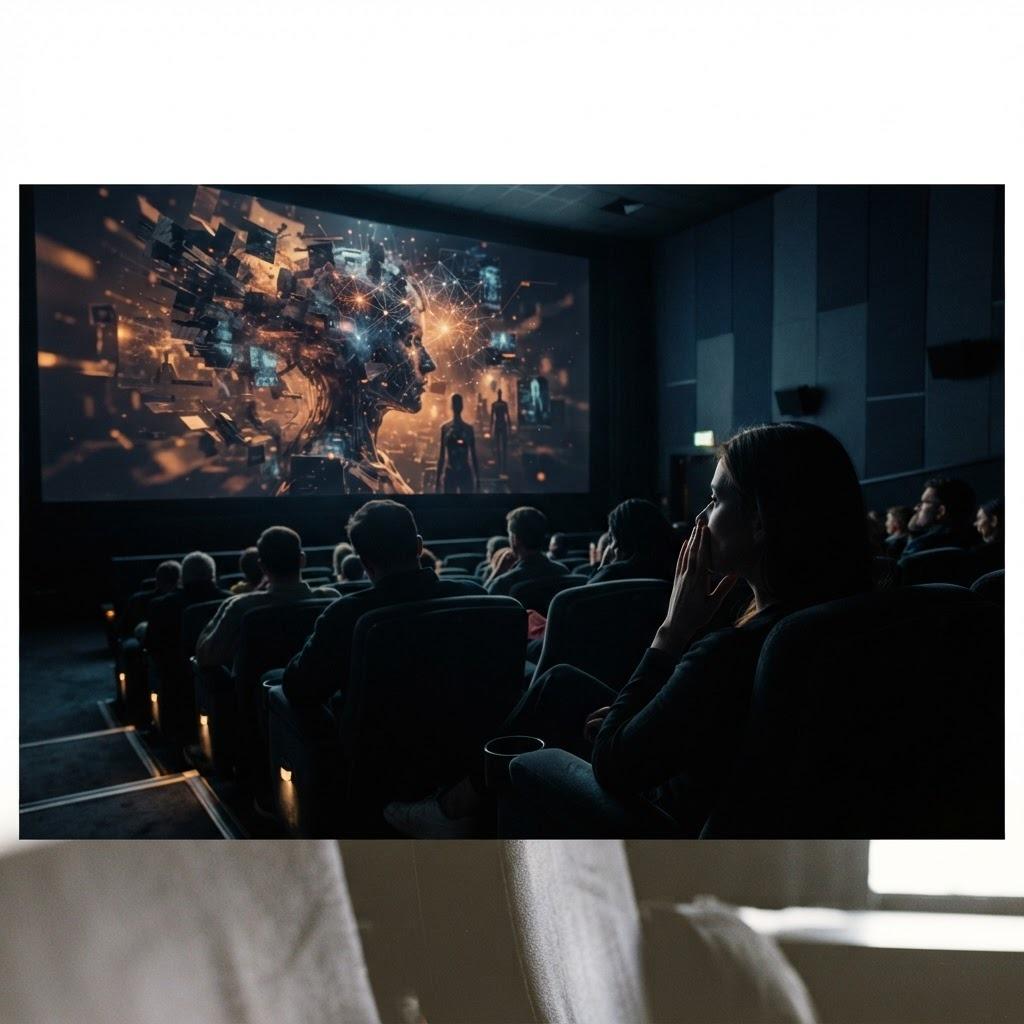
Anthropic's latest advertising campaign is a useful warning for every brand trying to market an uncomfortable product. Fear can earn attention quickly. It doesn't automatically earn belief.
The campaign opens with questions about whether AI can be trusted, who will stop it, and what happens when systems become too powerful. It moves through images of protests, a burning home, unhoused people, and soldiers' graves before arriving at a softer promise: there is hope in hard questions.
That is a striking creative choice. It's also a dangerous one. The company is asking people to hold two ideas at once: AI could create severe harm, and Anthropic is the company responsible enough to guide it. The first idea is easy to understand. The second requires proof.
The ad is doing two jobs
Most technology advertising tries to make the product feel useful, fast, or inevitable. Anthropic is trying something harder. It wants to make concern itself feel like a reason to choose Claude.
That positioning has a real strategic logic. If the public thinks every frontier AI company is racing without brakes, the company that admits the risk may look more mature. Acknowledging the problem can be a differentiator, especially when competitors are selling cheerful productivity and frictionless automation.
The problem is that safety language is no longer neutral. It is part of the competitive pitch. The moment a company says it is the responsible one, people start asking what responsibility costs, who gets to define it, and whether the company is still shipping as fast as everyone else.
TIME's reporting on the campaign captures the split reaction. Some viewers saw unusual candor. Others saw a company frightening the public and then offering itself as the adult in the room.
That split isn't a creative failure by itself. Provocative work is supposed to divide people. The failure would be assuming that controversy and credibility are the same asset.
Fear has a short half-life
A frightening image can create recall. It can make people stop scrolling. It can produce a conversation that a bland product demo never would.
But attention is not a durable brand position. Audiences remember the feeling before they remember the argument. If the emotion is dread, the brand inherits some of that dread unless the next experience gives people a concrete reason to feel safer.

This is where many AI campaigns get stuck. They talk about responsible development as a belief system, but they don't show the operating system behind it. There is a difference between saying a model should be safe and showing how a customer can control it, audit its behavior, challenge an output, or get a human answer when the system fails.
For a consumer brand, the equivalent might be a clear returns policy or visible product testing. For an enterprise AI company, it is governance that a buyer can inspect. The campaign can open the door, but the evidence has to walk through it.
That is the same measurement problem appearing in a different costume. Marketing teams already struggle to connect AI search visibility to revenue, as I argued in the attribution drift problem. Now brand teams have to connect safety language to trust behavior. Did the campaign change consideration? Did it reduce objections in a sales cycle? Did it increase willingness to deploy the product in sensitive workflows?
If the answer is only that people talked about the ad, the campaign measured attention, not trust.
The contradiction is the message
Anthropic's strongest argument may be the contradiction it cannot remove. The company warns that advanced AI could be dangerous while competing to build more capable models. That doesn't prove the warning is dishonest. It does mean the audience is right to examine the incentive behind it.
The public has learned to distrust corporate confession when the confession also functions as a sales pitch. Financial companies talk about inclusion while optimizing fees. Oil companies talk about transition while expanding production. Technology companies talk about safety while racing for distribution.
The comparison isn't meant to flatten the differences between industries. It points to a familiar pattern. A company can be sincere and self-interested at the same time. The audience doesn't need to choose one explanation and ignore the other.

That is why the campaign's most valuable audience may not be the general public. It may be buyers who already understand the contradiction. CIOs, security teams, regulators, and agency leaders don't need to be told that AI creates risk. They need to know whether the vendor has made the risk operationally manageable.
The right question is not, "Does this company care about safety?" Almost every serious company will say yes. The better questions are:
- What can customers inspect without a sales call?
- What happens when the model behaves badly?
- Which safety claims are independently tested?
- What does the company refuse to ship, and how consistently?
Those questions create a higher bar than a brand film. They also create better marketing.
Responsible branding needs receipts
There is a temptation for marketers to treat trust as a tone. Make the colors calmer. Use plain language. Put a thoughtful person on camera. Add a line about listening.
Tone matters, but it is the outer layer. Trust is built from repeated experiences that reduce uncertainty. For an AI product, that might include model cards that are readable by non-researchers, clear data controls, incident reporting, transparent limitations, and customer references that describe failures as well as wins.

This is also where the AI vendor lock-in problem becomes a brand issue. A vendor can promise responsible stewardship, but if leaving the platform is expensive, buyers have less practical power when that stewardship disappoints them. Portability, fallback options, and clear exit terms are trust signals because they give the customer bargaining power without requiring a public fight.
The same principle applies to agency work. Don't sell an AI implementation as safe because the deck has a governance slide. Show the approval path, the logs, the escalation rules, and the cases where automation is deliberately disabled. A cautious system that knows when to stop is easier to defend than an optimistic system that needs a crisis to reveal its limits.
Google's people-first guidance makes a related point in simpler language: content should serve users rather than manipulate them. That standard is useful beyond search. A safety campaign should help the audience understand the company's actual behavior, not merely borrow the emotional power of a scary future.
The next advantage is proof
AI marketing is entering a strange phase. The products are becoming more powerful, but the category's emotional vocabulary is getting less persuasive. Words like safe, responsible, aligned, and trustworthy have been used so often that they now function like empty fields in a form.
The brands that win the next phase won't necessarily be the ones with the most reassuring campaigns. They'll be the ones that make their claims easy to test.
That means publishing the uncomfortable details. It means letting customers see where the system fails. It means treating restraint as a product capability, not a mood board. It may even mean accepting slower growth in a few high-risk areas so the company has something real to point to later.
Anthropic's campaign is interesting because it understands the cultural moment. People are worried, and the company is willing to say so in public. But the ad also exposes the limit of fear-based differentiation. Once a company turns public anxiety into a brand asset, it inherits a higher burden of honesty.
The hard questions are not the campaign. They are the audit trail after it.